
New York state, as you might already know, regulates the rent an owner of residential property may charge to a tenant. Under a statute adopted in 1974, regulation is triggered by a locality’s declaration of a housing emergency, and the restrictions extend for the duration of the declared emergency. Most famously — or infamously —
APA Program: “Planning Law Careers in Land Development” (Wed, Mar 27, 2024)

If you’ve been around us long enough, you know that we’re big into the notion of “generational handoff” and doing what we can to make sure that students and others who are building their careers realize that dirt law and related topics are very good areas in which to find your way.
Well, here’s the
New Article: “Fines, Forfeitures, and Federalism” (Jessica Asbridge)

When it comes to property rights, we’re most often focused on takings, compensation, and due process. But as you all know, the concept of property rights encompasses a whole lot more.
Our colleague, lawprof Jessica Asbridge, has posted on SSRN an article that is forthcoming in the Virginia Law Review, “Fines, Forfeitures, and Federalism,” in which she delves into the question of how the Excessive Fines Clause applies to state and local forfeitures and fines. To resolve the federalism concerns she identifies, the article argues that courts “should look to the exactions doctrine under the Takings Clause.”
Count us as intrigued.
Here’s the Abstract:
Fines are ubiquitous in modern society, and they are imposed for both serious crimes and minor civil wrongs. The U.S. Supreme Court recently recognized that the Constitution’s Excessive Fines Clause applies to the states, but that decision raises previously unexplored questions as to how to enforce the Clause’s protections in the states. A key question is what role, if any, federalism should play in crafting doctrinal rules that apply the Clause’s protections to state and local fines and related property forfeitures. This Article is the first to accord in-depth treatment to that important question.
The extent to which federalism principles should apply does not have an immediate and obvious answer. On the one hand, federalism plays a significant role in the Court’s jurisprudence on the Cruel and Unusual Punishment Clause. The Court therefore generally takes a highly deferential approach in reviewing sentences of imprisonment. Lower courts have applied that same deferential review in the context of the Excessive Fines Clause. On the other hand, fines and forfeitures are unlike other forms of punishment—such as prison—because they are often used as a revenue source for state and local governments, creating a conflict of interest for state and local decision-making bodies.
To address this conundrum, this Article makes the novel argument that the Court should look to the exactions doctrine under the Takings Clause, which often implicates similar concerns of government self-interest and overreaching. Exactions and excessive fines are conceptually similar, but scholars thus far have overlooked the close relationship between them. The exactions doctrine gives minimal weight to federalism concerns, and it applies a heightened-scrutiny standard that is well suited to the excessive fines context. Indeed, differences between federal practice and state and local practices as to fines suggest that discretionary state and local fines should be subject to closer constitutional scrutiny than federal fines. As a recent example illustrates, such heightened scrutiny would ensure that the Excessive Fines Clause is not merely a parchment barrier, while still accounting for variations between states and localities in terms of their communities’ values and needs.
Check it out. Download your copy on SSRN here.
Continue Reading New Article: “Fines, Forfeitures, and Federalism” (Jessica Asbridge)
Too Soon For CA5 To Figure Out Whether City Demolishing Property For Code Violations Is A Taking
In Rhone v. City of Texas City, No. 22-40551 (Feb. 14, 2024), the U.S. Court of Appeals for the Fifth Circuit held that a municipality’s conclusion that Rhone’s apartment building had not been properly maintained, and a subsequent municipal court demolition order, might be a taking … or it might not be.
We won’t
Pass A Good Time: Our Report From The 41st ALI-CLE Eminent Domain & Land Valuation Litigation Conference, Feb 1-3, 2024, New Orleans

When it comes to the longstanding ALI-CLE American Law Institute-CLE Eminent Domain and Land Valuation Litigation Conferences, we’re always ready to go. You know that. But this year’s version — the 41st — was buzzing like no other in recent memory.
Maybe it was the New Orleans venue with its atmo, food, and music for
DC App: $350k Loss In Value Due To Home’s Historic Designation Not A Penn Central Taking
The DC Court of Appeals’ (note: not the U.S. Court of Appeals for the D.C. Circuit) opinion in Gordon v. District of Columbia, No. 20-CV-0568 (Feb. 15, 2024), presents a good cross-section of property rights issues. Not a good outcome on property rights issues, mind you.
If nothing else, be sure to check out
2024 Distinguished Gifford Property Lecture – Professor Carol N. Brown (Richmond Law) (March 12, 2024, U. Hawaii Law School)
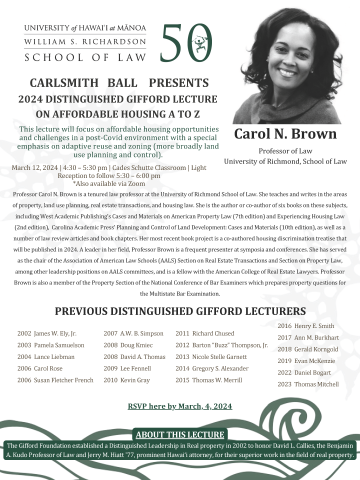
Join us and our Land Use class, in-person on the campus of the University of Hawaii Law School (or online via Zoom, where it will be livestreamed), as Richmond Law lawprof Carol Brown delivers the 2024 Distinguished Gifford Lecture in Real Property, on March 24, 2024, at 4:40 p.m. Hawaii Time in the Cades
SCOTUS Denies Review To Remaining Rent Control Takings Petitions: “Important and pressing question” (Just Not In This Case)
Yesterday, the other shoe dropped. In this order the U.S. Supreme Court denied review to a case that we’ve long been following, which challenged aspects of New York’s draconian rent control laws as a taking, 74 Pinehurst v. New York.
We say the “other shoe” because ever since the Court denied review months
Sad 191st Birthday To You, Barron v. Baltimore (Feb. 16, 1833) – The First SCOTUS Takings Case?

Today’s the day, 191 years ago, when — a mere 5 days after oral arguments — the U.S. Supreme Court issued its (in)famous opinion in Barron ex rel. Tiernan v. Mayor and City Council of Baltimore, 32 U.S. 243 (1833).
Generations of law students study this one in their Con Law classes, and it
Today, 12:30pm ET: Professor’s Corner – Legislative Exactions & Sheetz v. County of El Dorado (ABA RPTE)
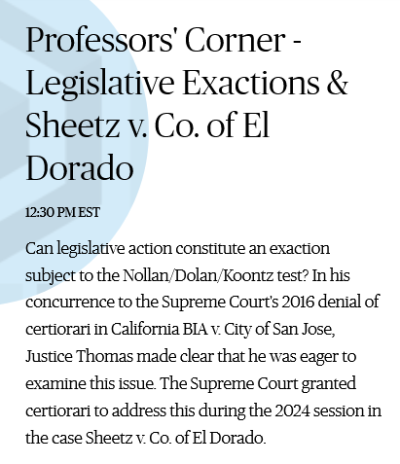
Join us at 12:30pm ET today, Tuesday, February 13, 2024, for the ABA’s Section of Real Property, Trust and Estates’ monthly Professor’s Corner, where we will join exactions experts Prof Tim Mulvaney, Andrew Gowder, and Prof Elizabeth Elia to discuss the Supreme Court arguments, the issues in the case, and what may be down