Nothing to do with the case, beyond the owner’s name.
But c’mon, its ABBA.

Ms. Money and her spouse own a home in San Marcos, Texas. That home is in a historic district.

But it turns out that some of that history isn’t pretty: one of the previous owners was “notoriously associated with the Ku Klux Klan.” Yikes. And to make it worse, that owner, a certain Frank Zimmerman, branded the home by installing a Juliet balcony with a big ol’ wrought iron “Z” on the front of the house.

Very understandably, once they found out this detail (after they purchased the home), Ms. Money and her spouse wanted the Z gone. First the good news: although the home is in a historic district, the structure itself isn’t historic. So there’s that. But game not over, because even though it isn’t historic, the home nonetheless

Continue Reading Show Me The Money: Reg Takings Claim Ripe Because City Made Its Decision Even If Owner Could Have Administratively Appealed

1992 Aerial Photo Island2
Shands Key, with the City of Marathon in the background

This just in: in Shands v. City of Marathon, No. 3D21-1987 (Fed. 5, 2025), Florida’s Third District Court of Appeals sitting en banc held that the city’s downzoning of property (Shands Key, shown above in an exhibit from the Key West trial we participated in in June 2021) from General Use (density: one home per acre) to Conservation Offshore Island (one home per 10 acres; Shands Key is just under 8 acres) effected a Lucas taking because it deprived the owners of economically beneficial uses of their land. This, notwithstanding the possibility of the owners selling the property to a third party, who could have donated the property to city in return for a chit to move up in the city’s development queue.

We’re not going to go into too much detail or offer our opinion because this

Continue Reading Fla Ct App (en banc) In Takings Case: “failing to vindicate a right expressly stated in the Constitution is not judicial restraint but judicial abnegation. That we must not do.”

What to say about the Colorado Supreme Court’s recent decision in Nonhuman Rights Project v. Cheyenne Mountain Zoo, No. 24SA21 (Jan. 21, 2025), wherein the court resolved the momentous and highly controversial question of whether an elephant is a person?

Our first temptation is to see this through the takings lens (surprise), and snark that courts seem be very willing to consider ridiculous cases like this one, determine whether a monkey owns a “selfie” that he snapped, and rule that bees qualify as “fish” in a statute because the legislature didn’t think to modify the term “invertebrate” in a list of marine invertebrates with the term “marine” — yet it is beneath the dignity of judges to consider cases where — oh, the humanity!they may be called on to be Super Zoning Boards of Appeals.

Our other snarky thought was the outcome of this case

Continue Reading Bees May Be Fish In California, But Here In Colorado, Elephants Ain’t Persons

Here’s what we’re reading this day:

Good weekend reading as well. Continue Reading Friday Dirt Law Round-Up

20180720_150853_HDR
The only courthouse we know where the Supreme Court
is
below the Court of Appeals (SJC on the second floor,
appellate court on the third)

A brief one from the Supreme Judicial Court of Massachusetts.

In Attorney General v. Town of Milton, No. SJC-13580 (Jan. 8, 2025), the court rejected a challenge to a state statue which allowed the Massachusetts Bay Transportation Authority, the public transit authority in the Boston area, to require municipalities which access the T loosen their zoning regimes to “provide for at least one district of multifamily housing ‘as of right’ near their local MTBA facilities.” Slip op. at 3. One town declined to do so, and the state AG sued to enforce the statute.

The town responded by challenging the statute’s validity and the AG’s authority to sue to enforce it. Yes on both counts held the SJC. But (and there’s a

Continue Reading Mass SJC: State Requiring Municipalities To Adopt Multi-Family Zoning Is Enforceable By AG…But

Here’s a recently-filed cert petition to watch. We won’t go into the background, because the Questions Presented pretty much lay the foundation:

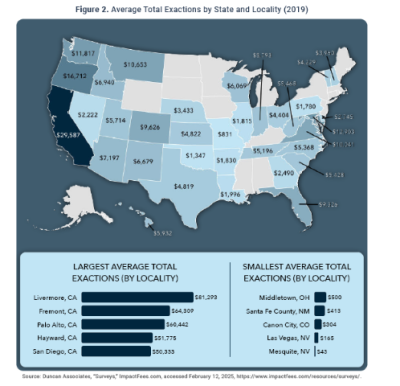
Respondent County of San Diego, et al. (County), a California land use agency, denied the land use permits for Village Communities et al. (Village) to develop a much-needed residential and mixed-use community in North San Diego County, California. The County denied the Project solely because Village “failed” to satisfy the County’s condition requiring Village to pay money to acquire offsite easements from 100 percent of the 50 property owners along a public road near Village’s property site in spite of the fact that the County made no individualized determination that the monetary exaction, a sum of approximately $2.5 million, bore an “essential nexus” and “rough proportionality” to the purported impacts associated with Village’s project as required by Nollan v. California Coastal Comm’n, 483 U.S. 825 (1987)

Continue Reading New Cert Petition: To Have A Nollan-Dolan-Koontz Claim, Must You Be Forced To Give Up Land And Money?

At first glance, it might seem like there’s a lot there in the U.S. Court of Appeals’ opinion in Becker v. City of Hillsboro, No. 23-3367 (Jan. 7, 2025).

After all, the city’s prohibition on new private wells and another requirement that newly built homes connect to the city’s water system seems a bit arbitrary (at least the opinion doesn’t give a lot of detail why, other than “the city said so”). And the opinion evaluates a Lucas wipeout, a physical invasion, a Penn Central ad hoc taking, and a Nollan/Dolan claim. Even a Murr denominator issue. This case could have been a good vehicle to examine those questions in more detail that many courts do.

But after taking a dive in, our initial impression that this case would provide a lot of insight — or even food for deeper thought — didn’t pan out. Take a

Continue Reading CA8 Misses An Opportunity For Penn Central Clarity: No Taking When City Bans New Private Wells, Requires City Water

With our tongues firmly planted in cheeks, the Planning Chairs for the upcoming 42d edition of this popular and venerable Conference bring you this “breaking news” report from San Diego!

As you know, in addition to being the best nationally-focused conference on the subjects that we love and a venue that is nearly certain to have some of the warmest winter weather in the continental United States, and we went on-location from some of the local highlights: the beaches, Torrey Pines, the Zoo, Balboa Park, the Gaslamp Quarter, and Coronado to name but a few.

More about the Conference here, including registration information.

Here are some of the highlights:

  • Property Rights at the Supreme Court: DeVillier and Sheetz and What’s Next
  • Slow Take: Possession, Rent, Relocation, and Offset
  • The Jury’s View: How Jurors See Your Case
  • From Penn Coal to Penn Central: How to


Continue Reading Breaking News: Come Join Us For The 42d ALI-CLE Eminent Domain & Land Valuation Litigation Conference, San Diego, Jan 30-Feb 1

In what might be the most cliched “New York City” land use situation, check out the Appellate Division’s opinion in Coalition For Fairness v. City of New York, No. 2023-05338 (Dec. 5, 2024).

Want to convert your SoHo-NoHo artist live/work space to unlimited residential use? Be prepared to pony up and pay to the City’s Arts Fund a non-refundable fee of $100 per square foot as a precondition of even filing a building permit. 

When owners challenged this fee as unconstitutional under Nollan/Dolan/Koontz/Sheetz, the trial division said no. But the Appellate Division held otherwise, concluding that the imposition of the fee lacked an essential nexus and was not roughly proportional to whatever impacts “certified artists” (who knew the government was in the business of “certifying” artists?) suffer when an owner converts.

The opinion, in true Appellate Division style is short (3 pages)

Continue Reading NY App Div: Requiring Art Fee “Donation” To Get Building Permit Lacks Nexus, Proportionality

‘Tis the season for TV holiday movies. Here’s one to add to your list, as it is on-brand for us dirt lawyers. “Christmas at the Drive In” is described thusly:

“A property lawyer works to prove that her town’s Drive In Theater, a local institution, is not closed down at the holidays, finding romance with the very person who is trying to sell the property.”

When property, redevelopment, historic preservation, and l’amour is involved, who could resist?Continue Reading Holiday Dirt Law Movie: “Christmas at the Drive In” (aka Rudolph The Red-Nosed Redeveloper)