Articles and publications

How should courts evaluate the claims for compensation arising out of emergency measures (many of which we’ve already seen; see here, here, here, here and here, for example)?

Rather than think about it piecemeal, we decided to write it up in a more comprehensive fashion. Here’s the result, so far. Rather than summarize it, let’s just cut-and-paste the Introduction. The complete piece is posted on SSRN, if you want to read it. 

Desperate times may breed desperate measures, but when do desperate measures undertaken during emergencies trigger the Fifth Amendment’s requirement that the government provide just compensation when it takes private property for public use?[1] The answer to that question has commonly been posed as a choice between the “police power”—a sovereign government’s power to regulate and restrict property’s use in order to further the public health, safety, and welfare[2]—and the eminent domain power, the authority to seize private property for public use with the corresponding requirement to pay compensation.[3]

But that should not be the question. An invocation of police power does not answer the compensation question at all, but is merely the predicate issue: all government actions must be for the public health, safety, or welfare, in the same way that an exercise of eminent domain power must be for a public use. In “normal” times, it is very difficult to win a regulatory takings claim for compensation. In the midst of emergencies—real or perceived—the courts are even more reluctant to provide a remedy, even where they should, and emergencies are a good time to make bad law, especially takings law. Emergencies do not increase government power, nor do they necessarily alter constitutional rights.[4] 

This article provides a roadmap for analyzing these questions, hoping that it will result in a more consistent approach to resolving claims for compensation that arise out of claims of emergencies—real or perceived. This article analyzes the potential takings claims stemming from emergency measures, mostly under current takings doctrine. What type of claims are likely to succeed or fail? Can a better case be made analytically for compensation?

Part I summarizes the economic “flattening the curve” principle that motivates takings claims for compensation. Part II sets out the prevailing three-factor Penn Central standard for how courts evaluate claims that a health, safety, or welfare measure “goes too far,” and requires compensation as a taking, examining the character of the government action, the impact of the action on the owner, and the extent of the owner’s property rights.[5] Deep criticism of Penn Central is beyond the scope of this article, and I will not here do more than accept it as the “default”[6]  takings test. But I do argue that the government’s motivation and reason for its actions—generally reviewed under the “rational basis” standard—should not be a major question in takings claims. Rather, as this article argues in Part III, the government’s emergency justifications should be considered as part of a necessity defense, and not subject to the low bar of rational basis, but a more fact and evidence driven standard of “actual necessity.” Part IV attempts to apply these standards and examines the various ways that emergency actions can take property for public use: commandeerings, occupations of property, and restrictions on use. I do not conclude that the approach will result in more (or less) successful claims for compensation, merely a more straightforward method of evaluating emergency takings claims than the current disjointed analytical methods.

In sum, this article argues there is no blanket immunity from compensation simply because the government claims to be acting in response to an emergency, even though its reasons and actions may satisfy the rational basis test. Instead, claims that the taking is not compensable because of the exigency of an emergency should only win the day if the government successfully shows that the measure was actually needed to avoid imminent danger posed by the property owner’s use, and that the measure was narrowly tailored to further that end.

————-

[1] See Robert Higgs and Charlotte Twight, National Emergency and the Erosion of Private Property Rights, 6 Cato J. 747 (1987) (“Much of the reduction [of private property rights] occurred episodically, as governmental officials too control of economic affairs during national emergencies—mainly wars, depressions, and actual or threatened strikes in critical industries.”).

[2] “Police power” describes everything a sovereign government can do. It even might be said to encompass the eminent domain power. See Hawaii Housing Auth. v. Midkiff, 467 U.S. 229, 240 (1984) (“The [Fifth Amendment’s] ‘public use’ requirement is thus coterminous with the scope of a sovereign’s police powers.).

[3] See U.S. Const. amend. V. The Fifth Amendment conditions the federal government’s takings power. See Barron v. Baltimore, 32 U.S. (7 Pet.) 243 (1833) (noting a wharf owner’s argument that city’s diversion of water pursuant to its police power could support a Fifth Amendment claim, but holding that the Fifth Amendment only limited the actions of the national government). The Fourteenth Amendment extended the just compensation requirement to the states as part of due process of law. See Chicago, B. & Q. R. Co. v. City of Chicago, 166 U.S. 226, 235 (1897).

[4] See Steven M. Silva, Closed for Business—Open for Litigation?, Nw. L. Rev. of Note (Apr. 29, 2020), https://blog.northwesternlaw.review/?p=1361 (“First, it must be recognized that the Constitution exists even in an emergency. The Constitution expressly permits some alterations to our ordinary system of rights during times of war—for example, the Third Amendment provides differing provisions for the quartering of soldiers in times of peace versus times of war—but those alterations are baked into the system, the Constitution does not disappear in war. And a pandemic is not even a war.”) (citing Home Bldg. & Loan Ass’n v. Blaisdell, 290 U.S. 398, 425 (1934))..

[5] Penn Cent. Transp. Co. v. New York City, 438 U.S. 104, 124-25 (1978).

[6] The Supreme Court has labeled Penn Central “default” test for regulatory takings. See Lingle v. Chevron U.S.A. Inc., 544 U.S. 528, 538-39 (2005).

Entire draft here

.
Continue Reading New Article – Evaluating Emergency Takings: Flattening The Economic Curve

FULJ_logo_2-5-300x66@2x

Lacking things to read during your shut-down? Well, we have the solution: the Fordham Urban Law Journal has devoted an entire issue to Knick and takings ripeness (“Taking Account: Procedure, Substance, and Stare Decisis in the Post-Knick World“). 

Our article “Sublimating Municipal Home Rule and Separation of Powers in Knick v.

W Su cover page

Be sure to download and read this article, recently published in the Virginia Law Review by legal scholar Wanling Su with the deceptively simple title, “What is Just Compensation?

The article delves into the history of ad quod damnum and concludes that “just” compensation means a jury must determine compensation. That’s an

IMG_20200123_070935

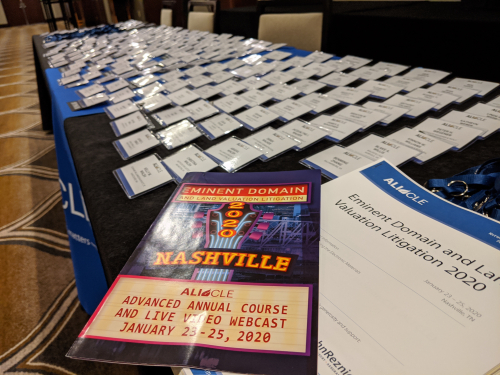
We’re in Nashville for the next three days, where we have record attendance (see above for the name-tag matrix), with nearly 300 attendees spread out over three rooms. 

IMG_20200123_070704

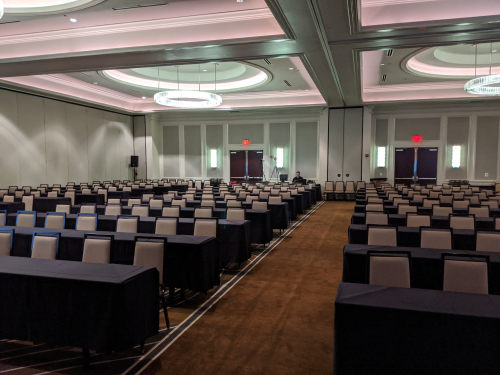
The Big Room, before. 

PANO_20200123_090701.vr

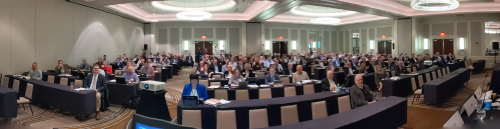
The Big Room, during. Like we said, record attendance. 

IMG_20200123_070830

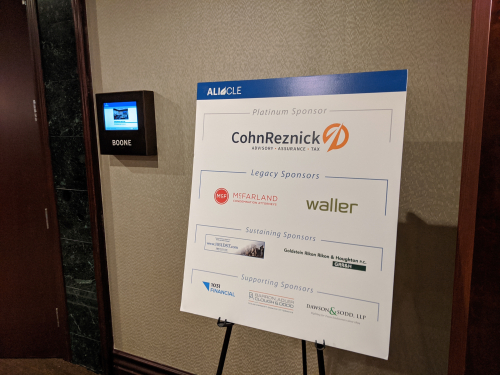
Thanks to the generosity of our sponsors, we have very good social events. Like

ELHy3bhUYAAdM4B

If there’s one downside to the law school experience from the teacher’s side of the lectern, it’s grading. Especially at a law school like William and Mary that has a pretty strict mandatory curve.

In an upper-division course like “Eminent Domain and Property Rights Law,” where we’re dealing with some very high-level

20170918_171029_Richtone(HDR)

We’re seeing a lot of “end of year” and “end of decade” wrap-ups, so figured we’d better chime in.

As the above graphic hints (this is detail of the doors of the U.S. Supreme Court), our biggest case of 2019 (and probably of the twenty-aughts) is Knick v. Township of Scott

With the 2019 edition of the Brigham-Kanner Property Rights Conference (and award of the B-K Prize to Professor Steven Eagle) to get underway later this week, it is also publication time for the latest issue of the Brigham-Kanner Property Rights Journal

This edition focuses on the “Federalism Dimension of Constitutional Property,” and we contributed

Klingonsnippet

Takings mavens know lawprof Ilya Somin. Among other things, he’s authored some of the more interesting and useful scholarship in our field.

Here’s his latest, published in the 2019 Cato Supreme Court Review, about the Supreme Court’s latest takings case, Knick v. Township of Scott

We naturally recommend you read the entirety

Here’s our Federalist Society blog post on Knick,After More Than 30 Years, the Supreme Court Reopens the Door To Federal Takings Claims.”

Check it out, takings fans. 

Restatement cover page

Here’s the article, recently published in the UMKC Law Review with thoughts on Murr v. Wisconsin, the case about the “denominator” issue in regulatory takings cases.

We won’t get into it in detail (if you are interested, you can read the article yourself), except to say that therein we offer views of what