Nollan/Dolan | Exactions

JLEPcover

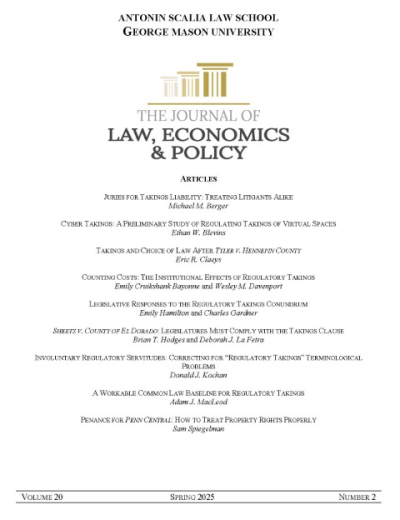
Last year, we attended a conference devoted to the future of regulatory takings, hosted by the Antonin Scalia School of Law (George Mason U), and Pacific Legal Foundation.

The publisher, the Journal of Law, Economics, and Policy has released the articles and essays from that conference, and made them available here

Here’s the

Fischel_600

Here’s news we’ve been waiting for.

The William and Mary Law School announced that Professor William Fischel will be awarded the 2025 Brigham-Kanner Property Rights Prize at the annual conference in Williamsburg in October 2025. 

The Brigham-Kanner Property Rights Prize is presented annually to a scholar, practitioner, or jurist whose work affirms the fundamental importance

We’re back to bump stocks. Indeed, we have covered cases raising similar issues so we’re not going into too much detail on the U.S. Court of Federal Claims’ recent decision in The Modern Sportsman, LLC v. United States, No. 19-449 (May 8, 2025), and we’ll just assume you, like us, have been following along with this issue.

Suffice it to say that the federal government adopted regulations defining these devices as prohibited machine guns and gave those in possession 90 days to either turn them over to the government, or to destroy them. The plaintiffs destroyed their bump stocks and then sued the federal government for a taking.

The CFC dismissed the complaint under the government’s “police power” authority to prohibit contraband and noxious items. As we noted in this post, the line between uncompensated destruction and compensated takings was not as clear at the CFC saw it (the Armstrong rationale cannot be ignored, even where a taking may be for a very good public reason), and thus the Federal Circuit affirmed, but shifted the rationale from police power to a lack of a private property interest. After the Supreme Court denied cert, “that was that.” Slip op. at 2.

Meanwhile, other bump stock owners challenged the validity of the administrative rule declaring these things machine guns. And there, the owners found more success, with the Supreme Court eventually concluding that the agency lacked the authority to adopt the bump stock rule. The owners here “then asked this Court to revive this lawsuit, which the Court did … [t]he next day, plaintiffs amended their pleadings to add an illegal exaction claim in addition to their takings claim.” Slip op. at 3. 

The government sought dismissal, arguing that the bump stock owners alleged a physical taking but the government hadn’t physically seized anything. It merely required the owners to destroy the bump stocks: as the CFC put it, the government “acknowledges that plaintiffs alleged that ‘the Rule required bump stock owners to destroy or surrender the devices to ATF.’ Reply 2. That does not pass muster for the government, however, because the government ‘did not seize any devices or otherwise physically invade plaintiffs’ property.’ Id. at 3.” Slip op. at 4. In short, we didn’t actually seize anything of yours, plaintiffs; we merely required you to destroy your property. Really. 

The CFC wasn’t having any of that, and rejected this too-clever-by-half argument:

The Court cannot agree. Let us be clear that the government need not literally force private persons to turn over their property for a taking to occur; a legal requirement is sufficient. For example, in Horne, the Supreme Court held that an administrative order requiring raisin croppers to “give a percentage of their crop to the Government, free of charge” effected a compensable appropriation. 576 U.S. at 355. The government did not literally oust the farmers from possession of the raisins, yet a taking occurred because the order made a “formal demand” backed by fines and penalties. Id. at 362, 367–68. It is the same here. The Rule plainly states: “This final rule requires the destruction of existing bump-stock-type devices.” 83 Fed. Reg. at 66,549. It then instructs: “Individuals who have purchased bump-stock-type devices prior to the implementation of this rule must destroy the devices themselves prior to the effective date of the rule or abandon them at their local ATF office.” Id. Finally, it makes clear that “individuals are subject to criminal liability . . . for possessing bump-stock- type devices after the effective date of regulation.” Id. at 66,525. These statements undoubtedly constitute a formal demand to destroy or transfer possession of bump stocks, satisfying the standard under Horne.

Slip op. at 4-5.

If this argument strikes you as nonsense, welcome to our world, where arguments like this are put forth with a straight face on a regular basis. 

And if that wasn’t enough, the government next argued that the regulations didn’t actually require the owners to destroy their bump stocks, “but ‘merely clarified’ the ‘longstanding statutory law’ banning machineguns.” Slip op. at 5. “Put plainly, the government essentially argues that the Rule is an informational document apprising the public of pre-existing legal obligations.” Id. The CFC held “[t]hat too is incorrect.” Id. That seems to be putting it mildly. What do you think would have happened to bump stock owners who didn’t comply with this “informational” rule and held on to their bump stocks?

Short story: the complaint alleged a physical taking.

Next, however, the CFC rejected the exaction claim, based on the remedy sought. As we know, the CFC is limited to awarding monetary damages in these kind of cases. The CFC held that an “exaction” generally “involves money that was ‘improperly paid, exacted, or taken from the claimant.'” Slip op. at 7 (quotations omitted). Here, the CFC held, no money changed hands and there’s no statute otherwise authorizing a claim for money damages:

In sum, plaintiffs cannot be said to have paid money, directly or “in effect,” for a very straightforward reason: They lost personal property, not money. Indeed, plaintiffs have not alleged that they spent any money for any purpose; or paid any money to any In sum, plaintiffs cannot be said to have paid money, directly or “in effect,” for a very straightforward reason: They lost personal property, not money. Indeed, plaintiffs have not alleged that they spent any money for any purpose; or paid any money to any

Slip op. at 8-9.

The CFC wrapped up by — get this — calling out the property owners’ lawyers for failing to expressly clarify that one of the cases they cited and relied on didn’t actually hold that an exaction could be a demand for “money or property,” only money. Slip op. at 9. The court acknowledged that the citation didn’t actually misquote the case, but that the lawyers should have been more candid that they were arguing for an extension of the law, and that the case limited exactions to money.

We’re fine with that (especially in the AI era), and requiring advocates to be candid. 

But where’s the call-out of the government’s horse hockey arguments, noted above? Dead silence, of course. In our view, the borderline frivolous, time-and-expense wasting, divorced-from-reality arguments the government made are equally if not more deserving of censure. 

Call us if that ever happens. We’ll wait.

The Modern Sportsman, LLC v. United States, No. 19-449 (Fed. Cl. May 8, 2025)

Continue Reading CFC: Allegation That Gov’t Ordered Destruction Of Bump Stocks Pleaded Physical Takings Claim

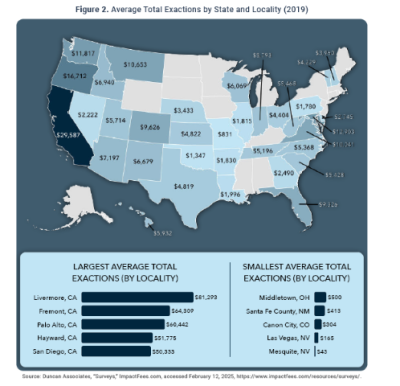
Chart

Check out the new report by our Pacific Legal Foundation colleagues Kyle Sweetland and Brian Hodges, “How to Protect Property Rights from Improperly Assessed Exactions” (Apr. 2025).

This research in brief shows how exactions grew and increased home construction costs over a 16-year period. It provides a history of exactions, showing how

Today we have a guest post by New York colleague Jennifer Polovetsky, who writes about an exactions case that is headed for the New York Court of Appeals. Disclosure: our firm represents the property owners in that court. 

Thanks to Jennifer (and to the New York Law Journal) for allowing us to republish her

Property_rights_and_the_roberts_court_Agenda_

Register now and plan on joining us on Thursday, February 27, 2025 at the U.C. Berkeley Law School for a one-day conference: “Property Rights and the Roberts Court: 2005-2025.”

Here’s the agenda. Here’s a description of the program:

For much of the past century, property rights were relegated to second-class status compared

Here’s a recently-filed cert petition to watch. We won’t go into the background, because the Questions Presented pretty much lay the foundation:

Respondent County of San Diego, et al. (County), a California land use agency, denied the land use permits for Village Communities et al. (Village) to develop a much-needed residential and mixed-use community

At first glance, it might seem like there’s a lot there in the U.S. Court of Appeals’ opinion in Becker v. City of Hillsboro, No. 23-3367 (Jan. 7, 2025).

After all, the city’s prohibition on new private wells and another requirement that newly built homes connect to the city’s water system seems a bit

With our tongues firmly planted in cheeks, the Planning Chairs for the upcoming 42d edition of this popular and venerable Conference bring you this “breaking news” report from San Diego!

As you know, in addition to being the best nationally-focused conference on the subjects that we love and a venue that is nearly certain to have some of the warmest winter weather in the continental United States, and we went on-location from some of the local highlights: the beaches, Torrey Pines, the Zoo, Balboa Park, the Gaslamp Quarter, and Coronado to name but a few.

More about the Conference here, including registration information.

Here are some of the highlights:

  • Property Rights at the Supreme Court: DeVillier and Sheetz and What’s Next
  • Slow Take: Possession, Rent, Relocation, and Offset
  • The Jury’s View: How Jurors See Your Case
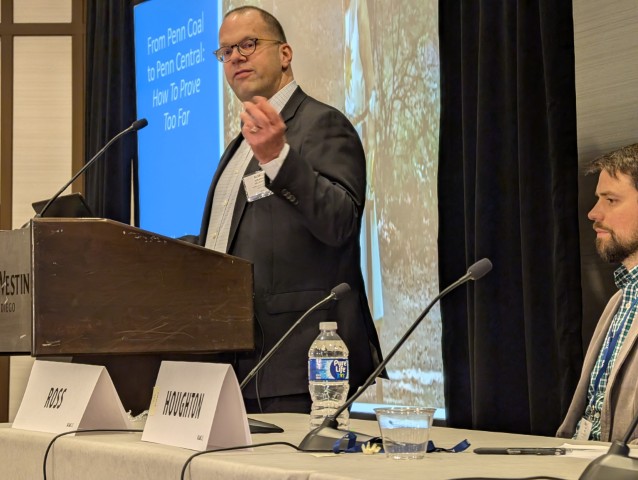
  • From Penn Coal to Penn Central: How to Prove “Too Far”
  • Leveraging Expertise in Eminent Domain Litigation: Working with Land Planners, Engineers, and Other Predicate Experts
  • Kelo at Twenty: What Changed, What Didn’t, and What’s on the Horizon
  • Viva Las Vegas: How the Nevada Judiciary Upheld Property Rights in 180 Land’s Inverse Condemnation Taking
  • Ethics: Guiding the Trolley: Perspectives on Professional Ethics in Eminent Domain for Lawyers, Appraisers, and Right of Way Agents
  • “I Think I Shall Never See” Just Compensation For a Tree: Strategies to Securing Recovery for Trees, Crops, and Fixtures

And more. Check out the complete agenda here. Registration information here

We especially welcome first-time participants, or those returning after an absence. Connect (or reconnect) with your colleagues from across the nation.

The 41st Conference was in New Orleans. Here’s a report of that event, and here are our reports from prior conferences in Austin and Scottsdale.

Don’t miss out on San Diego: we have had record attendance in recent years, so hold your space now. #EminentDomain2025

Continue Reading Breaking News: Come Join Us For The 42d ALI-CLE Eminent Domain & Land Valuation Litigation Conference, San Diego, Jan 30-Feb 1

In what might be the most cliched “New York City” land use situation, check out the Appellate Division’s opinion in Coalition For Fairness v. City of New York, No. 2023-05338 (Dec. 5, 2024).

Want to convert your SoHo-NoHo artist live/work space to unlimited residential use? Be prepared to pony up and pay to the City’s Arts Fund a non-refundable fee of $100 per square foot as a precondition of even filing a building permit. 

When owners challenged this fee as unconstitutional under Nollan/Dolan/Koontz/Sheetz, the trial division said no. But the Appellate Division held otherwise, concluding that the imposition of the fee lacked an essential nexus and was not roughly proportional to whatever impacts “certified artists” (who knew the government was in the business of “certifying” artists?) suffer when an owner converts.

The opinion, in true Appellate Division style is short (3 pages), so you can just read it. But here’s how the court laid out the analysis:

The ZR’s prohibition on new JLWQA units, coupled with this stated goal of broadening uses and the ZR text providing for conversions away from JLWQA use, further indicates that the City’s long-term land use goal is to phase out JLWQA units (see ZR § 143-13). By contrast, the City’s asserted goal in its arguments on appeal, of supporting art and local artists, is not related to any land use interest (see Nollan, 483 US at 837). Nor does payment into the Arts Fund promote the asserted legitimate end of preserving JLWQA stock for certified artists, as the Arts Fund does not pay for joint living-work units or other housing for artists, much less offer benefits specifically to certified artists. Instead, money from the Arts Fund “shall be allocated . . . to support arts programming, projects, organizations, and facilities that promote the public presence of the arts within the [SNX] District and surrounding neighborhoods,” with priority given to “under-resourced organizations and under-served areas” (ZR § 143-02).

Slip op. at 3.

And no proportionality either, because “there is no evidence of negative impacts on certified artists arising from the changes in zoning. Instead, [the City] represented during the approval process that there was a ‘scarcity of certified artists able to purchase’ JLWQA units, due to an ever-decreasing number of annual artist certifications the previous decade.” Id.

Declaratory judgment and injunction issued.

Check it out.

Coalition for Fairness v. City of New York, No. 2023-05338 (N.Y. App. Div. Dec. 5, 2024)

Continue Reading NY App Div: Requiring Art Fee “Donation” To Get Building Permit Lacks Nexus, Proportionality