Articles and publications

Minebook

We’ve talked about the “playground constitution” before (and written about it). You know this stuff:

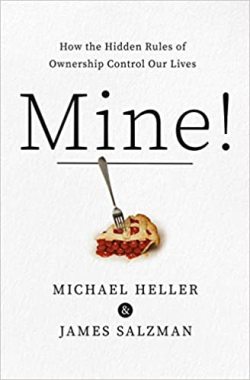
The third constitution is what has been labeled the “popular constitution” that exists, unwritten, in the broader culture. I call this the “playground constitution,” embodying rules that a broad swath of the populace believes are part of

PASH symposium

Back in February, we were honored to be part of the University of Hawaii Law Review’s symposium “25 Years of PASH,” a retrospective of one of the Hawaii Supreme Court’s most famous (or infamous) decisions, Pub. Access Shoreline Haw. v. Haw. Cnty. Plan. Comm’n, 79 Haw. 425, 903 P.2d 1246 (1993), cert. denied

Here’s a new law journal article, just published, which we recommend everyone read.

Michael M. Berger, “Whither Regulatory Takings,” 51 Urban Lawyer 171 (2021). Available online here.

If you need encouragement to read it, here’s a sample:

The thrust of this article is severalfold. First, Holmes was right. His simple conclusion on

Untitled Extract Pages

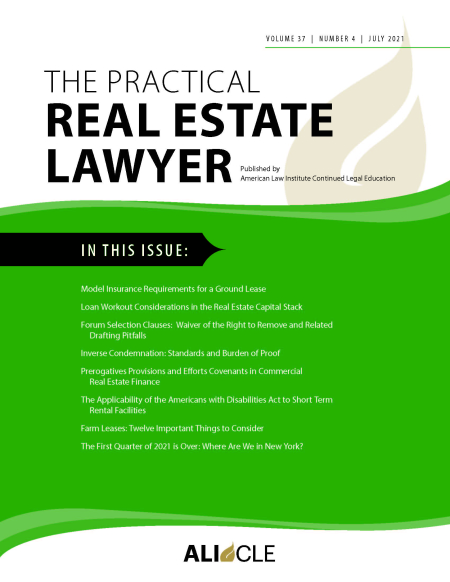
Worth reading: an article in ALI-CLE’s Practical Real Estate Lawyer, authored by our friends and colleagues Steve Clarke, Justin Hodge, Jeremy P. Hopkins, and Christian Torgrimson, “Inverse Condemnation: Standards and Burden of Proof.”

A subscription to PREL costs, but for this issue the good people at ALI have made it available for

Screenshot 2021-08-08 at 23-55-14 The Dawn of a Judicial Takings Doctrine em Stop the Beach Renourishment  Inc v Florida De[...]

Here’s what we’re reading today, a recently-published law review article by Brendan Mackesey, The Dawn of a Judicial Takings Doctrine: Stop the Beach Renourishment, Inc. v. Florida Department of Environmental Protection, 75 U. Miami L. Rev. 798 (2021). 

Here’s the Abstract:

In Stop the Beach Renourishment v. Florida Department of Environmental Protection, 130

Untitled Extract Pages

Here’s what we’re reading today. And this is one of those articles that you should not miss.

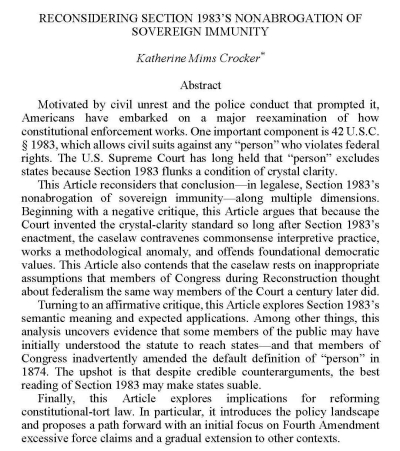
Our W&M colleague Katherine Mims Crocker has published “Reconsidering Section 1983’s Nonabrogation of Sovereign Immunity,” 73 Fla. L. Rev. 523 (2021).

Why is this a “must read” you ask? Because Professor Crocker concludes, “[t]he preceding Parts

Programming note: as we noted here, we’ve recently moved our email subscribers to a new service. If you are already subscribed to our email updates you should not need to do anything, except look for the emails coming from Feedblitz, not Feedburner. If you want to sign up for email updates anew

Floodsfiresarticle

Here’s what we’re reading today (inter alia): Walter W. Heiser, Floods, Fires, and Inverse Condemnation, 29 N.Y.U. Envtl. L. J. 1 (2021).

From the Introduction:

This Article examines the proper application of the doctrine of inverse condemnation in two important areas: flood damage to private property caused by a public improvement (e.g., a

For your Monday reading, Amnon Lehavi, Temporary Eminent Domain, 69 Buff. L. Rev. 683 (2021). From the Abstract:

Times of emergency call for drastic measures. These steps may include the physical takeover of privately-owned assets by the government for a certain period of time and for various purposes, aimed at addressing the state of emergency. When will such acts amount to a taking, and what compensation should be paid to the property owner? How do temporary physical appropriations during times of emergency diverge, if at all, from temporary takeovers in more ordinary times?

The doctrinal and theoretical analysis of potential temporary takings has been done mostly in the context of non-physical government intervention with private property, such as when a local government imposes a temporary moratorium on land development until a certain condition is met. This Article focuses, however, on less investigated scenarios of temporary physical takeovers or other forms of government invasions. It seeks to identify the differences between a temporary invasion and a permanent occupation of property considered a per se taking under the Loretto rule. In so doing, this Article argues that while the alleged distinction between prevention of public harm and promotion of public benefit often proves untenable in evaluating whether a permanent government measure constitutes a taking, it might make more sense in exploring temporary acts.

Temporary eminent domain—referring here to various types of acts amounting to time-limited physical takings, even if not initially recognized as such by the government—may diverge from permanent eminent domain in yet another key element: identifying the basis for just compensation. Under long established (although often criticized) rules, compensation for a permanent taking is based on identifying the “fair market value” of the rights taken, while ignoring the effects that the public use for which the underlying asset is taken might have on the property’s long-term value.

The allegedly parallel metric used in the case of temporary takings,one of “fair rental value,” may often prove inadequate, both practically and normatively. This Article argues that because of unique aspects of temporary physical takings, legal rules on compensation should often seek to identify lost profits or actual damage. Moreover, in some cases, in which there is a direct relation between the pre-appropriation use of the asset and its post-appropriation use by the government, just compensation might also be based on a certain portion of the value of the public use. This is especially so when the time-sensitive value of the asset during such public use is particularly high. On this point, the Article offers an analogy to rules pertaining to compulsory licenses for patents.

Check it out.
Continue Reading New L. Rev. Article: “Temporary Eminent Domain”

PASH symposium

Back in February, we were honored to be part of the University of Hawaii Law Review’s symposium “25 Years of PASH,” a retrospective of one of the Hawaii Supreme Court’s most famous (or infamous) decisions, Pub. Access Shoreline Haw. v. Haw. Cnty. Plan. Comm’n, 79 Haw. 425, 903 P.2d 1246 (1993), cert. denied