
Programming note: as we noted here, we’ve recently moved our email subscribers to a new service. If you are already subscribed to our email updates you should not need to do anything, except look for the emails coming from Feedblitz, not Feedburner. If you want to sign up for email updates anew
New L Rev Article: “Floods, Fires, and Inverse Condemnation”

Here’s what we’re reading today (inter alia): Walter W. Heiser, Floods, Fires, and Inverse Condemnation, 29 N.Y.U. Envtl. L. J. 1 (2021).
From the Introduction:
This Article examines the proper application of the doctrine of inverse condemnation in two important areas: flood damage to private property caused by a public improvement (e.g., a
New L. Rev. Article: “Temporary Eminent Domain”
For your Monday reading, Amnon Lehavi, Temporary Eminent Domain, 69 Buff. L. Rev. 683 (2021). From the Abstract:
Times of emergency call for drastic measures. These steps may include the physical takeover of privately-owned assets by the government for a certain period of time and for various purposes, aimed at addressing the state of emergency. When will such acts amount to a taking, and what compensation should be paid to the property owner? How do temporary physical appropriations during times of emergency diverge, if at all, from temporary takeovers in more ordinary times?
The doctrinal and theoretical analysis of potential temporary takings has been done mostly in the context of non-physical government intervention with private property, such as when a local government imposes a temporary moratorium on land development until a certain condition is met. This Article focuses, however, on less investigated scenarios of temporary physical takeovers or other forms of government invasions. It seeks to identify the differences between a temporary invasion and a permanent occupation of property considered a per se taking under the Loretto rule. In so doing, this Article argues that while the alleged distinction between prevention of public harm and promotion of public benefit often proves untenable in evaluating whether a permanent government measure constitutes a taking, it might make more sense in exploring temporary acts.
Temporary eminent domain—referring here to various types of acts amounting to time-limited physical takings, even if not initially recognized as such by the government—may diverge from permanent eminent domain in yet another key element: identifying the basis for just compensation. Under long established (although often criticized) rules, compensation for a permanent taking is based on identifying the “fair market value” of the rights taken, while ignoring the effects that the public use for which the underlying asset is taken might have on the property’s long-term value.
The allegedly parallel metric used in the case of temporary takings,one of “fair rental value,” may often prove inadequate, both practically and normatively. This Article argues that because of unique aspects of temporary physical takings, legal rules on compensation should often seek to identify lost profits or actual damage. Moreover, in some cases, in which there is a direct relation between the pre-appropriation use of the asset and its post-appropriation use by the government, just compensation might also be based on a certain portion of the value of the public use. This is especially so when the time-sensitive value of the asset during such public use is particularly high. On this point, the Article offers an analogy to rules pertaining to compulsory licenses for patents.
Check it out.
Continue Reading New L. Rev. Article: “Temporary Eminent Domain”
New Article: “Takings, PASH, and The Changing Coastal Environment” (U. Haw. L. Rev., forthcoming)

Back in February, we were honored to be part of the University of Hawaii Law Review’s symposium “25 Years of PASH,” a retrospective of one of the Hawaii Supreme Court’s most famous (or infamous) decisions, Pub. Access Shoreline Haw. v. Haw. Cnty. Plan. Comm’n, 79 Haw. 425, 903 P.2d 1246 (1993), cert. denied
New Law Review Article (Ours) – “Evaluating Emergency Takings: Flattening the Economic Curve,” 29 Wm. & Mary Bill of Rights J. 1145 (2021)

Wondering about so-called “covid takings” such as business lockdowns, seizures, commandeerings, eviction moratoria, and whether these might be takings?
If so, check out our latest article, Evaluating Emergency Takings: Flattening the Economic Curve, just published in the latest issue of the William and Mary Bill of Rights Journal.
Here’s the Intro to the article:
Desperate times may breed desperate measures, but when do desperate measures undertaken as a response to an emergency trigger the Fifth Amendment’s requirement that the government provide just compensation when it takes private property for public use? The answer to that question has commonly been posed as a choice between the “police power”—a sovereign government’s power to regulate property’s use in order to further the public health, safety, and welfare —and the eminent domain power, the authority to seize private property for public use with the corresponding requirement to pay compensation. But that should not be the question. After all, emergencies do not increase government power, nor do they necessarily alter constitutional rights, and an invocation of police power by itself does not solve the compensation question, but is merely the predicate issue: all government actions must be for the public health, safety, or welfare, in the same way that an exercise of eminent domain power must be for a public use.
This Article provides a roadmap for analyzing these questions, hoping that it will result in a more consistent approach for resolving claims for compensation that arise out of claims of emergencies. This Article analyzes the potential takings claims stemming from emergency measures, mostly under current takings doctrine. Which types of claims are likely to succeed or fail? In “normal” times, it is very difficult to win a regulatory takings claim for compensation. In the midst of emergencies—real or perceived—the courts are even more reluctant to provide a remedy, even when they should, and emergencies are a good time to make bad law, especially in takings law. Can a better case be made analytically for compensation?
Part I summarizes the economic “flattening the curve” principle that motivates takings claims for compensation. Part II sets out the prevailing three-factor Penn Central standard for how courts evaluate claims that a health, safety, or welfare measure “goes too far” and requires compensation as a taking, examining the character of the government action, the impact of the action on the owner, and the extent of the owner’s property rights. Deep criticism of the Penn Central standard is beyond the scope of this Article, and here, I accept it as the default takings test. But I argue that the government’s motivation and reason for its actions—generally reviewed under the “rational basis” standard—should not be a major question in takings claims. Rather, as this Article argues in Part III, the government’s emergency justifications should be considered as part of a necessity defense, not subject to the low bar of rational basis, but a more fact and evidence driven standard of “actual necessity.” Part IV attempts to apply these standards and examines the various ways that emergency actions can take property for public use: commandeerings, occupations of property, and restrictions on use. I do not conclude that the approach will result in more (or less) successful claims for compensation, merely a more straightforward method of evaluating emergency takings claims than the current disjointed analytical methods.
In sum, this article argues there is no blanket immunity from the requirement to provide just compensation when property is taken simply because the government claims to be acting in response to an emergency, even though its actions and reasons may satisfy the rational basis test. Instead, claims that the taking is not compensable because of the exigency of an emergency should only win the day if the government successfully shows that the measure was actually needed to avoid imminent danger posed by the property owner’s use and that the restriction on use was narrowly tailored to further that end.
One final word: the editors at the Bill of Rights Journal have been fantastic to work with to get this piece publication ready. Offering helpful comments, gently suggesting that certain parts are not working (but never insisting, and giving the author a lot of discretion), and getting the citations squared away: I could not have asked for more helpful editing. Congratulations on the publication of your latest issue.
Continue Reading New Law Review Article (Ours) – “Evaluating Emergency Takings: Flattening the Economic Curve,” 29 Wm. & Mary Bill of Rights J. 1145 (2021)New L Rev Article: Knick Won’t Mean Much Until Federal Courts Get Over “Strong Distate, If Not Outright Contempt” For Land Use Matters
R.S. Radford’s most-recent article, Knick and the Elephant in the Courtroom: Who Cares Least About Property Rights? in the latest issue of the Texas A&M Journal of Property Law, should be next on your to-read list.
Here’s the summary of the article:
Throughout the thirty-four-year history of Williamson County, one fact was taken for
Your Friday (And Weekend) Reading: Merrill On Compensation; Epstein On Valuation
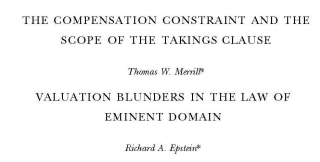
Two very interesting law review articles (essays) by well-known property experts are now available in the Notre Dame Law Review:
- Thomas Merrill, The Compensation Constraint and the Scope of the Takings Clause, 96 Notre Dame L. Rev. 1421 (2021). Professor Merrill asks “whether the established methods for determining just compensation can shed light
Hoist the Yellow Flag and Spam® Up: The Separation of Powers Limitation on Hawaii’s Emergency Authority, 43 U. Haw. L. Rev. 71 (2020)
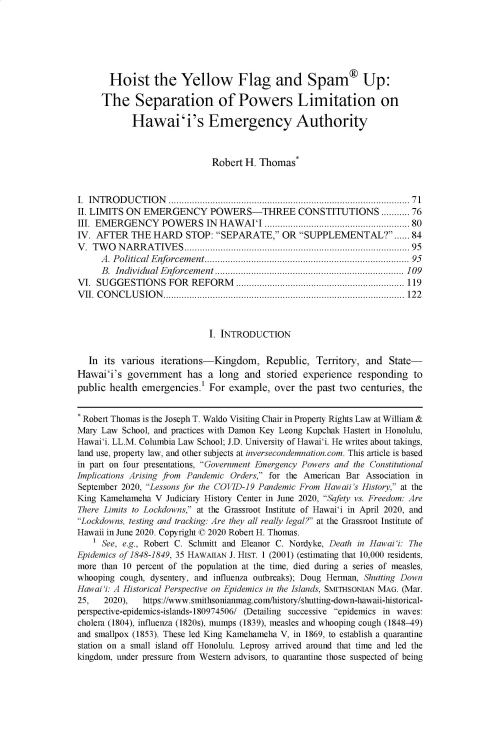
Not our usual takings fare, but our readers are pretty forgiving about our occasional sidebars. And this one is otherwise relevant if you are wondering how governors and other executive state and municipal officials have the power to do things in events deemed to be emergencies.
So here’s the final, as-published version of the law
New Takings Lawrev Article: Jessica Asbridge, “Redefining the Boundary Between Regulation and Appropriation”
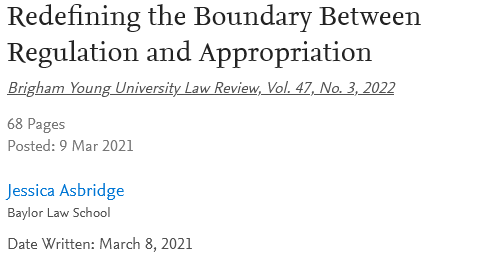
Next up on our reading list: “Redefining the Boundary Between Regulation and Appropriation” (forthcoming, BYU L Rev), by Baylor Lawprof Jessica Asbridge. Available on SSRN here.
This one is especially relevant in light of the upcoming arguments in Cedar Point, which will consider many of the issues Prof. Asbridge writes about.
Here’s the Abstract:
The U.S. Supreme Court currently claims to distinguish between appropriations and regulations when interpreting the Fifth Amendment’s Takings Clause. While appropriations always require just compensation to survive constitutional scrutiny, whether a regulation infringing upon property rights requires compensation is determined on an ad hoc basis, guided by concerns of fairness and justness. In Loretto v. Teleprompter Manhattan CATV Corporation, the Court attempted to define the boundary between regulations and appropriations, holding that an appropriation occurs when a government action results in a permanent, physical invasion of an owner’s real property. What constitutes a permanent, physical invasion, however, is entirely unclear due to the Court’s inconsistent decisions applying Loretto. The circumstances under which the physical takings doctrine applies has confounded the lower courts, rendering the heightened constitutional protection for appropriative actions largely illusory.
Takings Clause scholars almost uniformly call for the elimination of the Court’s physical takings doctrine. Most, if not all, critics of Loretto argue that any distinction between appropriations and regulations should be eliminated, such that all government actions short of formal acts of eminent domain should be evaluated on a case-by-case basis, with compensation only justified where the public interest is minimal or the economic hardship on the owner is great. This approach, however, would only further weaken the protection provided by the Takings Clause.
The physical takings doctrine is unsound, but, contrary to the dominant view in the scholarship, the Court’s distinction between regulations and appropriations is not. The Court has long recognized that appropriations require compensation without regard to the public interest at play or fairness and justness concerns, as shown by nineteenth and early twentieth century cases overlooked or ignored by contemporary Takings Clause scholars. Rather than define appropriations as permanent, physical invasions, however, these cases demonstrate that an appropriation occurs when government seeks to transfer the right to use private property to a third party or the government itself whereas a regulation involves the government controlling or restricting an owner’s use of property. Redefining the boundary consistent with this historical understanding would bring much needed doctrinal clarity to takings jurisprudence and further important normative considerations. Requiring compensation for all properly defined appropriative acts furthers multiple values including autonomy and political freedom and accounts for the interests of owners and non-owners alike.
Check it out. Especially before the upcoming oral arguments in Cedar Point.
Continue Reading New Takings Lawrev Article: Jessica Asbridge, “Redefining the Boundary Between Regulation and Appropriation”
Today’s Readings: “Federal Courts and Takings Litigation” (Woolhandler & Mahoney), “Swallowing its Own Tail: The Circular Grammar of Background Principles Under Lucas” (Stein)
It’s Monday, so we’re just going to ease into the week by (inter alia) reading a couple of law review articles:
- Federal Courts and Takings Litigation, by Prof. Ann Woolhandler & Prof. Julia D. Mahoney: “While Knick clearly expands the lower federal court role in takings claims, many questions remain, for it