
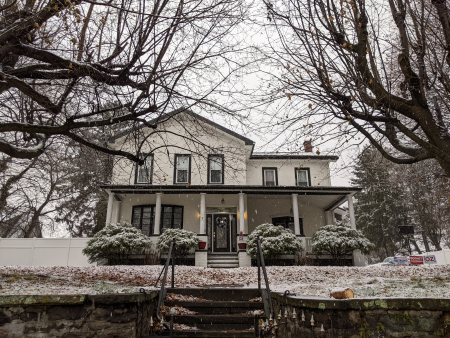
PXL_20221211_185826126

This story might be said to have had its roots millions of years ago.

It is about coal, after all. Anthracite coal, to be exact.

But that — and today’s date — should give you a clue that, as we teased in this post a mere 28 days ago (the Supreme Court worked hard
Check out the Ohio Supreme Court’s 6-1 opinion in State ex rel. Ohio History Connection v. Moundbuilders Country Club Co., No. 2020-0191 (Dec. 7, 2022), in which the court held held that the taking of the Country Club’s lease for the property served a public use.

Court News Ohio beat us to the punch

Here’s your must-read for today, the latest journal article from Michael Berger, “Theft, Extortion, and the Constitution: Land Use Practice Needs an Ethical Infusion,” 38 Touro L. Rev. 755 (2022).

Here’s the Abstract:

There are many ways in which property owners/developers interact with regulators. To the extent that texts and articles deal

The Supreme Court of Montana’s opinion in Tai Tam, LLC v. Missoula County, No. DA21-0660 (Nov. 15, 2022) starts off like a somewhat typical land use dispute turned into a constitutional fight. The property owner sought subdivision approvals for a 28-acre parcel to allow residential development, and the County denied the applications because “the

Due to our 808 roots, we’ve been fielding a lot of questions related to the ongoing eruption of Mauna Loa on the Big Island.

It’s big, it’s spectacular (see video above), and (for us) it’s law.

The questions (who owns “accreted” lava?, how does the NPS let the public out to see this?, what

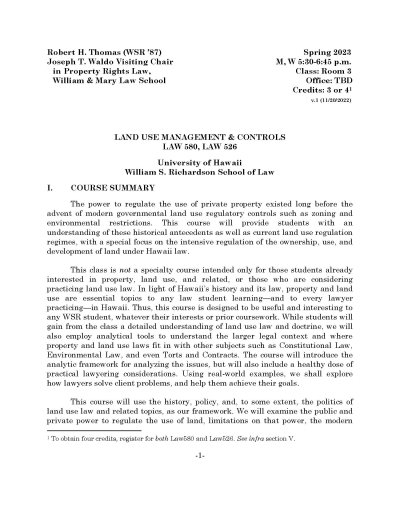
Syllabus

Starting in January, we’ll be teaching the venerated, and oh-so-important Land Use course (Law 580) at the University of Hawaii’s Law School.

We’re at least temporarily stepping into some mighty big slippers (this is Hawaii, so we don’t always wear shoes), as this is the course that our mentor Professor David Callies taught for

As we noted earlier this week, the Federal Quiet Title Act isn’t exactly on the public radar screens. Especially questions about whether the Act’s 12-year statute of limitations is “jurisdictional” or merely a claims processing rule.

Thus, you are not likely to see throngs of protesters on the Supreme Court steps today (Wednesday, Nov.

Here’s the latest in a case we’ve been following.

In this cert petition, business owners on the losing end of a Co-19 shutdown order assert that the Sixth Circuit got it wrong when it concluded that the “overriding public purpose” of the shutdown orders should be given what amounts to dispositive weight under

Here’s a short one you might have overlooked because it’s an unpublished memorandum opinion.

In Kagan v. City of Los Angeles, No. 21-55233 (Nov. 10, 2022), a Ninth Circuit panel summarily affirmed the dismissal of property owners’ challenge to a city ordinance prohibiting eviction of “protected status” tenants from a duplex in order to

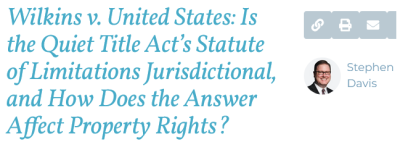
Screenshot 2022-11-28 at 12-12-00 Wilkins v. United States Is the Quiet Title Act’s Statute of Limitations Jurisdictional and How Does the Answer Affect Property Rights

The Federal Quiet Title Act isn’t exactly on the public radar screens. Especially questions about whether the Act’s 12-year statute of limitations is “jurisdictional” or merely a claims processing rule.

Thus, you are not likely to see throngs of protesters on the Supreme Court steps this Wednesday, Nov. 30, 2022 at 10:00 a.m. when the