Public Use | Kelo

Please mark your calendars for Friday, May 15, 2020 at 2:30pm Eastern Time, for the teleforum sponsored by the Federalist Society’s Environmental Law & Property Rights Practice Group, “COVID-19 & Property Rights: Do Government Actions in Response to the Coronavirus Pandemic Create Compensable Takings?”  

The issue: how should courts evaluate the claims for

How should courts evaluate the claims for compensation arising out of emergency measures (many of which we’ve already seen; see here, here, here, here and here, for example)?

Rather than think about it piecemeal, we decided to write it up in a more comprehensive fashion. Here’s the result, so far. Rather than summarize it, let’s just cut-and-paste the Introduction. The complete piece is posted on SSRN, if you want to read it. 

Desperate times may breed desperate measures, but when do desperate measures undertaken during emergencies trigger the Fifth Amendment’s requirement that the government provide just compensation when it takes private property for public use?[1] The answer to that question has commonly been posed as a choice between the “police power”—a sovereign government’s power to regulate and restrict property’s use in order to further the public health, safety, and welfare[2]—and the eminent domain power, the authority to seize private property for public use with the corresponding requirement to pay compensation.[3]

But that should not be the question. An invocation of police power does not answer the compensation question at all, but is merely the predicate issue: all government actions must be for the public health, safety, or welfare, in the same way that an exercise of eminent domain power must be for a public use. In “normal” times, it is very difficult to win a regulatory takings claim for compensation. In the midst of emergencies—real or perceived—the courts are even more reluctant to provide a remedy, even where they should, and emergencies are a good time to make bad law, especially takings law. Emergencies do not increase government power, nor do they necessarily alter constitutional rights.[4] 

This article provides a roadmap for analyzing these questions, hoping that it will result in a more consistent approach to resolving claims for compensation that arise out of claims of emergencies—real or perceived. This article analyzes the potential takings claims stemming from emergency measures, mostly under current takings doctrine. What type of claims are likely to succeed or fail? Can a better case be made analytically for compensation?

Part I summarizes the economic “flattening the curve” principle that motivates takings claims for compensation. Part II sets out the prevailing three-factor Penn Central standard for how courts evaluate claims that a health, safety, or welfare measure “goes too far,” and requires compensation as a taking, examining the character of the government action, the impact of the action on the owner, and the extent of the owner’s property rights.[5] Deep criticism of Penn Central is beyond the scope of this article, and I will not here do more than accept it as the “default”[6]  takings test. But I do argue that the government’s motivation and reason for its actions—generally reviewed under the “rational basis” standard—should not be a major question in takings claims. Rather, as this article argues in Part III, the government’s emergency justifications should be considered as part of a necessity defense, and not subject to the low bar of rational basis, but a more fact and evidence driven standard of “actual necessity.” Part IV attempts to apply these standards and examines the various ways that emergency actions can take property for public use: commandeerings, occupations of property, and restrictions on use. I do not conclude that the approach will result in more (or less) successful claims for compensation, merely a more straightforward method of evaluating emergency takings claims than the current disjointed analytical methods.

In sum, this article argues there is no blanket immunity from compensation simply because the government claims to be acting in response to an emergency, even though its reasons and actions may satisfy the rational basis test. Instead, claims that the taking is not compensable because of the exigency of an emergency should only win the day if the government successfully shows that the measure was actually needed to avoid imminent danger posed by the property owner’s use, and that the measure was narrowly tailored to further that end.

————-

[1] See Robert Higgs and Charlotte Twight, National Emergency and the Erosion of Private Property Rights, 6 Cato J. 747 (1987) (“Much of the reduction [of private property rights] occurred episodically, as governmental officials too control of economic affairs during national emergencies—mainly wars, depressions, and actual or threatened strikes in critical industries.”).

[2] “Police power” describes everything a sovereign government can do. It even might be said to encompass the eminent domain power. See Hawaii Housing Auth. v. Midkiff, 467 U.S. 229, 240 (1984) (“The [Fifth Amendment’s] ‘public use’ requirement is thus coterminous with the scope of a sovereign’s police powers.).

[3] See U.S. Const. amend. V. The Fifth Amendment conditions the federal government’s takings power. See Barron v. Baltimore, 32 U.S. (7 Pet.) 243 (1833) (noting a wharf owner’s argument that city’s diversion of water pursuant to its police power could support a Fifth Amendment claim, but holding that the Fifth Amendment only limited the actions of the national government). The Fourteenth Amendment extended the just compensation requirement to the states as part of due process of law. See Chicago, B. & Q. R. Co. v. City of Chicago, 166 U.S. 226, 235 (1897).

[4] See Steven M. Silva, Closed for Business—Open for Litigation?, Nw. L. Rev. of Note (Apr. 29, 2020), https://blog.northwesternlaw.review/?p=1361 (“First, it must be recognized that the Constitution exists even in an emergency. The Constitution expressly permits some alterations to our ordinary system of rights during times of war—for example, the Third Amendment provides differing provisions for the quartering of soldiers in times of peace versus times of war—but those alterations are baked into the system, the Constitution does not disappear in war. And a pandemic is not even a war.”) (citing Home Bldg. & Loan Ass’n v. Blaisdell, 290 U.S. 398, 425 (1934))..

[5] Penn Cent. Transp. Co. v. New York City, 438 U.S. 104, 124-25 (1978).

[6] The Supreme Court has labeled Penn Central “default” test for regulatory takings. See Lingle v. Chevron U.S.A. Inc., 544 U.S. 528, 538-39 (2005).

Entire draft here

.
Continue Reading New Article – Evaluating Emergency Takings: Flattening The Economic Curve

Two more complaints challenging covid shutdown orders as takings (inter alia). Add to the growing list. See here, here, here and here, for other similar complaints.

The first is from California. It asserts that ordering “nonessential” businesses to shut down is a taking. The complaint alleges that unless the

Missed out on the 2021 ALI-CLE Eminent Domain and Land Valuation Litigation Conference swag?

Well fear not: here’s your chance to get your high-class reminder — a kit of road warrior essentials — to save the Conference date on your calendar. We’re already underway with planning the agenda and faculty, so it’s never too soon

IMG_20200303_191820

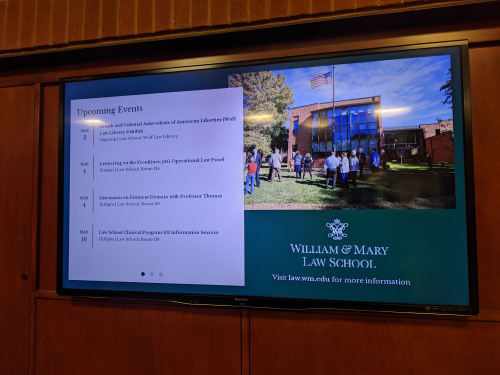
We just completed a fun hour-long talk with the students in the William and Mary Law School’s American Constitution Society, the Native American Law Society, and the Society on Environmental and Animal Law about the various pipeline cases that are ongoing nationwide. (If our tech worked, we shall post the audio recording in a future

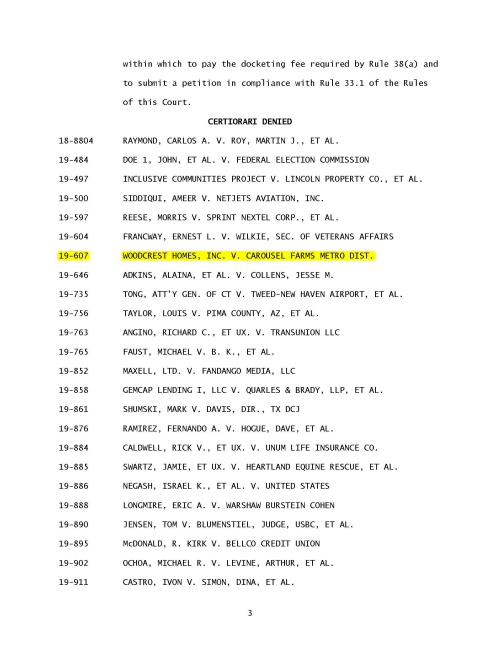
Here’s the latest episode of Clint Schumacher’s Eminent Domain Podcast. Featuring an interview with the Institute for Justice’s Robert McNamara about an eminent domain case we’ve been following, Woodcrest Homes, Inc. v. Carousel Farms Metro. Dist., No. 19-607 (cert. petition filed  Nov. 7, 2019). Also included, a short talk with Delia Root

Peasants carousing

The last two cert-stage briefs have been filed in a case we’ve been following for a while (since it was decided by the Colorado Court of Appeals). 

In Carousel Farms Metro. Dist. v. Woodcrest Homes, Inc., 444 P.3d 802 (Colo. App. 2017), the appeals court invalidated an attempt to exercise eminent domain to

Recall that recent Third Circuit decision which held that a private condemnor exercising federal eminent domain authority pursuant to the Natural Gas Act could not sue the State of New Jersey in federal court to take the state’s property for a pipeline? The court based its conclusion on the Eleventh Amendment immunity states enjoy. 

That

Netflix just released the first season (or should we say “series” since this is a UK-based production?) of “The Stranger,” a thriller based on Harlan Coben’s novel, about “the lives of suburban families whose secrets and lies are made public by the appearance of a stranger.”

Why we’re posting notice here that you