Just Compensation | Appraisal

Like a lot of residential communities these days, Foothills Reserve was developed under a master plan, and you know what that means … a homeowner’s association and CCRs (covenants, conditions, and restrictions). 

The HOA owned common areas, in which the homeowners had easements under the CCR’s. A “positive” easement to enter and use the common

In our earlier post today, we noted that on the same day last month, the U.S. Court of Appeals for the Fourth Circuit issued two published opinions about the admissibility of evidence in federal eminent domain cases under the Natural Gas Act

In our post about the other case, we focused on

As the title should inform you, Mountain Valley Pipeline, LLC v. 0.32 Acres of Land, No. 23-1935 (Jan. 27, 2025) is a federal taking. Here, a taking where a private pipeline condemnor is exercising the delegated federal power of eminent domain under the Natural Gas Act.

The issue we’re focusing on in this

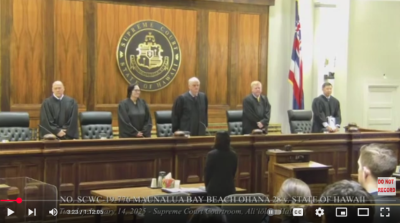
Screenshot 2025-01-18 at 14-58-03 No. SCWC-19-0000776 January 14 2025 10 30 a.m. Maunalua Bay v. State of Hawaiʻi - YouTube

Here’s the latest in a case we’ve been following for a long time.

As we previously noted, the Hawaii court of appeals affirmed a trial verdict that the just compensation owed to littoral property owners for the State’s regulatory taking of small portions of accreted beach is zero.

Last week, the Hawaii Supreme Court heard oral arguments. Here’s the video (sorry, can’t embed it here). Worth watching, if only because questions of just compensation and how it is calculated rarely are presented to this court (which is a frequent flyer in regulatory takings cases).

Here’s a description of the case and issues from the Hawaii Judiciary:

Petitioners Maunalua Bay Beach Ohana 28, Maunalua Bay Beach Ohana 29, and Maunalua Bay Beach Ohana 38 brought an inverse condemnation action against the State of Hawai‘i in 2005. At that time, they argued that the State effected a taking of accreted lands via Act 73 of 2005. In 2009, the Intermediate Court of Appeals (ICA) held that Act 73 “effectuated a permanent taking of littoral owners’ ownership rights to existing accretions to the owners’ oceanfront properties that had not been registered or recorded or made the subject of a then-pending quiet-title lawsuit or petition to register the accretions.” Maunalua Bay Beach Ohana 28 v. State, 122 Hawai‘i 34, 57, 222 P.3d 441, 464 (Ct. App. 2009).

On remand from the ICA, Petitioners sought just compensation for the alleged temporary taking of their accreted lands between 2005 and 2012. At trial, the circuit court concluded that $0 was just compensation for the alleged temporary taking of the accreted land and no nominal damages should be awarded to the petitioners. It also determined that the petitioners were not entitled to attorney’s fees.

The ICA affirmed the circuit court’s decision. With regard to attorney’s fees, the ICA held that the petitioners’ “claim for attorneys fees against the State for obtaining declaratory relief is barred by sovereign immunity.” The ICA further held that the Ohanas were not entitled to attorney’s fees under the private attorney general doctrine.

In their application for certiorari, the petitioners argue that the ICA erred in affirming the circuit court’s award of $0 in just compensation with no nominal or severance damages. Petitioners also contend that the ICA erred by concluding that sovereign immunity bars an award of attorney’s fees, and that they would not be entitled to fees under private attorney general doctrine. The State contends that the ICA did not err in affirming the circuit court’s award of $0 in just compensation or declining to award nominal damages to petitioners. It also argues that the ICA correctly held that sovereign immunity bars petitioners’ claim for attorney’s fees, and that even if it did not, petitioners would not be entitled to attorney’s fees under the private attorney general doctrine.

We watched live, and have a couple of thoughts:

  • Justice McKenna’s questions indicate she recalls that in an earlier regulatory takings case, the court concluded that even “speculation value” was enough to place a regulatory takings claim outside a Lucas wipeout analysis, an indicator that in this court’s view, property always has value, even if it has no use. Is that enough to say the owners here were entitled to, at the very least, nominal just compensation?
  • Does obtaining a decision holding the State to its constitutional obligation (after which the State repeals the unconstitutional statute) qualify the plaintiff for fee recovery from the State under the private attorney general doctrine, even where the adjudicated compensation is zero? We think so, because suing to keep the State in line when it has acted beyond its authority is exactly the kind of thing that the Attorney General should do (but didn’t here, because it has been too busy defending the State’s action). What about the advocate for the State who argued that there was no constitutional wrong here, because of the zero compensation verdict (the notion that the Takings Clause does not prohibit takings, only uncompensated takings)? The fact that the State withdrew the offending statute after the plaintiffs won the takings claim seems to contradict that argument because at the heart of it, the court ruled that the State should have used its eminent domain power to take future accreted land, and not the police power.

Stay tuned. We’ll continue to follow along and will post the court’s opinion when issued.Continue Reading Hawaii Supreme Court Arguments: Is Just Compensation For Even A Small Slice Of A Primo Hawaii Beach Zero?

With our tongues firmly planted in cheeks, the Planning Chairs for the upcoming 42d edition of this popular and venerable Conference bring you this “breaking news” report from San Diego!

As you know, in addition to being the best nationally-focused conference on the subjects that we love and a venue that is nearly certain to have some of the warmest winter weather in the continental United States, and we went on-location from some of the local highlights: the beaches, Torrey Pines, the Zoo, Balboa Park, the Gaslamp Quarter, and Coronado to name but a few.

More about the Conference here, including registration information.

Here are some of the highlights:

  • Property Rights at the Supreme Court: DeVillier and Sheetz and What’s Next
  • Slow Take: Possession, Rent, Relocation, and Offset
  • The Jury’s View: How Jurors See Your Case
  • From Penn Coal to Penn Central: How to Prove “Too Far”
  • Leveraging Expertise in Eminent Domain Litigation: Working with Land Planners, Engineers, and Other Predicate Experts
  • Kelo at Twenty: What Changed, What Didn’t, and What’s on the Horizon
  • Viva Las Vegas: How the Nevada Judiciary Upheld Property Rights in 180 Land’s Inverse Condemnation Taking
  • Ethics: Guiding the Trolley: Perspectives on Professional Ethics in Eminent Domain for Lawyers, Appraisers, and Right of Way Agents
  • “I Think I Shall Never See” Just Compensation For a Tree: Strategies to Securing Recovery for Trees, Crops, and Fixtures

And more. Check out the complete agenda here. Registration information here

We especially welcome first-time participants, or those returning after an absence. Connect (or reconnect) with your colleagues from across the nation.

The 41st Conference was in New Orleans. Here’s a report of that event, and here are our reports from prior conferences in Austin and Scottsdale.

Don’t miss out on San Diego: we have had record attendance in recent years, so hold your space now. #EminentDomain2025Continue Reading Breaking News: Come Join Us For The 42d ALI-CLE Eminent Domain & Land Valuation Litigation Conference, San Diego, Jan 30-Feb 1

A short one today, but worth reading because the Kentucky Supreme Court’s opinion in Kentucky Transportation Cabinet v. Atkins, No.2023-SC-0173 (Dec. 19, 2024) highlights an important point: when offering evidence of the compensation owed for the taking of income-producing property–and “[d]etermining the value of condemned real property is not a science”– it isn’t “speculative”

Today we have another guest post by New York colleague Jennifer Polovetsky, who writes about trade fixtures in New York. Lots of good stuff for those of us not in NY as well. Thanks to Jennifer (and to the New York Law Journal) for allowing us to republish her intriguing piece.

_____________________________

Trade Fixtures