
Inverse condemnation

20180126_111558_HDR

You’ve known for a while that Palm Springs, California, specifically the Renaissance Palm Springs Hotel (a resort facility, but right in town, so you will have many options for “off campus” activities like art museums, the aerial tram, golf, and whatever suits your fancy, and close-in to the Palm Springs Airport), is the venue
A quick one today because we’re offline (more on that later). Pacific Legal Foundation (the folks who are representing the property owner in the pending case challenging the continuing viability of the Williamson County ripeness doctrine), has posted this entry on their blog, “This monkey got his day in court. Property owners still

Back in April, we posted the Florida District Court of Appeal’s opinion in a case where landowners sued the state fish and wildlife commission because “deer dog hunters and their dogs” who had hunting licenses trespassed on the plaintiffs’ lands. The court, over a single judge dissent, affirmed the dismissal of the takings claims, because

Appeals from motions to dismiss can be very unsatisfying, even for the winner. Granted, from a doctrinal standpoint, they’re pretty good at clarifying the law. And from a practice standpoint, the courts’ opinions often help future lawyers and litigants figure out how to plead cases, and frame issues. And the party who wins the appeal

Challenging an ordinance that the court characterizes as an “even-handed” zoning regulation, even if it outlaws an existing conditional use, is going to be a tough one for a plaintiff. In theory, it need not be, given the right conditions. But any zoning lawyer will tell you that it is tough to overcome most courts’

No surprises in the U.S. Court of Appeals for the Eleventh Circuit’s opinion in Checker Cab Operators, Inc. v. Miami-Dade County, No. 17-11955 (Aug. 6, 2018). As the caption suggests, this is another one of those takings claims brought by “traditional” taxicab operators against a local government for its refusal to keep ridesharing services

Doesnotsimply

We already knew from its amicus brief brief that the federal government supported the property owner in Knick v. Township of Scott, No. 17-647, the case in which the US. Supreme Court agreed to review the continuing validity of the “state procedures” rule of Williamson County Regional Planning Comm’n v. Hamilton Bank, 473

Clare Trapasso has a Realtor.com piece on what a Justice Kavanaugh could mean for real estate, property, and land use issues, “What Supreme Court Nominee Brett Kavanaugh Could Mean for Real Estate,” where she correctly notes that “while commentators have been scrutinizing Kavanaugh’s record on hot-button topics like abortion and immigration, there’s been

The City’s sewage pipe backed up into several residences. The City has known for decades that these pipes were “cracked, structurally unsound, and that they had significant root intrusion.” The City took measures, but apparently these were not enough, and after “an extremely intense rain and hail storm,” three million gallons of wastewater overflowed into

20180717_135234_HDR

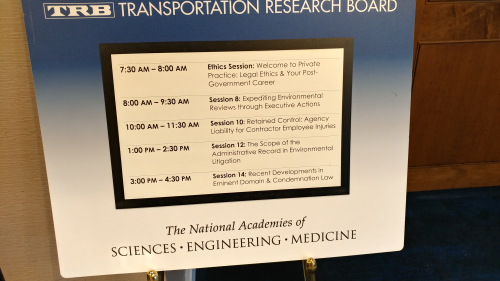
Here are the cases and other items I either spoke about or mentioned at today’s Transportation Research Board‘s 57th Annual Workshop on Transportation Law in Cambridge, Massachusetts: