Inverse condemnation

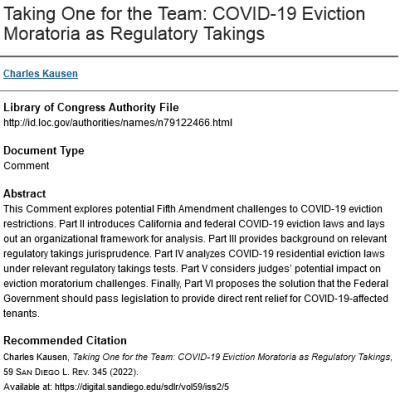
Screenshot 2022-07-02 at 09-16-05 Taking One for the Team COVID-19 Eviction Moratoria as Regulatory Takings

Check it out: a new article from the San Diego Law Review that’s worth reading. Here’s the Abstract:

This Comment explores potential Fifth Amendment challenges to COVID-19 eviction restrictions. Part II introduces California and federal COVID-19 eviction laws and lays out an organizational framework for analysis. Part III provides background on relevant regulatory takings jurisprudence.

Whatpropertydoes

Worth checking out: Christopher Serkin, What Property Does, 75 Vand. L. Rev. 891 (2022).

Covering (inter alia) property, rule against perpetuities, adverse possession, Lucas background principles, judicial and regulatory takings, Mahon v. Keystone Bituminous, and vested rights and amortization of preexisting uses.

Here’s the abstract:

For centuries, scholars have wrestled with

We’ve been meaning to post the U.S. Court of Appeals for the Sixth Circuit’s opinion in Barber v. Charter Twp of Springfield, No. 20-2298 (Apr. 11, 2022) for a while because it emphasizes an important point about “final decision” ripeness, and the sometimes ridiculous arguments made to support an argument that a takings claim

20151205_145854

We’ve covered some of the litigation against the federal government for its actions flooding property during Hurricane Harvey, including at least one from the “upstream” owners. Well here’s one from the case involving the “downstream” owners.

In Milton v. United States, No. 21-1131 (June 2, 2022), the U.S. Court of Appeals for the

Here’s a pretty rare one: a trial court entering summary judgment on liability in favor of the property owner in a takings case. Yes, you read that right.

And to top it off, this ruling comes in a case in which the taking alleged was a police invasion and destruction of a home for the

In City of Baytown v. Schrock, No. 20-0309 (May 13, 2022), the Texas Supreme Court held that it isn’t a taking when a city, in violation of state law, cuts off utility services to property.

The issue, as the court restated it, was “whether a claim of economic harm to property resulting from the

After the U.S. Supreme Court in Cedar Point Nursery reminded everyone that the Court’s longstanding focus on the right to exclude others as one of the most fundamental of property rights is as fresh today as it ever was (see Kaiser Aetna (uninvited boaters), Loretto (cable TV box), Nollan (beachcombers) and

Anyone who reads this blog regularly knows Tiburon, California, even if you’ve never stepped foot there. Yes, that Tiburon. Well, the beat goes on: the Agins litigation wasn’t the only time that the town and its residents combined forces to try and draw up the drawbridge and prevent the building of more

Screenshot 2022-05-02 at 11-51-57 Display event - 2022 Hawaii Land Use Law Conference (LIVE)

It’s back! After a hiatus on the in-person program, the bi-annual Hawaii Land Use Conference is back in-person (see here for a sample of one of our prior presentations at this conference).

May 25 and 26, 2022, downtown Honolulu.

The full agenda and speaker list has not yet been published, but here’s a summary

Bergerpage

A new article by lawprof Bethany Berger, “Property and the Right to Enter,” criticizing the Supreme Court’s ruling in Cedar Point Nursery. The article builds on the amicus brief in the case, also authored by Prof Berger.

Here’s the Abstract:

On June 23, 2021, the Supreme Court decided Cedar Point Nursery v. Hassid, holding that laws that authorize entry to land are takings without regard to duration, impact, or the public interest. The decision runs roughshod over precedent, but it does something more. It undermines the important place of rights to enter in preserving the virtues of property itself. This Article examines rights to enter as a matter of theory, history, and constitutional law, arguing that the law has always recognized their essential role. Throughout history, moreover, expansions of legal exclusion have often reflected unjust domination antithetical to property norms. The legal advocacy that led to Cedar Point continues this trend, both undermining protections for vulnerable immigrant workers in this case, and succeeding in a decades long effort to use exclusion as a constitutional shield against regulation.

Definitely worth reading.
Continue Reading New Article (Bethany Berger): “Property and the Right to Enter”