Environmental law

Clare Trapasso has a Realtor.com piece on what a Justice Kavanaugh could mean for real estate, property, and land use issues, “What Supreme Court Nominee Brett Kavanaugh Could Mean for Real Estate,” where she correctly notes that “while commentators have been scrutinizing Kavanaugh’s record on hot-button topics like abortion and immigration, there’s been

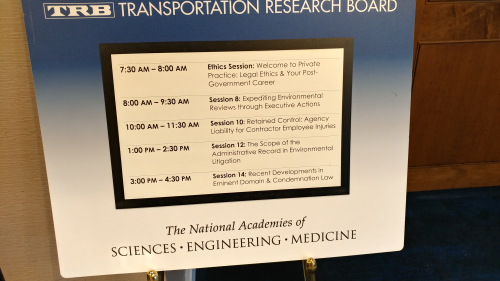
20180717_135234_HDR

Here are the cases and other items I either spoke about or mentioned at today’s Transportation Research Board‘s 57th Annual Workshop on Transportation Law in Cambridge, Massachusetts:

The plaintiffs owned mining and homestead claims on land in the Santa Fe National Forest. They claimed they own easements to access these lands, recognized by federal statutes. The government said no, these are just access rights, not easements. 

Then a fire, followed by flooding which severely damaged the Forest Service roads which the plaintiffs

Remember that case from earlier this year where the Hawaii Supreme Court held that for purposes of Hawaii’s Due Process Clause, the Sierra Club (any “person,” actually) has a property right in a “clean and healthful environment?”

We asked if that were the case, then what does that “property” right look like? For example, how

18730910_303

Here’s the not unexpected decision from the U.S. Court of Appeals for the Ninth Circuit in a case we’ve been following (sort of). It should never have gotten this far, even as the “plaintiffs” raise the specter of a cert petition.

We say again: the federal courts seem to have time for this brand

IMG_2947
Some of the Land Use Institute faculty, including (front row left), Planning Chair Frank Schnidman and Planning Co-Chair Patty Salkin

Last Friday at the 32nd Annual Land Use Institute in Detroit, I was honored to moderate a freewheeling discussion by a panel of takings experts, Professor Steven Eagle, Minnesota lawyer Howard Roston, and Michigan’s

20180419_150416_HDR

We’re in Detroit the rest of the week at the Mercy Law School for the venerable Land Use Institute, now in its 32nd iteration.

Planning Chair Frank Schnidman has assembled a great faculty including out Detroit colleague Alan Ackerman (above, talking about takings liability for flooding), and we’ll be spending the time talking inverse

Space is filling up, but there’s still time to join us later this month in Detroit for the 32nd Annual Land Use Institute (April-19-20). 

We’ll let program Planning Chair Frank Schnidman explain all the reasons why, and we’ll add only these points: (1) it’s a very good program that won’t take much of your time

Here’s what we’re reading this Thursday:

Cert(s) Denied

  • Brott v. United States, No. 17-712. This one was disappointing, but, I suppose, not surprising given that it would have upset current practice, no matter how unconstitutional that practice is. This is the case which challenged the takings-claims-against-the-feds-over-$10k-must-go-to-the-CFC-with-no-jury scheme. We did a brief in support

Remember the Tom Cruise/Steven Spielberg flick Minority Report? That’s the one based on Philip K. Dick’s short story in which the police force’s PreCrime unit can presage that a citizen will violate the law in the future, so they arrest him now even though he has committed no crime. 

That’s the same vibe we