
A short one today, but worth reading because the Kentucky Supreme Court’s opinion in Kentucky Transportation Cabinet v. Atkins, No.2023-SC-0173 (Dec. 19, 2024) highlights an important point: when offering evidence of the compensation owed for the taking of income-producing property–and “[d]etermining the value of condemned real property is not a science”– it isn’t “speculative”
Latest Ep, Eminent Domain Podcast: Podworthy Cases, ALI-CLE, And 1970s Bands
Our thanks to Bobby Debelak for having us back on as a guest on his Eminent Domain Podcast.
We’re long-time fans of the pod (naturally), and it was good to get together with Bobby and talk a bit of shop.
Here’s a description of our session:
Robert Thomas joins Bobby Debelak to discuss the
Another Semester Of Dirt Law In The Books
How it started.
Once again, our fall duties included teaching two property law courses at the William and Mary Law School: Eminent Domain & Property Rights, and Land Use Controls. We started in mid-August, and just wrapped the classroom portion of the courses earlier this week. I say “classroom portions” because although we are done
NYT Word Of The Day: “Eminent Domain”
Thanks to lawprof Donald Kochan for the heads-up: the “Word of the Day” in today’s New York Times is … “eminent domain.”
Defined by the piece as:
“the right of the state to take private property for public use; the Fifth Amendment that was added to the Constitution of the United States requires that just
NJ App: “Public Use” Is What Condemnor Says It Is, Not What Use Actually Will Be Made
We usually don’t cover unpublished opinions, but the New Jersey Appellate Division’s reasoning in Hudson County Improvement Authority v. Mariana Properties, Inc., No. A-2686-22 (Oct. 29, 2024) stuck in our craw a bit.
This is an eminent domain case in which the Authority is taking an easement and intends to construct one of
Registration For The 42d ALI-CLE Eminent Domain & Land Valuation Litigation Conference Is Underway (Don’t Miss Out!)

Get ready to join your colleagues and friends in San Diego for the 42d ALI-CLE Eminent Domain & Land Valuation Litigation Conference.
The 41st Conference was in New Orleans. Here’s a report of that event, and here are our reports from prior conferences in Austin and Scottsdale.
Here are some of the
Blight Redevelopment & Eminent Domain, India Style: Private Property As A Basis For “Economic Democracy”
We’re not going to pretend to fully understand the Supreme Court of India’s recent decision in Property Owners Ass’n v. State of Maharashtra, No. 2012-2022 (Nov. 4, 2024) for obvious reasons (plus, the judgement and various opinions and dissents total 193 pages).
But we post it here because we think it gives some insight
Links From Today’s ABA Land Use Session
Here are the cases and other materials we discussed in today’s Section of State & Local Government Law Land Use group meeting on takings:
- By The Thinnest Of Margins, SCOTUS Declines Public Use Pretext “Spite Taking” Case
- SCOTUS Declines To Review NYC Rent Control Challenge
- Sheetz pt. I – “Radical Agreement” At SCOTUS: “Your Money
Indiana: No Compensable Property Right In Traffic Flow; No Compensation For Impairment Of Access
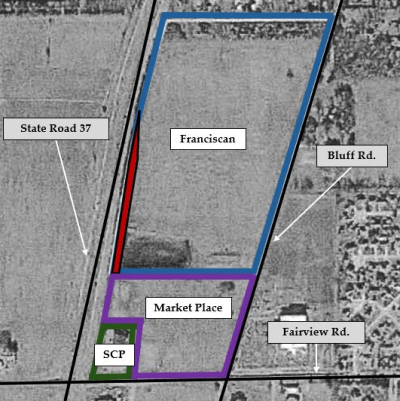
We like it when courts include photos and maps.
The Indiana Supreme Court’s ruling in State of Indiana v. Franciscan Alliance, Inc., No. 245-PL-118 (Oct. 31, 2024) isn’t all that surprising. After all, the State’s eminent domain action did not take access to the undeveloped property, and the owner was not entitled to
Nevada: Private-to-Private Takings By Privately-Owned Utilities Are OK, Even Though State Constitution Prohibits “transfer … from one private party to another”
Those of you who are students of eminent domain and the public use requirement know that in Berman v. Parker, 348 U.S. 26 (1954), the Court (in)famously held, “when the legislature has spoken, the public interest has been declared in terms well nigh conclusive.”
Not only was the Court in Berman signalling that it