Eminent Domain | Condemnation

The Cass County Water Resource District wanted to acquire the Sauvageau property for a flood control project. That means flooding the property, removing all trees and vegetation, and taking dirt. Putting the land underwater, permanently. Cutting off the public access road. And removing the Sauvageau home.

The District offered to buy the fee interest from

Here’s one we’ve been meaning to post for a while. In Bd. of Comm’rs of Mill Creek Park Metro Dist. v. Less, No. 20MA0074 (Apr. 14, 2022), the Ohio Court of Appeals held that the Park District lacked the authority to condemn Less’s property for a bike path, which did not qualify under the

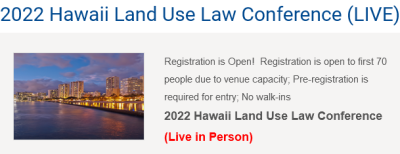
Screenshot 2022-05-02 at 11-51-57 Display event - 2022 Hawaii Land Use Law Conference (LIVE)

It’s back! After a hiatus on the in-person program, the bi-annual Hawaii Land Use Conference is back in-person (see here for a sample of one of our prior presentations at this conference).

May 25 and 26, 2022, downtown Honolulu.

The full agenda and speaker list has not yet been published, but here’s a summary

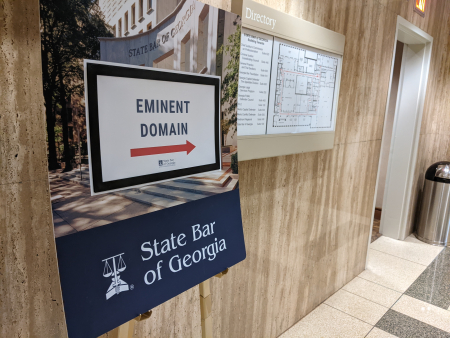
PXL_20220422_171653637

Here are the links to the cases and other materials that we talked about last Friday at the Georgia Bar Association’s annual Eminent Domain Conference. Our talk was entitled “It’s the Chief Justice’s Property World, We Just Live In It: National Trends in Takings, Property, & Eminent Domain,” and was part of

Not too long ago, we posted the Fifth Circuit’s panel opinion in a case where the court held that there’s nothing a federal court can do if a local government does not pay a state-court just compensation judgment. We filed an amicus brief in that case arguing “[t]he Takings Clause does not permit the Sewerage

Here’s an issue that we’ve been following for a while. What will a court do when a condemnor is ordered to pay (the property owner has a judgment in hand), but the condemnor says “no thanks”?

The latest incarnation is the U.S. Court of Appeals’ opinion in Ariyan, Inc. v. Sewerage & Water Board

When you are building a sewer, grading is important. Otherwise, the stuff might not “flow” correctly, if you get our drift. Okay Public Works Authority built a sewer, and guess what? “The work performed by OPWA caused extensive damage” to private property, and the “lines installed by OPWA had not been properly graded.”

Not good.

CedarpointPRELcoverpage

Thank you to the editors over at The Practical Real Estate Lawyer for publishing my missive on Cedar Point Nursery v. Hassid, the U.S. Supreme Court’s recent blockbuster regulatory takings decision (and for letting me post a copy of the article here so it is available even if you are not a PREL subscriber).

Screenshot 2022-02-15 at 07-42-11 Eminent Domain Reports - Publications IRWA

Check this out: the International Right of Way Association’s Real Estate Law Committee produces twice-a-year reports “which contain summaries of eminent domain decisions and legislation within the United States.” (This is the “international” right of way association, so that last qualifier is important.)

And what is really nice is that they make the report available

PXL_20220127_144224442

After a two-year absence in which we went remote, in the last week of last month (our usual spot on the calendar, between the playoffs and Super Bowl), we once again met in-person for the American Law Institute-CLE Eminent Domain and Land Valuation Litigation Conference.

Approximately 200 lawyers, judges, legal scholars, appraisers, law students