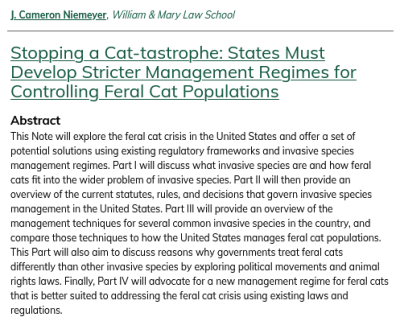
Check this out, a new student note published in the latest edition of the William and Mary Environmental and Policy Review, J. Cameron Niemeyer, Stopping a Cat-tastrophe: States Must Develop Stricter Management Regimes for Controlling Feral Cat Populations, 49 Wm. & Mary Env’t L. & Pol’y Rev. 739 (2025).

2025
“There’s no doubt about it – The Castle is the best Aussie movie of all time”
Readers of this blog are surely familiar with the soft spot we have in our heart for the Australian film, “The Castle.”
We described it as “Kelo Down Under,” noting that despite its comic spin, the film accurately portrays why owners of property object to eminent domain (in Australia, “compulsory…
Still Time To Register: 2025 Texas Eminent Domain Conference (Houston), August 14-15, 2025
Houston Says ‘Welcome!’ – What Happens When Another City Has No Zoning?
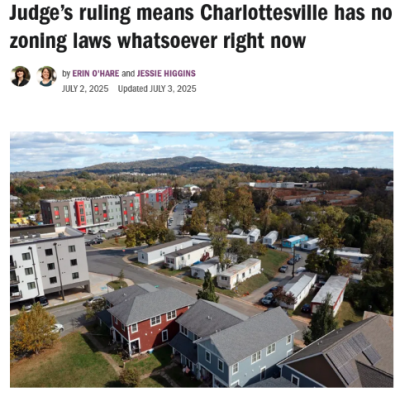
This interesting — and kind of funny — story has been circulating: “Judge’s ruling means Charlottesville has no zoning laws whatsoever right now.”
What happened? Is the counter-Euclid revolution underway? Did the judge rediscover Nectow? Did Charlottesville voters decide to go Full Houston?
No, nothing quite as dramatic. The story…
Michigan: Gov’t Can’t Avoid A Rafaeli Taking Just By Having A Proxy Do It
Here’s the latest in an issue we’ve been following for a long time.
In Jackson v. Southfield Neighborhood Revitalization Initiative, No. 166320 (July 16, 2025), the Michigan Supreme Court re-confirmed its ruling in Rafaeli v. Oakland County, that the government “keeping the change” after liquidating property to satisfy a delinquent tax debt…
Tex App: Challengers Likely To Succeed On Due Course Of Law Claim For Short-Term Rental Ban
In City of Dallas v. Dallas Short-Term Rental Alliance, No. 05-23-01309-CV (July 18, 2025), the Texas Court of Appeals affirmed a preliminary injunction, suspending operation of two ordinances which (1) restrict, and (2) require registration of short-term rentals in Dallas.
It’s a short opinion and up on appeal from interlocutory emergency relief, so there…
The Doohickeys – Eminent Domain Country & Western
Say hello to the country music duo The Doohickeys. They have a great sound (both country and western). Check ’em out!
With such songs as “All Hat, No Cattle” (the title track of their latest album), “I Wish My Truck Was Bigger,” “This Town Sucks,” “…
Call For Papers: “Euclid Turns 100: Rethinking an Antiquated Case and Reimagining Zoning for the Century Ahead”
With the 100th anniversary of Village of Euclid v. Ambler Realty Co. nearly upon us in 2026, we’ve put together a series of events designed to reexamine the case that set the stage for a century’s-worth of intense land use regulations and restrictions.
Are Euclid‘s assumptions and conclusions still valid? If the…
NJ: Forcing Hospitals To Lose Money To Treat Nonpaying Patients Isn’t A Taking
Here’s the latest in a case we’ve been following.
In Englewood Hospital & Medical Center v. State, No A-16-24 (July 16, 2025), the New Jersey Supreme Court rejected physical and regulatory takings claims made by hospitals which are required to treat nonpaying patients even though the Medicare reimbursements available will not cover the …
New Cert Petition In “Corner Crossing” Case: Can A Federal Anti-Fencing Statute “Preempt” A State-Recognized Right to Exclude?
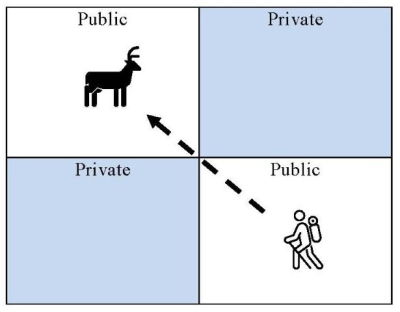
Your Mission: go from Public to Public, without invading Private
Here’s the latest in a case we’ve been following from its inception.
This is the “corner crossing” case, which as we noted here, is sure to be a mainstay in future Property Law casebooks, because the checkerboard pattern of public and private land ownership has resulted in a fascinating case. We’re not going to wait for the pocket part, and the case will almost certainly make an appearance in our William and Mary Eminent Domain and Property Rights course in the fall.
Hunters want to access the public lands. This can only be accomplished by crossing at the corners where the parcels connect as shown in the above illustration. Problem is that this cannot be done without trespassing on the private parcels. Even where the hunters go through “Twister“-like contortions to avoid touching the land or violating private airspace. Check this out:
After the Tenth Circuit held that the The private property owner has now filed a cert petition.
Before we go further, here’s the Question Presented:
Between 1850 and 1870, Congress ceded millions of acres of public land in the West to railroads in a distinct checkerboard pattern of alternating public and private plats of land. The result of Congress’s peculiar land-grant scheme is that many parcels of public land in the checkerboard are landlocked and accessible only by “corner crossing”—the act of moving diagonally from the corner of one public parcel to another, trespassing through the adjoining private property in the process.
Nearly fifty years ago, this Court unanimously rejected the government’s argument that Congress “implicitly reserved an easement to pass over the [privately-owned] sections in order to reach the [public] sections that were held by the Government” in the checkerboard. Leo Sheep Co. v. United States, 440 U.S. 668, 678 (1979). In Leo Sheep, that meant the government could not create public access to a Wyoming reservoir by clearing a dirt road that crossed two checkerboard corners—at least not without exercising the government’s power of eminent domain and paying just compensation.
In 2021, four hunters corner crossed through Iron Bar’s property to hunt on public land; Iron Bar sued for trespass. In the decision below, the Tenth Circuit recognized that, under Wyoming law, the hunters had trespassed on Iron Bar’s property. The court nonetheless held that an 1885 federal statute governing fences—the Unlawful Inclosures Act—implicitly preempted Wyoming law and “functionally” created a “limited easement” across privately-held checkerboard land.
The question presented is:
Whether the Unlawful Inclosures Act implicitly preempts private landowners’ state-law property right to exclude in an area covering millions of acres of land throughout the West.
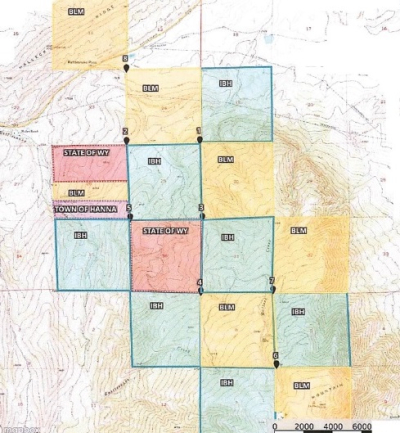
Here are the actual parcels, and some of the corner crossings at issue (again, from the District Court).

The Tenth Circuit started by noting that under Wyoming state law, corner crossings are likely actionable civil trespasses. But the court went on, concluding that the federal anti-fencing statute “preempts” state property law and prohibits the private owners from excluding the hunters. In short, the federal statute and interpreting caselaw “have overridden the state’s civil trespass regime[.]” Id.
In short, here is the Tenth Circuit’s rationale: The owners here have a right to exclude corner-crossers. But the statute says that the public has a right to access public lands, which means any private owner that is getting in the way of that — even where that owner does nothing affirmative to impede public access — is creating a nuisance.
Now the issue has been offered up for Supreme Court review. Stay tuned to see what the Court does with this fascinating case.
Petition for Writ of Certiorari, Iron Bar Holdings, LLC v. Cape, No. ___ (U.S. July 16, 2025)