July 2025

Here’s the latest in a case we’ve been following.

In Englewood Hospital & Medical Center v. State, No A-16-24 (July 16, 2025), the New Jersey Supreme Court rejected physical and regulatory takings claims made by hospitals which are required to treat nonpaying patients even though the Medicare reimbursements available will not cover the
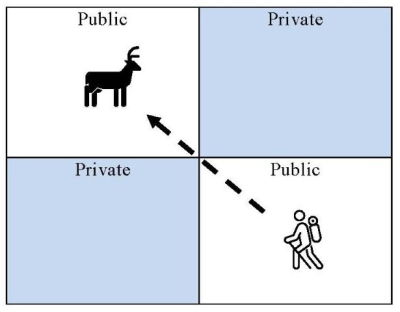
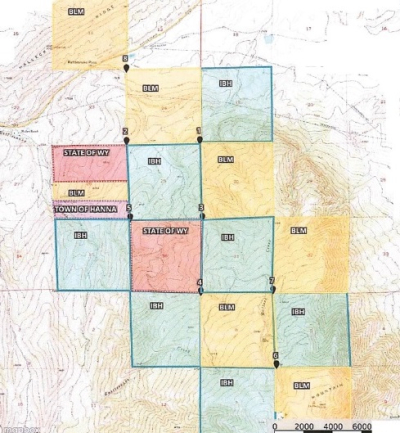
CornercrossingYour Mission: go from Public to Public, without invading Private 

Here’s the latest in a case we’ve been following from its inception.

This is the “corner crossing” case, which as we noted here, is sure to be a mainstay in future Property Law casebooks, because the checkerboard pattern of public and private land ownership has resulted in a fascinating case. We’re not going to wait for the pocket part, and the case will almost certainly make an appearance in our William and Mary Eminent Domain and Property Rights course in the fall.

Hunters want to access the public lands. This can only be accomplished by crossing at the corners where the parcels connect as shown in the above illustration. Problem is that this cannot be done without trespassing on the private parcels. Even where the hunters go through “Twister“-like contortions to avoid touching the land or violating private airspace. Check this out:

Ladders
Now that is dedication.

After the Tenth Circuit held that the The private property owner has now filed a cert petition.

Before we go further, here’s the Question Presented:

Between 1850 and 1870, Congress ceded millions of acres of public land in the West to railroads in a distinct checkerboard pattern of alternating public and private plats of land. The result of Congress’s peculiar land-grant scheme is that many parcels of public land in the checkerboard are landlocked and accessible only by “corner crossing”—the act of moving diagonally from the corner of one public parcel to another, trespassing through the adjoining private property in the process.

Nearly fifty years ago, this Court unanimously rejected the government’s argument that Congress “implicitly reserved an easement to pass over the [privately-owned] sections in order to reach the [public] sections that were held by the Government” in the checkerboard. Leo Sheep Co. v. United States, 440 U.S. 668, 678 (1979). In Leo Sheep, that meant the government could not create public access to a Wyoming reservoir by clearing a dirt road that crossed two checkerboard corners—at least not without exercising the government’s power of eminent domain and paying just compensation.

In 2021, four hunters corner crossed through Iron Bar’s property to hunt on public land; Iron Bar sued for trespass. In the decision below, the Tenth Circuit recognized that, under Wyoming law, the hunters had trespassed on Iron Bar’s property. The court nonetheless held that an 1885 federal statute governing fences—the Unlawful Inclosures Act—implicitly preempted Wyoming law and “functionally” created a “limited easement” across privately-held checkerboard land.

The question presented is:

Whether the Unlawful Inclosures Act implicitly preempts private landowners’ state-law property right to exclude in an area covering millions of acres of land throughout the West.

Here are the actual parcels, and some of the corner crossings at issue (again, from the District Court).

Signs1

The Tenth Circuit started by noting that under Wyoming state law, corner crossings are likely actionable civil trespasses. But the court went on, concluding that the federal anti-fencing statute “preempts” state property law and prohibits the private owners from excluding the hunters. In short, the federal statute and interpreting caselaw “have overridden the state’s civil trespass regime[.]” Id.

In short, here is the Tenth Circuit’s rationale: The owners here have a right to exclude corner-crossers. But the statute says that the public has a right to access public lands, which means any private owner that is getting in the way of that — even where that owner does nothing affirmative to impede public access — is creating a nuisance.

Now the issue has been offered up for Supreme Court review. Stay tuned to see what the Court does with this fascinating case. 

Petition for Writ of Certiorari, Iron Bar Holdings, LLC v. Cape, No. ___ (U.S. July 16, 2025) 

Continue Reading New Cert Petition In “Corner Crossing” Case: Can A Federal Anti-Fencing Statute “Preempt” A State-Recognized Right to Exclude?

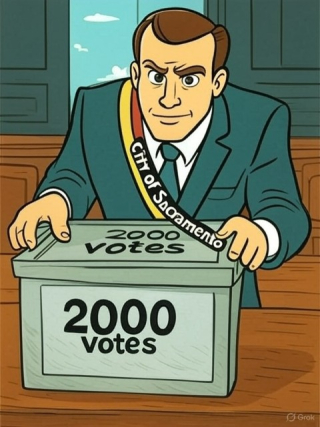
Sacto_votes

The above is the image Skynet returned when we
asked for a graphic for this post

The California Court of Appeal’s recent opinion in Dessins LLC v. City of Sacramento, No. C100644 (July 9, 2025) doesn’t deal with eminent domain or takings, but is about municipal fees and the way California requires these things

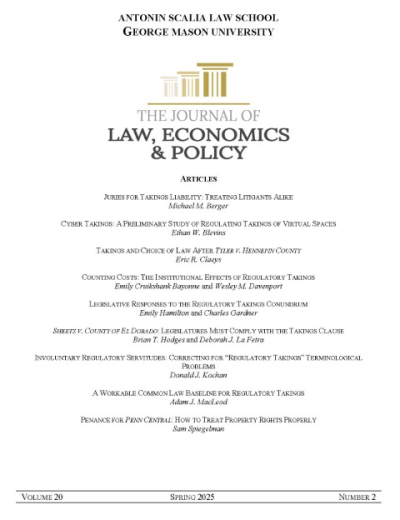
JLEPcover

Last year, we attended a conference devoted to the future of regulatory takings, hosted by the Antonin Scalia School of Law (George Mason U), and Pacific Legal Foundation.

The publisher, the Journal of Law, Economics, and Policy has released the articles and essays from that conference, and made them available here

Here’s the

Here’s the latest in a case we’ve been following.

In Idaho Power Co. v. Bean, No. 23CV12213 (July 9, 2025), the Oregon Court of Appeals reversed a trial court ruling which held that Oregon’s precondemnation entry statute, which requires “reasonable compensation” for physical damage or substantial interference with the owner’s possession or

“The Irrigation District will disavow any knowledge of your actions…”

In Hamann v. Heart Mountain Irrigation District, No. S-24-0234 (July 11, 2025), the Wyoming Supreme Court unanimously held that a state agency cannot avoid its obligation to provide just compensation when its employee causes a taking or damaging of private property, merely because the

What’s going on in the Sixth Circuit? First, there was this opinion in Howard v. Macomb County, which in our view really missed the Knick vibe and resurrected the overruled Williamson County “state procedures” requirement.

Now there’s a doubling down, OPV  Partners, LLC v. City of Lansing, No. 24-2035 (July 9, 2025).

The latest episode of the Is That Even Legal?” podcast features a familiar voice, that of former Eminent Domain Podcast host, Clint Schumacher who joins host Bob Sewell as a guest to discuss takings by eminent domain, and by overregulation. 

Clint joins the ITEL Podcast to discuss a situation that has been in

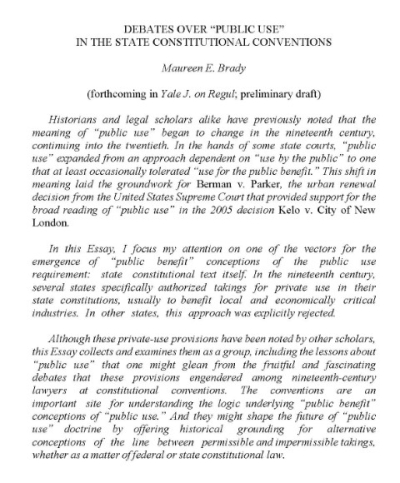
Bradyfrontpage

Be sure to check out the latest scholarship from lawprof Molly Brady, which sheds new light on the public use question in eminent domain, “Debates Over ‘Public Use’ in the State Constitutional Conventions,” forthcoming from the Yale Journal of Regulation. 

Here’s the Abstract:

Historians and legal scholars alike have previously noted that the