
Here’s one that’s been a long time coming (or coming back, more accurately).

In this recently-filed cert petition, the issue is whether an “exaction” imposed by the legislature should be subject to the nexus and rough proportionality requirements of Nollan, Dolan, and Koontz, or is merely subject to rational basis review (i.e.
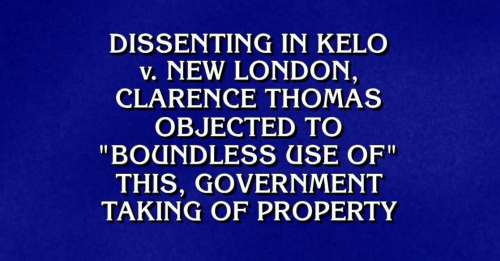
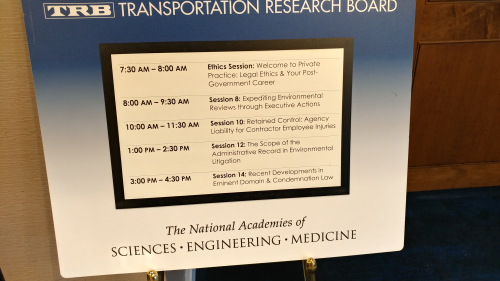
20180717_135234_HDR

Here are the cases and other items I either spoke about or mentioned at today’s Transportation Research Board‘s 57th Annual Workshop on Transportation Law in Cambridge, Massachusetts:

The plaintiffs owned mining and homestead claims on land in the Santa Fe National Forest. They claimed they own easements to access these lands, recognized by federal statutes. The government said no, these are just access rights, not easements. 

Then a fire, followed by flooding which severely damaged the Forest Service roads which the plaintiffs

Remember that case from earlier this year where the Hawaii Supreme Court held that for purposes of Hawaii’s Due Process Clause, the Sierra Club (any “person,” actually) has a property right in a “clean and healthful environment?”

We asked if that were the case, then what does that “property” right look like? For example, how

Here’s the amici brief we’re filing in an important Public Use case we’ve been following.

In St. Bernard Port, Harbor & Terminal District v. Violet Dock Port, Inc., No. 2017-C-0434 (Jan. 30, 2017), the Louisiana Supreme Court upheld the taking by the St. Bernard Port, Harbor, and Terminal District of a Mississippi River docking facility

To lawyers, the word “and” between two clauses in a statute means that the requirements of both clauses must be met (aka “conjunctive”), while the word “or” signifies that either of the requirements are enough (“disjunctive”).

So you might think that when asked to interpret whether a statute that allows pipeline companies to enter land

The Colorado Supreme Court has agreed to review a public use case we’ve been following with keen interest, Carousel Farms Metropolitan District, No. 18SC30 (July 2, 2018), one we noted was the “most interesting” such case of 2017

The Court of Appeals held that the actual purpose of the taking was private, so