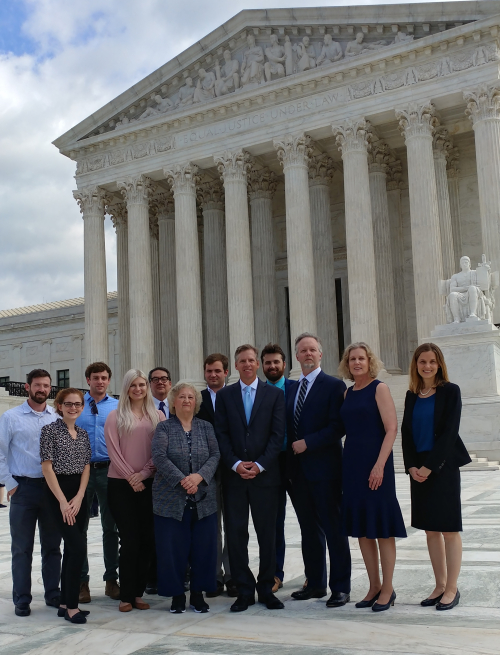
Last week, the 15th Annual Brigham-Kanner Property Rights Conference saw the gathering of legal scholars, judges, lawyers, and law students at the William and Mary Law School to award the B-K Property Rights Prize to Cardozo lawprof Stewart Sterk, followed by a day-long conference focusing on Professor Sterk’s work and the latest developments in property

Law 608’s Infinite Playlist: Takings-Related And Road Trip Songs
For the six-hour-plus roundtrip from Williamsburg to DC for last week’s SCOTUS oral arguments in Knick v. Township of Scott, the only assignment our class had — the ticket for the van ride, so to speak — was that each student was required to make two contributions to our day’s playlist. Otherwise, we’d be…
Oranges And Tangerines – The Difference Between Eminent Domain And Inverse Condemnation: Deconstructing The Knick Oral Arguments
Seeking A Cause of Action
It has been just under a century since the U.S. Supreme Court first recognized (in the modern era, that is) the regulatory takings doctrine. You might think that the intervening decades would be enough time to allow the Justices, collectively, to have figured out what a cause of action looks like.
Meanwhile Back At 1 First Street … Hot Take On The Knick Arguments
Just out of the Knick arguments. Full report to come later. But for now, these thoughts:
College of Surgeons – D.O.A. I think there’s a consensus to overrule the case to the extent it allows municipalities to remove takings cases to federal court.
San Remo – On life support. I think also that there may…
Knick Preview: Reevaluating Williamson County Ripeness With An Eight-Justice Court – Just How Badly Can SCOTUS Screw Up Takings Law?
I’m not going to do an in-depth preview of tomorrow’s Supreme Court oral arguments in Knick v. Township of Scott, No. 17-647 for several reasons.
First, a lot of others have summarized the issues already, far better than I can. See the list below.
Second, I filed an amicus brief in the case in…
NM App: Inequitable Precondemnation Activities
Been meaning to post this one for a while, because it’s on a topic that is frequently on the mind of eminent domain lawyers, but isn’t often covered by the courts: liability for inequitable precondemnation activities.
In City of Albuquerque v. SMP Properties, LLC , No. A-1-CA-35261 (Sep. 26, 2018), the New Mexico Court of…
La App: I Get By With A Little Help From My Friends – When Condemnor Testifies That “were it not for [the benefited private project], the District would not have looked at acquiring,” A Property Owner Can Enjoin A Taking
A very important public use case from the Louisiana Court of Appeals.
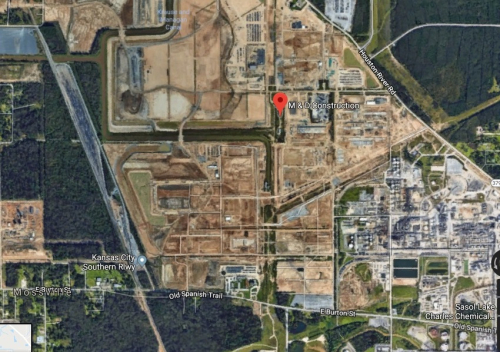
In Ryan v. Calcasieu Parish Police Jury, No. 17-00016 (Sep. 27, 2018), the court upheld a preliminary injunction issued by the trial court “barring the [Lake Charles Harbor and Terminal] District from expropriating a tract of [the Meyers’] property in Westlake Louisiana.”…
Utah: “Condemnation Clause” In Lease Terminated Tenant’s Ability To Be Compensated
“Condemnation clauses” — provisions in leases that say if the leased premises is taken, then the lease automatically terminates — are pretty common. They also “codify” the common law, which provided the same thing. These provisions also commonly allocate if and how the lessor and the lessee would divide up any compensation award (often the…
Join Us For The 36th Annual ALI-CLE Eminent Domain & Land Valuation Litigation Conference In Palm Springs (Jan 24-26, 2019)
Our colleague and co-planning chair Joe Waldo was in town yesterday, so we walked through historic Williamsburg, Virginia (cradle of the Constitution and the Bill of Rights), to invite you to join us for the 36th Annual ALI-CLE Eminent Domain & Land Valuation Litigation Conference (January 24-26, 2019, in Palm Springs, California).
4th Cir Judge In Pipeline Arguments: “Condemnation is one of those monarchy things” – Is Immediate Possession Unconstitutional When Congress Has Not Delegated That Power To A Pipeline?
Here’s the latest in an issue we’ve been following closely. In the Natural Gas Act, Congress has not delegated to private pipeline companies the quick-take power. To get around that, to get immediate possession of properties which they are taking, pipeline companies use a procedural mechanism — a preliminary injunction under Fed. R. Civ. P.