Ripeness | Knick

Here’s the first post-Murr cert petition (as far as we can tell), in a case we’ve been following. As we wrote in “The First Post-Murr Case? Fourth Circuit: No Taking Because Anti-Development Merger Regulations Actually Make Property Developable,” the Fourth Circuit concluded:

[T]he County’s regulations were run-of-the-mill zoning/land use ordinances, and thus

One word is conspicuously absent from the Federal Circuit’s opinion in Alpine PCS, Inc. v. United States, No. 17-1029 (Jan. 2, 2017): “exhaustion.”

We all know that exhaustion of administrative remedies isn’t usually required before bringing a constitutional takings claim, but make no mistake — despite the absence of the word in the opinion

 A short one, an unpublished and unsigned opinion from the U.S. Court of Appeals for the Eleventh Circuit, Warner v. City of Marathon, No. 16-10086 (Dec. 8, 2017).

As the title of this post indicates, the claims made by the plaintiff included a regulatory takings claim. The facts and details of their claims are

Here’s a case about the denominator in a regulatory takings case from July 2017, just after the U.S. Supreme Court issued its opinion in Murr v. Wisconsin. We somehow missed the opinion when it was issued, but since we think it must be the first case which attempted to apply the Murr majority’s multi-factor test

…this is might be it: Lampkins Crossing, LLC v. Williamson County, No. 3:17-cv-00906 (Nov. 14, 2017), in which the District Court dismissed substantive due process, procedural due process, and equal protection claims for not being ripe under Williamson County‘s “final decision” prong. The Williamson County case decided on Williamson County grounds.

Now, we’re

Here’s the cert petition in a case we’ve been following from the Third Circuit, Knick v. Township of Scott. 

Read more about the case’s background here. The short story is that the court concluded the Township’s ordinance which requires owners of all cemeteries, public or private, to maintain them was “constitutionally suspect,” but also held

We all know that if you are challenging a federal government action as either beyond the agency’s authority (or is unconstitutional), and as a taking, you’ve got to split your claim between a U.S. district court, and the Court of Federal Claims. The district court considers challenges to the validity of the government action, while

20170918_190120
No soup for you!

Update: our colleague Bryan Wenter has his take on one of the cases denied review here (“U.S. Supreme Court Again Declines to Consider Important Property Rights Issue Regarding the Unconstitutional Conditions Doctrine“) (“Because the current composition of the U.S. Supreme Court leans ideologically conservative by any traditional measure and

The complete agenda and faculty list has now been posted on the ALI-CLE website, and early registration is open! Go now and reserve your spot. 

We paid a visit to Charleston recently, the venue for our January 2018 conference, to scout it out. We can report that we’re going to have a great time

ALI-CLE2018

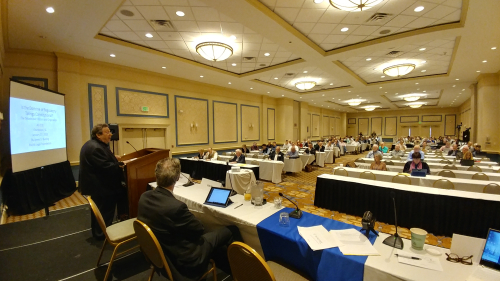
It’s not too early to reserve your spot at the 35th Annual ALI-CLE Eminent Domain and Land Valuation Litigation Conference, to be held at the Francis Marion Hotel in historic downtown Charleston, South Carolina, January 25-27, 2018. 

We’re finalizing the Conference details, but can report that the program will, as usual, feature