
A quick one today because we’re offline (more on that later). Pacific Legal Foundation (the folks who are representing the property owner in the pending case challenging the continuing viability of the Williamson County ripeness doctrine), has posted this entry on their blog, “This monkey got his day in court. Property owners still
Some Takings Musings From The Ninth Circuit: “Prudential” Williamson County Ripeness, Interest As Property, And Rooker-Feldman…Oh My!
There’s a lot to digest in the Ninth Circuit’s opinion in Fowler v. Guerin, No. 16-35052 (Aug. 16, 2018). (We’ve been following the case, but the court’s issuance of the opinion slipped by — our thanks to a colleague for pointing it out).
The plaintiffs filed a class action alleging that state officials failed
Federal Govt: Reject Williamson County! Property Owners Whose Property Is Taken By Local Governments Should Be Able To Enforce Fifth Amendment Rights In A Federal Forum
We already knew from its amicus brief brief that the federal government supported the property owner in Knick v. Township of Scott, No. 17-647, the case in which the US. Supreme Court agreed to review the continuing validity of the “state procedures” rule of Williamson County Regional Planning Comm’n v. Hamilton Bank, 473
Links And Materials From Today’s Transportation Research Board Session
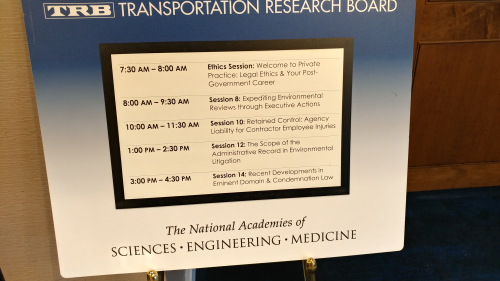
Here are the cases and other items I either spoke about or mentioned at today’s Transportation Research Board‘s 57th Annual Workshop on Transportation Law in Cambridge, Massachusetts:
- The Colorado public use cases: public use vs. public purpose: Lafayette and Carousel Farms
- On the Supreme Court docket: Violet Dock Port (SCOTUS, Louisiana)
- The Louisiana Supreme
Fed Cir: Takings Claim For Loss Of Access To National Forest Land Not Ripe
The plaintiffs owned mining and homestead claims on land in the Santa Fe National Forest. They claimed they own easements to access these lands, recognized by federal statutes. The government said no, these are just access rights, not easements.
Then a fire, followed by flooding which severely damaged the Forest Service roads which the plaintiffs
New Cert Petition: The Other Williamson County Ripeness Test, Intentional Precondemnation Value Depression
Here’s a cert petition we’ve been waiting to drop, in a case we’ve been following out of Florida.
In Town of Ponce Inlet v. Pacetta, LLC, No. 5D14-4520 (Fla. Dist. Ct. App. June 16, 2017), the Florida District Court of Appeal reversed a Lucas takings verdict, concluding the case might not even be ripe
Fifth Circuit: Williamson County Doesn’t Require District Court Dismiss Due Process Or Takings Claim
A short, but published, opinion from the U.S. Court of Appeals for the Fifth Circuit.
In Archbold-Garrett v. New Orleans, No. 17-30692 (June 22, 2018), the court held that the plaintiffs’ Fourth Amendment, Fifth Amendment, and Fourteenth Amendment claims (search and seizure, compensation, and procedural due process) were ripe for federal court, even though
Takings Ripeness Of Apparent Interest: Eighteen—18!—Amicus Briefs In Knick. Here’s Your Rundown.
A quick check of the Supreme Court’s docket in the Knick v. Township of Scott case shows that no less than 18 amici briefs have been filed top side. Not all of them in support of the Petitioner mind you (two, the briefs of the United States and of the American Planning Association, are in
Our Knick Amicus Brief: Monkey Selfies Can Get To Federal Court, But Not Fifth Amendment Takings?
The main point we’re trying to make in the amici brief we are filing today on behalf of Citizens’ Alliance for Property Rights Legal Fund in Knick v. Township of Scott, No. 17-647 (cert. granted Mar. 5, 2018), is that the average property owner simply cannot fathom why—if a state or local government has taken
Knick Brief On The Merits: Time To Ditch Williamson County‘s State Exhaustion Requirement
Here’s the Petitioner’s Brief on the Merits in Knick v. Township of Scott, No. 17-647, the case in which the Supreme Court is being asked to revisit our old nemesis, Williamson County‘s “state exhaustion” requirement, a doctrine which tells takings plaintiffs that they cannot press a takings claim against state or local governments