
If there’s a silver lining in the U.S. Court of Appeals for the Sixth Circuit’s opinion in Slaybaugh v. Rutherford County, No. 23-5765 (Sep. 3, 2024), a case about what we call “SWAT takings” (police destroy someone’s property in order to dislodge a criminal suspect), it’s that the court did not adopt
Comity Of Errors: CA11 Chooses Nondisruption Of State’s Administrative Process Over Constitutional Right To Compensation
In Turner v. Jordan, No. 22-13159 (Sep. 17, 2024), the U.S. Court of Appeals for the Eleventh Circuit held that even though the federal courts have jurisdiction over Turner’s takings claim, the court nonetheless has the discretion to choose to wash its hands of the case in order to protect a state’s administrative procedures.
Guns N’ Encloses: While Figuring Out Gun “Sensitive Places,” CA9 Backhandedly Upholds The Right To Exclude
The gunfight at the OK Corral is about all we know
about bearing arms in public places.
There’s a lot going on in the U.S. Court of Appeals for the Ninth Circuit’s opinion in Wolford v. Lopez, No. 23-4356 (Sep. 6, 2024), and none of it is about takings, at least directly. And the
Court To Phoenix: Clean Up Your Act!
A frequent vibe in cases where a member of the public asks a court to compel a local government to do something about an undesired land use (i.e., “the city should stop my neighbor from illegally renting their property,” or “the police should remove the pop-up unlicensed food stand on the sidewalk in
Michigan, Over Dissent, Declines To Hear Co-19 Shutdown Takings Case
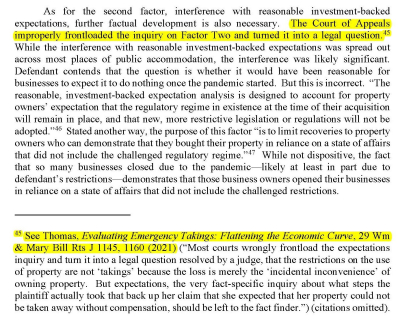
In this Order, the Michigan Supreme Court declined to consider a case which challenges the Michigan governor’s Co-19 shutdown executive orders, which, in the words of the dissenting Justices, reached “nearly every aspect of life in our state.”
There have been a lot of cases asserting that Co-19 shutdowns are takings, with most (
S Dakota: Only Way To Read Precondemnation Entry Statute Constitutionally Is Allowing “minimally invasive superficial inspections” and “minor soil disturbances”
This would not be authorized.
Here’s the latest in an issue that found new vitality after the U.S. Supreme Court’s decision in Cedar Point affirming that government-authorized physical entry to private property is presumptively a taking.
This is the “precondemnation entry” issue in eminent domain which several courts have addressed:
Back To School For Dirt Law @ William & Mary, Season VII

Yes, the mysterious ducks remain — and seem to have multiplied.
It’s that time of the year again. Fall’s-a-coming, and that means that starting today, we’re back at the William and Mary Law School in Williamsburg, Virginia to lead two courses:
- Eminent Domain and Property Rights (W&M is one of the few law schools
Book Launch Event, Aug 13, 2024: Jim Burling, “Nowhere to Live: The Hidden Story of America’s Housing Crisis”

If you are in the California Southland (or plan to be in the next week), please be sure to reserve on your calendar Tuesday, August 13, 2024, to join us in-person for the launch of our colleague Jim Burling‘s forthcoming book, “Nowhere to Live: The Hidden Story of America’s Housing Crisis.”
Govt: We Were Really Really Really About To Pay…Until You Forced Us To Pay! Sewer Board Seeks Rehearing In Self-Executing Just Comp Case

Just a few posts ago, we put up the Louisiana Supreme Court’s opinion in a case where property owners obtained a final inverse condemnation judgment ordering the New Orleans Sewer Board to pay just compensation.
Then…crickets. The sewer board did not satisfy the judgment. It relied on a provision in the Louisiana Constitution
Blight Slight: No Taking Of Property For “The Proposed Project” When No Project Has Been Proposed
You all have likely seen ’em, those “We Buy Houses Any Condition” billboards letting the world know that no matter what condition it might be in, there’s an outfit that says it is willing to buy your house.
Well, that outfit ran into the one other outfit that is willing to buy your house