
Check this out, the Complaint we filed a couple of weeks ago in the U.S. District Court for the Western District of Virginia, in Grano v. Rappahannock Elec. Coop., No. 3:20-cv-00065-NKM (W.D. Va. Oct. 28, 2020).
It’s not a true “takings” case because the claims for relief are limited to due process and Contract

Join us next Tuesday, November 10, 2020 at 3pm ET (12 noon Pacific) for the free webinar “Shutdowns, Closures, Moratoria, and Bans,” produced by Pacific Legal Foundation and Owners’ Counsel of America.
Along with my colleagues Leslie Fields (Executive Director, OCA), and Jim Burling (PLF), I’ll be talking about the legal foundations for

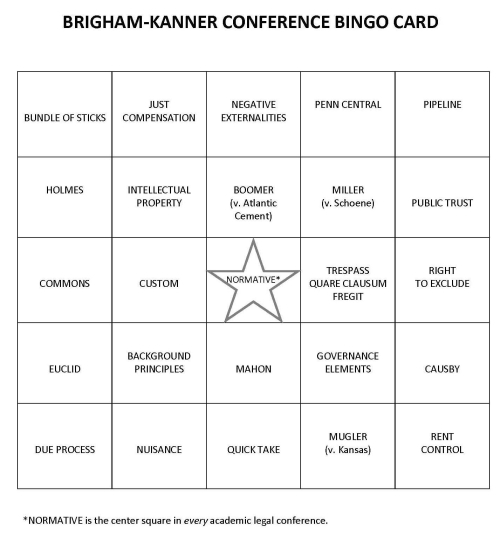
In case you missed any part of it: the recordings of the recent 2020 Brigham-Kanner Property Rights Conference are now available.
Go here for the descriptions of the panels, speakers, and links to the recorded sessions.
This year’s conference, held on October 1-2, opened with the Brigham-Kanner Property Rights Prize being awarded to Professor
When an opinion starts off with “[t]his case offers a feast of legal issues – ranging from procedural to constitutional – but its main course is a cautionary tale to government entities: they must follow the exact statutory requirements for bringing a condemnation action[,]” you just know that you have to read the entire thing.
We all know that despite the heightened Twombly/Iqbal federal pleadings standard, that it doesn’t mean a whole lot if a complaint survives a 12(b)(6) motion to dismiss. All this means that the court thinks it is plausible that the complaint states a claim. And that the plaintiff gets to keep going. That’s it.
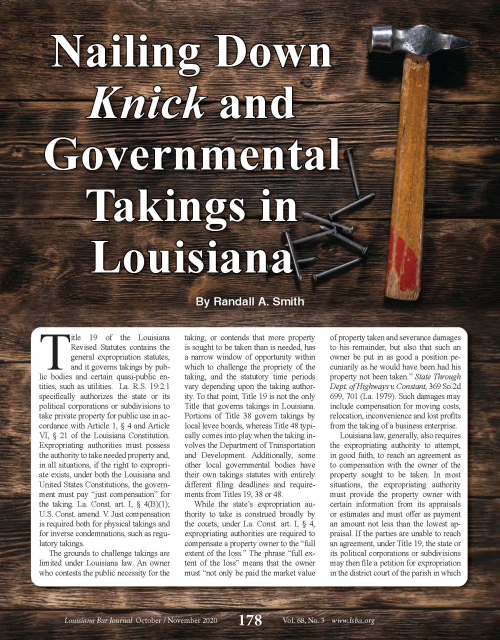
Check this out, a quick read from our New Orleans colleague Randy Smith, his article from the current edition of the Louisiana Bar Journal, “Nailing Down Knick and Governmental Takings in Louisiana.“
Therein, he tells the story (inter alia) of Violet Dock Port (see here and here for two
We have looked through the entire judicial and scholarly oeuvre of SCOTUS nominee Judge Amy Barrett, who today is continuing to run the gauntlet of the Senate Judiciary Committee. Naturally, our scanners were searching for any of her decisions or writings that might give us some clue how a “Justice Barrett” might treat takings and
In between talking about eminent domain-y songs, the goofy cult film “Snakes on a Plane” (yes, we really do have a cast-signed poster of that film in our office), and other fun stuff, we returned to the Pendulum Land Podcast for part II of our guest spot, where we also discussed Virginia