

Photo of Robert H. Thomas

Robert H. Thomas

Do we really need to tell you how a rent control regulatory takings claim fared in the Ninth Circuit? We didn’t think so.

In Colony Cove Properties, LLC v. City of Carson, No. 16-562655 (Apr. 23, 2018), a three-judge panel reversed a district court jury verdict which concluded that the City was liable for
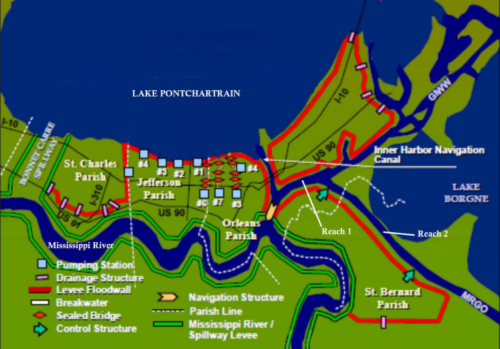
MRGO

When you a federal takings plaintiff in the Federal Circuit and you pull Judge Timothy Dyk on your panel, your heart sinks. More so when he aggressively questions you in oral argument. And when you see he has written the opinion, you know it’s game over at this level.

Because we can’t remember a single

Here are the cases and materials I either discussed, or planned to discuss (but ran out of time), in this morning’s session at the 32nd Annual Land Use Institute:

  • Kaiser Aetna v. United States, 444 U.S. 164 (1979) (establishing that “navigability” for purposes of regulation is different in kind from navigability for purposes

20180419_150416_HDR

We’re in Detroit the rest of the week at the Mercy Law School for the venerable Land Use Institute, now in its 32nd iteration.

Planning Chair Frank Schnidman has assembled a great faculty including out Detroit colleague Alan Ackerman (above, talking about takings liability for flooding), and we’ll be spending the time talking inverse

IMG_20180411_093027

For those of you who subscribe, check your inboxes for the latest issue of the University of Hawaii Law Review.

Most worthwhile article in our view: Adam N. Miller, Up in the Air: The Status & Future of Drone Regulation in Hawaii.  (Sidebar: Mr. Miller will be one of our firm’s summer associates

Today’s case is one of what we call “regionally classic” cases that we come across from time to time. You know, cases that just fit into all your preconceived notions about a place. Beach cases from Hawaii. Gator law opinions from Southern states. Vermont = snow law, California, land and wineries. Here’s another one

Here’s a bit passed on to us from a colleague who reads USA Today. Leading off “Justice Gorsuch confirms conservatives’ hopes, liberals’ fears in first year on Supreme Court,” is this snippet, which points out a Just Compensation case in which we represented the (denied) petitioner:

WASHINGTON – Neil Gorsuch had been a member of the Supreme Court for exactly 11 weeks when he made clear in a single day what type of justice he would be.

The court struck down an Arkansas law that treated same-sex couples differently than opposite-sex couples on their children’s birth certificates. Gorsuch dissented. 

The court refused to consider a challenge to the Department of Veterans Affairs’ system for evaluating disability claims. Gorsuch dissented.

The court declined to hear a challenge to a California law limiting who can carry a concealed gun in public. Gorsuch dissented.

And the court turned aside a challenge to the meager sum Mississippi paid when it converted a former landowner’s property into a park. Gorsuch said the justices should hear a similar case “at its next opportunity.”

Thus it was that on the last day of its 2016-17 term — as the court addressed gay rights, government power, gun ownership and government takings — Neil McGill Gorsuch announced to the legal world that he would not go along to get along.

“He came to the court more ready to jump into the deep end than a lot of recent nominees,” says Jonathan Adler, a law professor at Case Western Reserve University School of Law.

Here’s why

we thought the denial of cert in that case (and others) wasn’t necessarily a bad sign.
Continue Reading USA Today Notes Just Comp An Area Where Justice Gorsuch “Jumping Into The Deep End”

Sterk_475

The William and Mary Law School has announced the recipient of the 2018 Brigham-Kanner Property Rights Prize, Cardozo School of Law Professor Stewart E. Sterk.

He will receive the prize at the 15th Annual B-K Conference in Williamsburg, October 4-5, 2018

Sterk’s publications span a wide variety of areas, ranging from property