August 2019

The California Supreme Court’s relatively short unanimous opinion yesterday in City of Oroville v. Superior Court, No. S243247 (Aug. 15, 2019) may have a bigger impact outside of that case than within in.

While that is undoubtedly true in many decisions by a precedential court of last resort, we highlight that here because inverse condemnation is a trending topic in California right now due to the multiple litigations spawned by a series of wildfires, and the City of Oroville case is all about the details of California’s somewhat unique inverse condemnation doctrine.  
Short story is that a dentist’s office flooded with you-know-what when the municipal sewer backed up. Dentists said the City didn’t maintain the sewer (sewer systems are supposed to take crap away in a one-way direction, not return it into habitable spaces). The City for its part argued that if the dentists had only installed the

Continue Reading Cal Supreme Court: Stop Saying Inverse Condemnation Is “Strict Liability”

20180823_102346_HDR

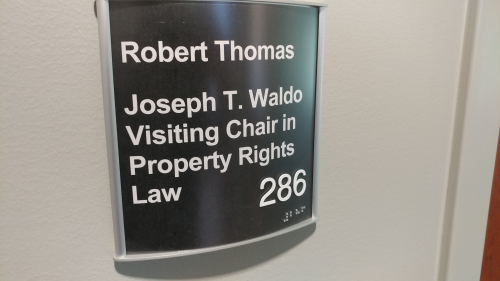
We’re about to get underway with the fall semester at William and Mary Law School, where we’re again teaching an upper-division course, Eminent Domain and Property Rights

We’ve more than doubled the size of last year’s enrollment, so it looks like the word is getting out. We cover not only eminent domain and just compensation, but takings (yes, we have a lot of new materials to cover there), civil forfeiture, a small bit of crossover with land use, local government, and related, property rights as civil rights, how property law is discussed in the public sphere, due process, and how to lawyer up these cases. And in early October, the opportunity to have some of the nation’s best property law scholars “guest lecture” during the Brigham-Kanner Property Rights Conference. Here’s the official description:

Property rights and the sovereign’s power of eminent domain have been essential components of

Continue Reading Law 608: Eminent Domain And Property Rights – Season 2

Check this out. What at first appears to be something along the lines of the grainy Zapruder film (this particular piece was recorded on video, not film, and certainly well before the days of high-res camera phones that we now take for granted) is an important piece of takings history.

It is (the late) Anthony Palazzolo driving his famous “wetlands” property, recorded after the U.S. Supreme Court issued its opinion in his favor in Palazzolo v. Rhode Island, 533 U.S. 606 (2001).

Dwight Merriam, who graciously provided the raw footage, became Tony Palazzolo’s friend after interviewing him for an article Dwight was writing on the Supreme Court decision, and they frequently met, dined together, and conversed as Palazzolo’s matter continued on remand. Dwight recorded this video from the back seat of Palazzolo’s car. In the front is John Boehnert of Providence, another longtime friend of Dwight’s and a

Continue Reading Anthony Palazzolo Drives His Property

Mark your calendars for Thursday, August 22, 2019, 2 – 3pm ET, for a free ABA program, “When the Floods and Fires Come: Landowner’s Property Damage Claims.” This session, produced by the Section of Litigation and organized by our Damon Key colleague Mark Murakami. Featured speakers are our colleagues Anthony Della Pelle (NJ), Kristen Renfro (CA), and Pepperdine lawprof Shelley Saxer (CA).

Here’s the description:

In the wake of the Superstorm Sandy, the 2017 hurricanes, and the California wildfires, landowners damaged by the disasters are faced with a confusing array of potential recovery options. This program is designed to assist small and general practice attorneys whose clients are harmed by these disasters. Anthony Della Pelle, Esq. of New Jersey and Kristen Renfro, Esq. of California will discuss the practitioner’s views and Professor Shelley Saxer of Pepperdine Law School will discuss the legal theories relating to governmental

Continue Reading Upcoming Free Program: “When the Floods and Fires Come: Landowner’s Property Damage Claims”

Quot

Don’t worry, you didn’t miss the U.S. Supreme Court issuing a major eminent domain case. Today’s post is about a decidedly older decision, Danforth v. United States, 308 U.S. 271 (1939). 

The reason we’re posting this decision now, eighty years after it was issued, is that a colleague recently passed on a note with a cite to the case. So we dusted off the opinion and read it (again). And when we did, this quote stuck out:

“Condemnation is a means by which the sovereign may find out what any piece of property will cost.”

Id. at 284.

The case involved a straight taking (not quick take). The question was when the “taking” actually takes place in such a case, and whether interest is due if the condemnor pays 100% of the adjudicated compensation when it is owed. The Court held:

Unless a taking has occurred previously in actuality

Continue Reading “Condemnation is a means by which the sovereign may find out what any piece of property will cost.”

People like to go to lakes. Lakes are nice. Especially in the summer. Especially Oswego Lake, Oregon (former name “Sucker Lake” — not an auspicious start). Problem is, most of the land surrounding the lake is private property. Some is owned by the municipality, but it limits access to residents of the municipality. 

So like in a similar New York case, a recreational kayaker who does not reside in the City sued, asserting that because the Lake is navigable, the public is allowed to access it. The lower courts agreed with the City and the owners that the general public does not have a right under either the public trust or public use doctrines to access. 

In Kramer v. City of Lake Oswego, No. CV12100913 (Aug. 1, 2019), the Oregon Supreme Court mostly agreed. But not entirely. It concluded that “neither the public trust nor the public

Continue Reading Oregon Hardens “Background Principles” Public Trust Firewall In Lake Access Case

Here is the motion asking the Hawaii Supreme Court for leave to file an amicus curiae brief (and the proposed brief) we filed earlier today in a case we’ve been following

The question is the applicable statute of limitations for regulatory takings claims under the Hawaii Constitution’s “takings or damagings” clause. The case started out in a Hawaii state court, was removed to the U.S. District Court by the State Land Use Commission. The district court dismissed the state takings claim under the statute of limitations. 

Hawaii has not adopted a statute of limitations expressly for takings or inverse condemnation claims. Thus, the question is what is the closest analogue claim. If there isn’t one, Hawaii has a “catch all” statute (six years) for civil claims. When the case reached the Ninth Circuit, that court certified the state law question limitations to the Hawaii Supreme Court. 

Our brief argues the

Continue Reading Amicus Brief: State Takings Claims Are Constitutional (Not Torts); Adverse Possession Statute Of Limitations Is Nearest Analogue

Here’s the amici brief we’re filing today on behalf of the Owners’ Counsel of America, New Jersey property owners subject to natural gas pipeline takings, the Institute for Justice, and the Cato Institute, in support of a cert petition which is challenging the federal courts of appeals which have upheld giving prejudgment possession of property to a private pipeline condemnor once a district has ruled in favor of the pipeline that it qualifies under the three predicates in the Natural Gas Act, 15 U.S.C. § 717f(h).

The issue is one we’ve covered before (in our amicus in support of an earlier petition on the same issue), but there are some new twists which make this case especially ripe for SCOTUS review. 

First, this isn’t some isolated problem, but of nationwide concern. This is at least the third cert petition recently on this subject. The problem isn’t going away.

Continue Reading New SCOTUS Amici Brief (OCA, NJ Prop Owners, IJ, Cato): Quick-Take-By-Injunction Scheme Shows Complete Lack Of Respect For The Law

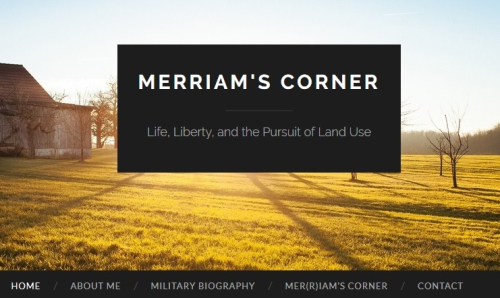
Merriamscorner

Land users and dirt lawyers know Dwight Merriam. (And if you don’t, you are not really a land user, are you?)

He’s won landmark cases (has even beaten Yours Truly in one of those cases way back in the day). Written tons of articles and books. Edits Rathkopf. Contributes to Nichols. Mentored multiple generations of land use lawyers (me included). All while serving his country in the U.S. Navy. 

Here’s your chance to tap directly into the source. Dwight has (finally) started a blog, Merriam’s Corner, about the topics we all love. 

So sign up and follow. Listen in as Dwight thinks out loud for our benefit.

Welcome to the blog world, Mr. Merriam.  Continue Reading New Land Use Law Blog To Follow: Merriam’s Corner (“Life, Liberty, and the Pursuit of Land Use”)