August 2019

Every year at this time, it seems, we’re realizing again that as you get older, you forget birthdays. Thus, it only occurred to us only over this past weekend that that this blog’s “birthday” passed without notice.

It hardly seems like thirteen years ago that we posted here for the first time. In law blog years, that’s quite a while.
Because doing this in a vacuum would not be worthwhile, we’d like to recognize those who send us items, who make comments, who gently prod with suggestions.

We’d also like to hail our fellow law bloggers who, like us, make the time to share thoughts about the legal issues of the day. Although you’re not quite “Real Men [and Women] of Genius,” today we salute you, Mr. and Ms. Law Blog Blogging Bloggers:


Continue Reading Entering Our Fourteenth Year

SupremeCourtofVirginiaBuilding

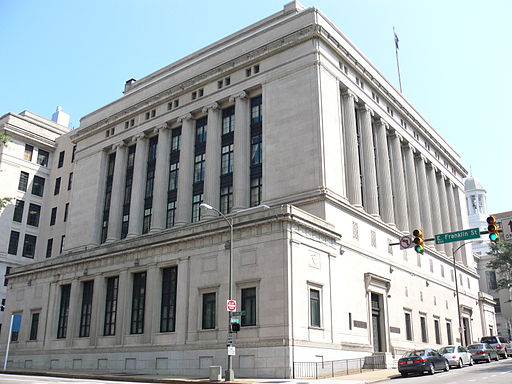
We sometimes assume that everyone gets that the point of an eminent domain valuation trial is to try to establish the price the real-world market of buyers and sellers would have arrived on for the property being taken had the transaction been voluntary. We know it is all hypothetical because this market didn’t actually exist, and the taking itself isn’t a market transaction. In fact, a taking is pretty much the opposite of a market transaction. In other words, you’re trying to recreate a market that did not in fact exist. 

To do so, you try to step into the shoes of a potential buyer of the property. What would they look at when trying to come up with a price? Would they limit themselves to the property’s present use? Maybe. But depending on the circumstances, they also might think its worth paying more than the present use for the

Continue Reading Virginia SCT: Reasonable Probability Of Rezoning Is Something The Jury Should Consider

A very short (3 pages) opinion from the U.S. Court of Appeals for the Fifth Circuit in a takings case. In Bay Point Properties, Inc. v. Mississippi Trans. Comm’n, No. 18-60674 (Aug. 27, 2019), the court somewhat cryptically concluded that a property owner who asserted that it was not fully compensated in state court inverse condemnation case, could not then sue the state DOT in federal court for the difference.

If this case sounds somewhat familiar to you, it does to us also. We were counsel for the property owner on the cert petition which the opinion mentions. See slip op. at 2 (“So the property owner, after losing on appeal in state court and unsuccessfully seeking certiorari in the U.S. Supreme Court…”). 

Read the opinion. There’s not a whole lot there, except the court concluding that yes, Eleventh Amendment immunity prevents a state from being sued in

Continue Reading CA5: Even After Knick, You Still Can’t Sue A State In Federal Court For Money For A Taking

For many years, a tenant had a month-to-month lease from Baltimore for a space in one of the city’s public markets. One day, the market sent the tenant an email informing it that it no longer “fit in the [redevelopment] plans,” and that it should “pursue other options.” The tenant took that as “get out.” And instead of digging its heels in, the tenant did what the city instructed and sought “other options.” It left.

The tenant then sued, claiming a taking. It also sought relocation benefits under Maryland’s version of the Relocation Act, which requires “[w]henever a program or project undertaken by a displacing agency will result in the displacement of any person, the displacing agency shall make a payment to the displaced person” for things like moving expenses and the cost of locating a replacement business.

The question the Maryland Court of Appeals determined in Wireless One,

Continue Reading Md On Relocation And Present Participles: Tenant’s Departure After City Told It To Get Out Was “Voluntary”

Today, we’re featuring a post written by our Tennessee colleague, economist William Wade. He writes about the Massachusetts Court of Appeals’ recent decision in Smyth v. Conservation Comm’n of Falmouth, and the more recent cert petition in that case. Bill writes and comments frequently on takings cases. See, e.g., William W. Wade, “Theory and Abuse of Just Compensation for Income Producing Property in Federal Courts: A View from above the Forest,” 46 Tex. Envt’l L. Rev. 140 (2016). 

* * * *

Smyth and Massachusetts’ “New” Penn Central Factor

William W. Wade, Ph.D.

The Massachusetts case, Janice Smyth v. Conservation Commission of Falmouth,[1] is current again. Pacific Legal Foundation lawyer J. David Breemer, filed a petition for writ of certiorari to the U.S. Supreme Court. Mr. Breemer’s petition is encyclopedic in its survey of regulatory takings cases, which demonstrates that Penn Central’s

Continue Reading Guest Post: An Economist Looks At Takings Law – Smyth And Massachusetts’ New Penn Central Factor

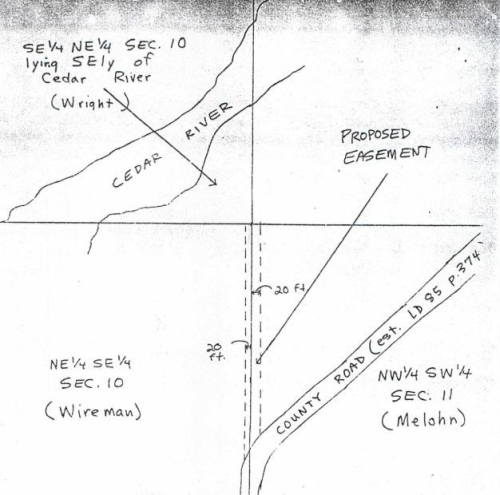
181437_RAGSDALE_v_WIREMAN_2151A2F856C99

Here’s an interesting twist on the process which, in some states, recognizes the ability of one private owner to condemn the property of a neighbor. Most often this arises when a landlocked parcel exercises eminent domain to take the property of a neighbor for access.

It always struck us a little odd that the sovereign power to take property for the public use or a public purpose can be used by private party A to involuntarily acquire the private property of B. These statutes operate somewhat like common law easements by necessity, so we never gave them that much thought. But over the years, we’ve seen some interesting cases from Pennsylvania (private takings still must serve a public purpose) and Colorado (condemning owner must have concrete development plans), for example. 

The unusual twist in the Iowa Court of Appeals’ opinion in Ragsdale v. Wireman, No. 18-1437 (Aug. 21, 2019)

Continue Reading “Private” Condemnors: Be Careful What You Wish For (You Might Just Get It)

Here’s the Brief in Opposition in a case (and issue) we’ve been tracking for a while (including filing several amicus briefs along the way, including this one). The BIO is the pipeline’s response to the cert petition on the question of whether  

Brief in Opposition to Petition for Writ of Certiorari, Givens v. Mountain Valley Pipeline, LLC, No. 19-54…

Continue Reading BIO In Pipeline Quick-Take-By-Injunction Case: The Injunction Is Correct, And It Is Too Late To Do Anything About It Because We’re Already Building

ALI Nashville 2020

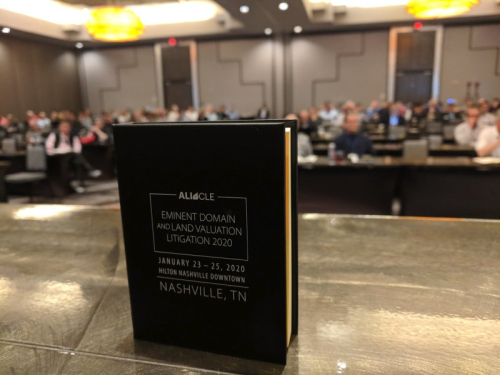
The final agenda and faculty list will soon be officially published, but we wanted to give you a preview of what is in store at the ALI-CLE Eminent Domain and Land Valuation Litigation Conference, January 23-25, 2020, at the Nashville Hilton (downtown, just a few steps away from everything that Nashville has to offer). 

Don’t miss out: in recent years, we’ve been at-or-near capacity, and the conference hotel has even sold out a couple of times. Visit the ALI-CLE website to register and hold your space

Here are some of the things we’ll be discussing: 

  • Making Sense of the New Rules After Knick v. Township of Scott: Where Do I Go, What Do I Do?
  • The Missing Link in Valuing Fixtures
  • When a River Runs Through it: Water Rights and Takings
  • Responding to Project Changes: Valuation When Government Action is Ongoing
  • Property Rights as Civil Rights: Seeking Justice Through


Continue Reading Get Ready: The 2020 ALI-CLE Eminent Domain And Land Valuation Litigation Conference Agenda Coming Soon

IMG_20170810_183940
You know where this is. 

Here’s the cert petition filed recently in a case we’ve been tracking. (See also this guest post by economist Bill Wade about that case.)

As the above photo tells you, this one is going into what may the last truly unexplored frontier of regulatory takings law, the details of the ad hoc Penn Central test, the “default” test in most situations where the regulation does not wipe out all economically beneficial use (Lucas), doesn’t physically invade the property (Loretto, Kaiser Aetna), or doesn’t render useless a fundamental attribute of property (Webb’s Fabulous Pharmacies). 

In all but those situations, the Court has told us to apply the multifactor three-part (or as Professor Steve Eagle argues, the four-part) test from Penn Central. But only in a few cases have property owners successfully navigated that minefield to

Continue Reading Hic Sunt Dracones – New Cert Petition Argues Penn Central Results In “Inconsistent,” “Unprincipled,” “Amorphous,” “Illegitimate” Decisions

Here’s what we are reading this Tuesday:


Continue Reading Tuesday Takings Round-Up: Alien Takings; Zombies; Kelo, Philippines-Style; Kafka