Police Power

Virginia eminent domain 2025

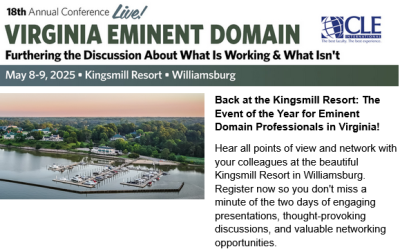
Virginians: now is a good time to register for the Virginia Eminent Domain Conference, May 8-9, 2025, at the Kingsmill Resort in Williamsburg.

We have spoken and attended the Conference in past editions, and can report that it is excellent. We’re looking forward to joining friends and colleagues again in The Burg in the

1992 Aerial Photo Island2
Shands Key, with the City of Marathon in the background

This just in: in Shands v. City of Marathon, No. 3D21-1987 (Fed. 5, 2025), Florida’s Third District Court of Appeals sitting en banc held that the city’s downzoning of property (Shands Key, shown above in an exhibit from the Key West trial we participated

The facts in D.A. Realestate Inv., LLC v. City of Norfolk, No. 23-1863 (Jan. 16, 2025), a recent decision from the U.S. Court of Appeals for the Fourth Circuit, are fairly sympathetic. And the opinion starts off with a tantalizing quote:

In 1761, Massachusetts lawyer James Otis exclaimed “one of the most essential branches

Screenshot 2024-12-09 at 16-13-02 Involuntary Regulatory Servitudes Correcting for “Regulatory Takings” Terminological Problems by Donald J. Kochan SSRN

Check this out, a new SSRN posting by lawprof Donald Kochan (George Mason/Scalia Law).

If this one is not a direct sequel to his earlier work on re-branding the “takings clause” (a piece we think is excellent and is part of the materials we teach in our Eminent Domain course at William and Mary Law), it does at least seem like a spiritual successor.

Here, Professor Kochan suggests that we’re being unclear when we use the term “regulatory takings” to describe those instances where an exercise of some governmental power other than eminent domain results in what feels like an eminent domain taking from the property owner’s viewpoint.

Instead, he argues, we should focus on the burdens the regulations place on an owner’s use (what the common law described as a servitude). To us, that seems very consistent with the Supreme Court’s approach, and proposals from other commentators. And it does focus the inquiry on the right question, namely what effect has a regulation put on an owner’s property rights. As that suggests, this should be a property-centric inquiry, and not on such unknowables such as the “character of the government action,” or whether an owner has “distinct investment-backed expectations.”

Here’s the Abstract:

This essay challenges the use of the term “regulatory takings” in our takings jurisprudence and scholarly discussion. The words we choose when developing doctrine matter. They can, even subconsciously, affect—by reducing, enlarging, distorting, limiting, or accurately shaping—the perceived and functional quality and character of the things they describe.

The better way to frame the inquiry underlying what is often called regulatory takings law should be to determine not whether there is a “regulatory taking” – some special kind of taking – but instead whether there is a regulation that amounts to a taking. Segmenting the judicial treatment of regulatory effects into a specialized analysis that takes it farther and farther away from an enterprise focused on equivalency between the private law of voluntary servitudes and the public law of what we should be calling involuntary regulatory servitudes. Regulations that restrict some but not all sticks in the property rights bundle should be characterized as the involuntary equivalent of the voluntary instrument, mechanism, or transfer that would have been necessary to achieve a parallel result. The essay proposes an alternative test for determining whether a regulation should be deemed a taking based on a comparison between the effect on the bundle from the regulation and determining whether the same effect in the private marketplace would have required a consensual, mutually beneficial exchange with appropriate compensation. This would better serve the meaning and purposes of the so-called Takings Clause.

The essay also documents the usage history of the regulatory takings label. To be sure, “regulatory takings” was not a dominate part of the takings lexicon before 1981. The first law review publication available in Westlaw to use the term “regulatory takings” is from 1965. The first court opinion to use the term came in a footnote in 1977. Briefing in advance of the 1980 U.S. Supreme Court decision in Agins v. Tiburon involved significant invocations of “regulatory takings” language across nearly a dozen briefs. But, the U.S. Supreme Court in its Agins opinion never uses the phrase “regulatory takings.” The first major court opinion to use “regulatory takings” language is the dissenting opinion by Justice William Brennan—joined by Justices Stewart, Marshall, and Powell—in the 1981 case of San Diego Gas & Elec. Co. v. City of San Diego. And, the Brennan dissent may have entrenched the term in the takings lexicon and is likely the impetus for widespread adoption of the term after 1981.

A must-read for all you takings…uh, dirt law…mavens.
Continue Reading New Article (Donald Kochan): “Involuntary Regulatory Servitudes: Correcting for ‘Regulatory Takings’ Terminological Problems”

Screenshot 2024-11-04 at 12-34-18 Texas Supreme Court
Charles McFarland, arguing.

Here’s the latest in a case we’ve been following closely (and disclosure: our firm filed an amicus brief in the Texas Supreme Court).

In The Commons of Lake Houston, Ltd. v. City of Houston, the Texas Court of Appeals held that the city could not be liable for a taking

Screenshot 2024-10-11 at 08-06-50 RPFSS

Hawaii lawyers (and those barred in the 808), take note: On October 21, 2024, the Hawaii State Bar Association will hold its annual Convention, and as always there’s a full lineup of CLE programs so you can meet your MCLE requirements.

Thanks to the Real Property & Financial Services Section, there’s a significant dirt law

If there’s a silver lining in the U.S. Court of Appeals for the Sixth Circuit’s opinion in Slaybaugh v. Rutherford County, No. 23-5765 (Sep. 3, 2024), a case about what we call “SWAT takings” (police destroy someone’s property in order to dislodge a criminal suspect), it’s that the court did not adopt