Municipal & Local Govt law

Check out the U.S. Court of Appeals for the Sixth Circuit’s opinion in Harrison v. Montgomery County, No. 20-4-51 (May 11, 2021). It’s short, readable. And, most importantly, involves a subject that’s near and dear: takings, and the myriad potential traps that await an unsuspecting property owner making such a claim.

If you’ve ever
R.S. Radford’s most-recent article, Knick and the Elephant in the Courtroom: Who Cares Least About Property Rights? in the latest issue of the Texas A&M Journal of Property Law, should be next on your to-read list. 

Here’s the summary of the article:

Throughout the thirty-four-year history of Williamson County, one fact was taken for

What’s up with that (sorta) snarky headline, you ask? After all, isn’t the PennEast v. New Jersey case, heard yesterday by the Supreme Court, a real honest-to-goodness eminent domain case about a pipeline?

Doesn’t the transcript show terms like “in rem,” “takings,” “eminent” and “eminent domain” were used a whole lot? Aren’t a lot of

Order

This In Chambers Order recently issued by a federal district judge may just be the most unusual, flat-out wild judicial opinion we have ever read.

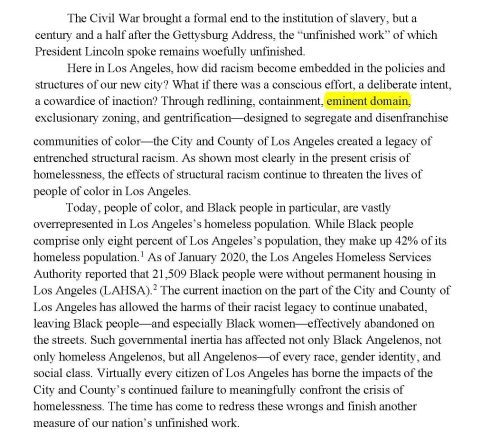
Citing the Gettysburg Address, Brown v. Board of Education, systemic racism (including eminent domain) systemic sexism, and a slew of newspaper articles, the Central District of California (without even

IMG_20180720_152126_1

Under a Massachusetts statute, local redevelopment agencies have the power to respond to “decadent, substandard, and blighted open areas” either by creating an urban renewal project (redeveloping an area pursuant to a “detailed” and “comprehensive” plan; the statute expressly includes the power of eminent domain for urban renewal projects), or by a “demonstration” development (a

IMG_4261
Come at me!
(Bolick, J., dissenting)

We have a Wexis alert for “Kelo,” because that’s one of the ways we keep up on the latest developments in this area. That alert doesn’t ping all that often, so we were all excited when yesterday, we received an alert notifying us of the Arizona Supreme

In which we join the Pendulum Land Podcast (again, thank you hosts!) to talk about the Virginia Supreme Court’s recent opinion in Johnson v. City of Suffolk, the case we label the “oyster takings” case in which Hampton Roads oystermen claimed that their property was taken when the City of Suffolk and the Sanitation

PICT1199

Here’s the recorded arguments.

  1. California will try and push the Court to seeing this as an “anti-union” lawsuit: this is not that big of an intrusion, we’ve been doing it for 50 years under both Cal and federal law, and a ruling for the property owners will upset this apple cart and prevent unions

Dig this: property owners assert that the County’s right of way dedication ordinance is an unlawful exaction. You know the drill – logical nexus, rough proportionality, etc. Nollan, Dolan, Koontz. Here’s the short story: the owners sought subdivision plat approval without the dedication for public roads required by the ordinance. No deal. The County’s process

We don’t usually post trial court rulings, but this one is very interesting, so we’re going to break our own rule.

New Orleans had a traffic camera program. Not popular, we’d suppose. People who were caught on camera brought a class action suit in Louisiana state court, arguing that the city didn’t have the legal