Court of Federal Claims | Federal Circuit

0116190650b_HDR

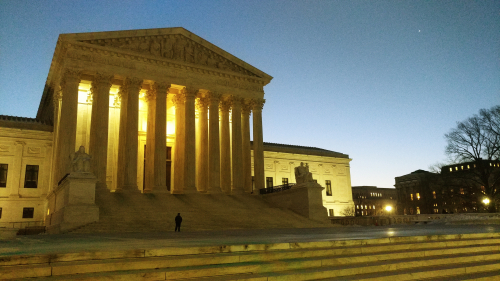
As Professor Gideon Kanner likes to remind us, eminent domain has been characterized as “the dark corner of the law.” We thought back to that phrase when we joined the queue outside of the Supreme Court this very dark (and very cold) morning, for the rehearing in the Knick v. Township of Scott case

Our final 2018 post focused on what we thought was the biggest case of that year, and which, we’re predicting, will be the biggest case of 2019: Knick v. Township of Scott, No. 17-647, that’s the one in which the Supreme Court is considering whether federal takings claims can be brought in federal court

We’re going to end 2018 with the latest in what we think was the most important issue of the past year (and which, we predict, will be the most important case in takings law for at least a decade when it likely gets decided in 2019), Knick v. Township of Scott, No. 17-647.

That

1126181629e_HDR

We’re almost there, but we still have room remaining. At the 2018 Conference in Charleston, we both sold out the registrations and the conference hotel, so we planned ahead for the upcoming 2019 Conference in Palm Springs at the Renaissance Palm Springs Resort

Register here. You will also be able to download

Reading the fact section of the Federal Circuit’s recent opinion in Katzin v. United States, No. 16-2636 (Nov. 19, 2018), will make your eyes glaze over. It’s all about some property on an island near Puerto Rico, and is full of maps, diagrams, history, and even a photo of some “Keep Out” signs the

Get ready. In this and upcoming posts, we’re going to be featuring the items on our agenda for the upcoming ALI-CLE Eminent Domain and Land Valuation Litigation Conference, January 24-26, 2019, in sunny Palm Springs, California. 

ALI-CLE has released the brochure, which those of you on the mailing list should have received —

Retroactive continuity — or “retconning” — is, according to that authoritative source Wikipedia, a “literary device in which established facts in a fictional work are adjusted, ignored, or contradicted by a subsequently published work which breaks continuity.”

For example, compare the real-world explanation for why the 1960’s Star Trek show’s Klingons didn’t have

MRGO

Here’s the amici brief filed late last week on behalf of a lot of us (me included, check it out) in the MR-GO case we’ve been following closely ever since it was filed in the Court of Federal Claims.

That court concluded the Corps of Engineers built MR-GO (the Mississippi River-Gulf Outlet) shipping channel, essentially