
We’ve been meaning to post the U.S. Court of Appeals for the Sixth Circuit’s opinion in Barber v. Charter Twp of Springfield, No. 20-2298 (Apr. 11, 2022) for a while because it emphasizes an important point about “final decision” ripeness, and the sometimes ridiculous arguments made to support an argument that a takings claim
The Keepings Clause: CA5 (Again) Throws Up Its Hands When Local Gov Refuses To Pay Back Money It Owes
Its deja vu all over again: like it did just a short while back, in Lafave v. City of New Orleans, No. 21-30358 (June 1, 2022), the U.S. Court of Appeals for the Fifth Circuit once again has rejected a takings claims “based on the city’s failure to honor a judgment of the
CA7: Like Other Circuits, We’re Going To Dodge The Judicial Takings Question
Here’s one we’ve been following since its inception, even before we joined the law firm that represents the property owner. (And because our Pacific Legal Foundation colleagues are repping the plaintiffs in this one, we won’t be commenting in-depth.)
You may remember that in Gunderson v. Indiana, 90 N.E.3d 171 (Ind. 2018)
District Court: City Liable For Physical Taking For Destroying Home While Apprehending A Criminal
Here’s a pretty rare one: a trial court entering summary judgment on liability in favor of the property owner in a takings case. Yes, you read that right.
And to top it off, this ruling comes in a case in which the taking alleged was a police invasion and destruction of a home for the
“Something is very wrong with this picture.” Cal Ct App Calls Out CEQA (“fearsome weapon”), Tiburon’s “official hostility,” And “combined animus of two levels of local government”
Anyone who reads this blog regularly knows Tiburon, California, even if you’ve never stepped foot there. Yes, that Tiburon. Well, the beat goes on: the Agins litigation wasn’t the only time that the town and its residents combined forces to try and draw up the drawbridge and prevent the building of more
Hawaii Land Use Law Conference, May 25-26, 2022, Honolulu – Join Us!
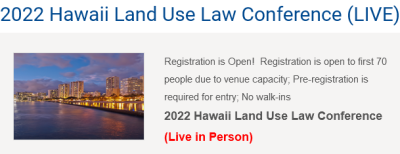
It’s back! After a hiatus on the in-person program, the bi-annual Hawaii Land Use Conference is back in-person (see here for a sample of one of our prior presentations at this conference).
May 25 and 26, 2022, downtown Honolulu.
The full agenda and speaker list has not yet been published, but here’s a summary
New Article (Bethany Berger): “Property and the Right to Enter”
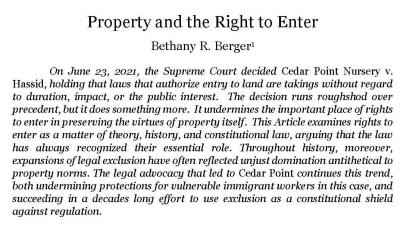
A new article by lawprof Bethany Berger, “Property and the Right to Enter,” criticizing the Supreme Court’s ruling in Cedar Point Nursery. The article builds on the amicus brief in the case, also authored by Prof Berger.
Here’s the Abstract:
On June 23, 2021, the Supreme Court decided Cedar Point Nursery v. Hassid, holding that laws that authorize entry to land are takings without regard to duration, impact, or the public interest. The decision runs roughshod over precedent, but it does something more. It undermines the important place of rights to enter in preserving the virtues of property itself. This Article examines rights to enter as a matter of theory, history, and constitutional law, arguing that the law has always recognized their essential role. Throughout history, moreover, expansions of legal exclusion have often reflected unjust domination antithetical to property norms. The legal advocacy that led to Cedar Point continues this trend, both undermining protections for vulnerable immigrant workers in this case, and succeeding in a decades long effort to use exclusion as a constitutional shield against regulation.
Definitely worth reading.
Continue Reading New Article (Bethany Berger): “Property and the Right to Enter”
Links From Last Week’s Georgia Bar Association Eminent Domain Conference
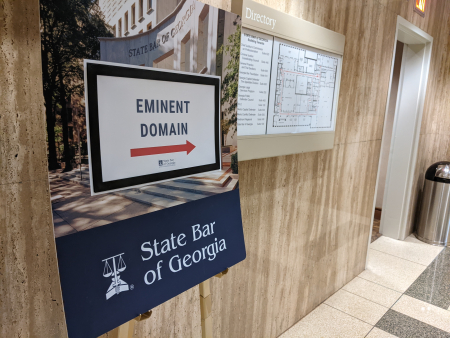
Here are the links to the cases and other materials that we talked about last Friday at the Georgia Bar Association’s annual Eminent Domain Conference. Our talk was entitled “It’s the Chief Justice’s Property World, We Just Live In It: National Trends in Takings, Property, & Eminent Domain,” and was part of
New Article: Woolhandler & Mahoney, Federal Courts and Takings Litigation, 97 Notre Dame L. Rev. 679 (2022)
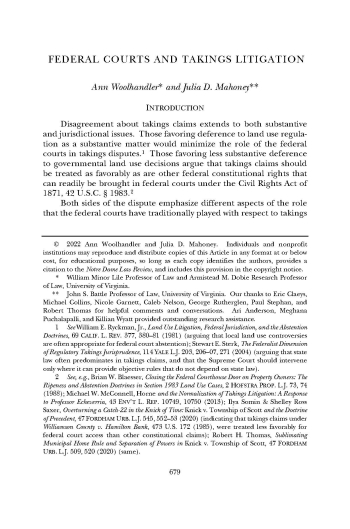
A new article on takings from U. Virginia Law School profs Ann Woolhandler and Julia Mahoney in the Notre Dame Law Review, “Federal Courts and Takings Litigation.” Get the pdf here.
Rather than try and summarize the piece, we’re just going to cut-and-paste the highlights from the article’s Introduction:
While Knick clearly expands
Are The Federal Courts Powerless When A Condemnor Doesn’t Pay Just Compensation?
Not too long ago, we posted the Fifth Circuit’s panel opinion in a case where the court held that there’s nothing a federal court can do if a local government does not pay a state-court just compensation judgment. We filed an amicus brief in that case arguing “[t]he Takings Clause does not permit the Sewerage