Most of the time these days, we’re rooting for cert granted. That comes, naturally, from our work pushing cases and issues up to the Supreme Court, looking to correct lower court errors and in the process make some good law. And that usually entails being on the “petitioner” side of things. Cases like Sackett
2023
CA7: Riparian Owner Has No Property Right In Water Level On Navigable River
There’s not a lot new to report in the U.S. Court of Appeals for the Seventh Circuit’s opinion in Kreuziger v Milwaukee County, No. 22-2489 (Feb. 13, 2023). But there’s a bit of old that make it worth posting.
The issue the court considered was whether riparian property owners have any protectable interest in…
New Takings Cert Petition: Yee v. Escondido And Physical Occupations
Here’s the latest SCOTUS cert petition, filed by our law firm colleagues Dave Breemer and Deborah LaFetra. Because this is one of ours, we won’t be commenting, but leave it to you to digest it yourself.
Here’s the Question Presented:
Frank and Rachel Revere and David and Judith Kagan (Owners) own a duplex in…
Video: “Are Zoning Laws the Cause of Hawaii’s Housing Crisis?” With Nolan Gray
As we wrote up here, national zoning and planning expert Nolan Gray joined our U. Hawaii Land Use class (and the public) last week for a talk about whether zoning is an impediment to affordable housing in Hawaii.
Thank you to Grassroot Institute of Hawaii for recording the talk, as well as making Mr.
A National Zoning Expert Pays A Visit To The L580 Land Use Class At U. Hawaii

The session was recorded.
Here’s the video and audio.
Earlier this week, planner M. Nolan Gray, author of the new book, “Arbitrary Lines: How Zoning Broke the American City and How to Fix It” (Island Press 2022) joined our Land Use class at the University of Hawaii Law School to talk…
CAFED: Commercial Fishing In The U.S. Exclusive Economic Zone Is A Govt-Granted Privilege, Not A Property Right

We thought this fellow has “authority over all fish.”
By statute (the Magnuson-Stevens Act), the feds claim the sovereign right to exclusive fishery management and “authority over all fish” in the U.S. Exclusive Economic Zone, a zone “extending 200 nautical miles from the baseline[.]”
The question facing the U.S. Court of Appeals for the Federal…
Cases And Links From Today’s Land Use Institute Session: “The Use of Eminent Domain for Redevelopment & Economic Development Projects”
Here are the opinions that we spoke about this afternoon at the Land Use Institute on “The Use of Eminent Domain for Redevelopment & Economic Development Projects.”
- Redevelopment: You Can’t Just Say “Redevelopment” – Take Now, Decide Later Isn’t A Public Use
- Due Process: Before Taking Property, Condemnor Must Provide Notice Reasonably Calculated
…
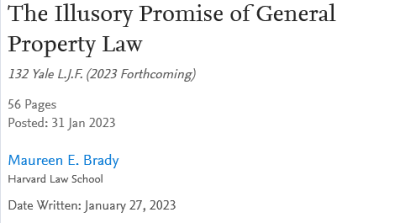
New Article: Maureeen Brady, “The Illusory Promise of General Property Law”
Check this out, a new piece by lawprof Molly Brady, “The Illusory Promise of General Property Law,” 132 Yale. L.J.F. (2023 forthcoming).
If the title alone isn’t enough to grab you, here’s the abstract:
In The Fourth Amendment and General Law, Danielle D’Onfro and Daniel Epps endorse an approach to the Fourth Amendment that defines the scope of protection largely by reference to “general property law”—uniform principles of trespass, abandonment, and so forth—discerned from and informed by the customs and rules of multiple jurisdictions. While their approach attractively reasons from useful common-law and private-law concepts, the specific general-law model they outline has both unresolved internal puzzles and unaddressed external effects.
In this Response, I probe this vision of “general law,” which has the potential to be more open-ended and unconstrained than the general law as it has previously been understood. Even if it did more closely resemble traditional general law, a court’s resort to making general law in a particular context is typically justified by some federal interest or power meriting the application of uniform rules. The authors do not satisfactorily explain that need here, especially given traditional deference to positive state law—and the desirability of some variation reflecting local conditions and expertise—in matters involving property questions in other areas of constitutional law. Further, in justifying reliance on the general law, the authors over-sell its determinacy and stability vis-à-vis existing Fourth Amendment law, which assesses whether an individual’s “reasonable expectations of privacy” have been violated. Given the vagaries of some common-law standards and the breadth of the sources of general law, courts will still be faced with unclear choices within and among them. The general-law approach does not offer guidance on resolving these conflicts and uncertainties, dooming it to the same indeterminacy.
To illustrate with specific examples, I turn to a doctrinal area where the pitfalls of general law—and specifically, general property law—can already be observed: in recent decisions under the Takings Clause of the Fifth Amendment. Decisions interpreting the Takings Clause traditionally “emphasiz[ed] the role of nonconstitutional state property law in defining both what counts as constitutional property and in measuring whether a taking has occurred.” The presumption of deference to state-specific property principles was grounded in a belief that property is an inherently local matter and that different states might opt to recognize and regulate property interests differently. However, two Supreme Court decisions within the last five years—Murr v. Wisconsin and Cedar Point Nursery v. Hassid—have unsettled that longstanding tradition with troubling effects. Takings law also teaches that decisions by courts in federal constitutional cases can influence the direction of nonconstitutional state private law, even though that result is not compelled.
There is an approach that would carry some of the benefits of the general-law model while leaving most of the development of property law to the states. In articles covering the Due Process and Takings clauses, Thomas Merrill has advocated for a “patterning definition” of constitutional property—a set of federal criteria that are met (or not) by the characteristics an interest has under nonconstitutional state law. The idea behind patterning is to provide a baseline, uniform constitutional standard across the states—one of the key purported advantages of the general-law model over the positive-law one—without having courts make a confusing national law of property specific for federal purposes. While private law can helpfully frame and elucidate Fourth Amendment problems, the general-law model offers limited promise for the development of Fourth Amendment doctrine while posing unwarranted risks for the viability of variable state property law.
.
Continue Reading New Article: Maureeen Brady, “The Illusory Promise of General Property Law”
Seattle’s Hazard Pay For Food Delivery Gig Workers Might Be A Penn Central Taking
“But we had to eat.”
So begins the Washington Supreme Court’s opinion in Washington Food Industry Ass’n v. City of Seattle, No. 99771-3 (Feb. 9, 2023), wherein the court held that a takings challenge to Seattle’s ordinance requiring Co-19 combat pay for food delivery workers may proceed.
There’s a lot in the opinion about…
Land Use, Hawaii Style: We’re Underway With Law 580 (Land Use) At The University Of Hawaii
The Registrar would not accept our suggestion
to change the course description to “Dirt Law”
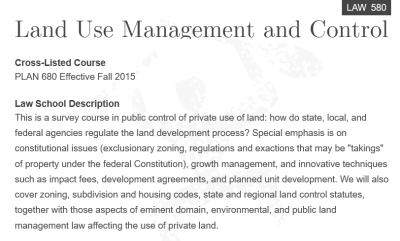
This spring, starting mid-January we’ve been back in a law classroom, this time at one of our law almae matres, the University of Hawaii School of Law in Honolulu.
The course is Land Use Management and Control, and…