
We won’t go into the details of the Court of Federal Claims’ opinion and order in In re Upstream Addicks and Barker (Texas) Flood Control Reservoirs, No. 17-9001L (Dec. 17, 2019), since it is 46 single-spaced pages long. You can (and should) read the entire thing. But we shall highlight of a few of
ND SCT: It’s Enough That The Resolution Of Necessity Described The Public Use As “Flood Protection Project”
Quick quiz: a taking of private property for a public flood protection property is a “public use,” right?
Yes, but that wasn’t quite what the property owner had a problem with in a recent decision from the North Dakota Supreme Court, City of Fargo v. Wieland, No. 2019-153 (Dec. 12, 2019).
Rather, it was
NC Supreme Court Considers Just Compensation For Formerly Indefinite–But Now Temporary–“Map Act” Takings
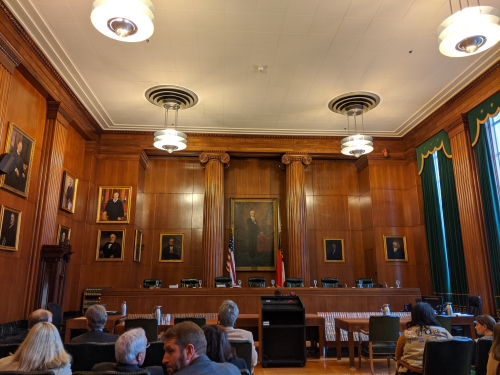
This time last week, we were sitting in the North Carolina Supreme Court’s (very beautiful) courtroom, above, having just observed oral arguments in a case we’ve been following for quite a while, Chappell v. NCDOT, No. 51PA19 (docket here).
This case is the follow up (after remand) of the N.C. Supreme Court’s
If You Build It, It Might Be A Zoning Violation: No Taking, No RLUIPA Violation When Zoning Limited Lights On Religious School’s Baseball Field
Check out Marianist Province of the United States v. City of Kirkwood, No. 18-3076 (Dec. 13, 2019), for the U.S. Court of Appeals’ handling of RLUIPA and (state law) takings claims stemming from the city not allowing a religious school to light up its baseball field.
Today’s a busy day, so we won’t delve
HAWSCT: When Agency Includes Conditions In Phase 1 Land Use Permit, But Later Removes The Conditions In Phase 2 Permit, Party Who Asked For Conditions Is Entitled To Notification
Here’s the latest opinion about land use from the Hawaii Supreme Court. Unite Here! Local 5 v. Dep’t of Planning & Permitting, No. SCAP-17-823 (Haw. Dec. 13, 2019). Because our Damon Key partner Greg Kugle was the prevailing lawyer in the case, we won’t go into detail about the opinion, but leave it
Amicus Brief: Legislature’s “Gut-And-Replace” Procedure Violates Hawaii Constitution’s Three Readings Requirement
This one is not in the usual subject area of this blog, but we figured we’re allowed to stray off course a bit every now and then.
Here’s the motion we filed today, asking the Hawaii appellate courts to let us file an amicus brief in a case in which the League of Women Voters
Takings Maven Prof Epstein Weighs In On Latest SCOTUS Judicial Takings Case: Owners Had A “Legitimate Claim Of Entitlement” To Rent Decontrol
Here’s the latest on the judicial takings/rent control case which we’ve been following.
This is the case where New York property owners assert that the N.Y. Court of Appeals’ decision which concluded that the luxury apartments (which were never formerly subject to rent control) are now governed by the Rent Stabilization Law. This
New SCOTUS Amici Brief: Invoking A “Classic” Public Use Isn’t Enough When The Circumstances Reveal “A Private Purpose May Be Afoot”
Here’s the amicus brief we filed yesterday in a public use case we’ve been following that asks whether pretext and private benefit are irrelevant as long as the condemnor invokes a “classic” public use. In this case, the Colorado Supreme Court overturned the court of appeals’ conclusion that even though the purported purpose of the
Owner Objects To Being Offered *More* Compensation: DOT’s Offer Invalid Because It Included Severance Damages The Appraisal Omitted
Here’s one where you have to stop and pause and ask “why?” Because most of the time, you’d think that an offer to the property owner made by DOT that included more compensation than DOT’s own appraisal recognized would be a good thing.
Apparently not here: DOT’s appraiser opined that the owner incurred no severance damages