
In which we pay a return visit to Clint Schumacher’s Eminent Domain Podcast to catch up with Clint about our new gig, Cedar Point (briefly, since the opinion came down the day we recorded the podcast), just compensation and attorneys’ fees, assessing severance damages in appraisals supporting jurisdictional offers, public use
Another SCOTUS Property Rights Win, This Time On Williamson County’s “Final Decision” Requirement
Another day, another property rights decision from SCOTUS. This time, the unanimous per curiam opinion in a case we’ve been following, Pakdel v. City & County of San Francisco, No. 20-1212 (June 28, 2021).
[Disclosure: our PLF colleague Jeff McCoy is lead counsel on this case, and we pitched in with help on
Cedar Point Part II: Common Sense (Keep Out) And Common Law (The Right To Exclude)
In this post — the second in a series of deeper dives that we’re posting about last week’s U.S. Supreme Court opinion in Cedar Point Nursery v. Hassid, No. 20-107 (June 23, 2021) — we’ll be covering more on the “right to exclude,” how the Court treated our old frenemy Pruneyard, and how
11th Circuit Affirms Penn Central Jury Verdict For Rezoning Resulting In 86% Loss Of Value
More good takings news, hot off the press.
Before Cedar Point came down last week, we were all set to let you know about the Eleventh Circuit’s opinion in South Grande View Dev. Co., Inc. v City of Alabaster, No. 18-14044 (June 21, 2021), in which the court affirmed a jury verdict that
Join Us Friday, July 16, 2-3pm ET: ALI-CLE’s “Takings and Eminent Domain After Cedar Point: What Practitioners Need to Know”
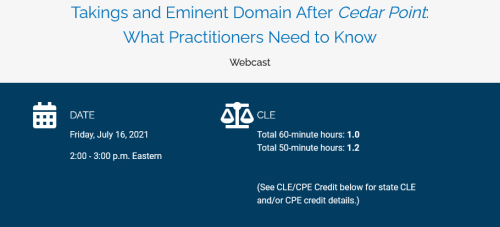
The ink’s not quite yet dry on the U.S. Supreme Court’s landmark decision in Cedar Point Nursery v. Hassid, No. 20-107 (June 23, 2021), but we’re already ready to roll with a program about what this decision means for you and your clients, and for takings law.
Find out from the experts in a
Cedar Point Part I: SCOTUS’s Strawberry Letter 23 To Property Rights
In this post — the first in a series of deeper dives that we’ll be posting about over the next few days about yesterday’s U.S. Supreme Court opinion in Cedar Point Nursery v. Hassid, No. 20-107 (June 23, 2021) — we’ll be covering the background of the case, and the heart of the majority
Well, You Really Can Say “Keep Out” In California (Cedar Point – A Per Se Taking)
We haven’t had time to read it in detail yet, but here’s the slip opinion in a case we have been following for a long time, Cedar Point Nursery v. Hassid, No. 20-107 (June 23, 2021).
Writing for a six-Justice majority (no one went wobbly!), Chief Justice Roberts concluded that California’s labor regulations, which
New L. Rev. Article: “Temporary Eminent Domain”
For your Monday reading, Amnon Lehavi, Temporary Eminent Domain, 69 Buff. L. Rev. 683 (2021). From the Abstract:
Times of emergency call for drastic measures. These steps may include the physical takeover of privately-owned assets by the government for a certain period of time and for various purposes, aimed at addressing the state of emergency. When will such acts amount to a taking, and what compensation should be paid to the property owner? How do temporary physical appropriations during times of emergency diverge, if at all, from temporary takeovers in more ordinary times?
The doctrinal and theoretical analysis of potential temporary takings has been done mostly in the context of non-physical government intervention with private property, such as when a local government imposes a temporary moratorium on land development until a certain condition is met. This Article focuses, however, on less investigated scenarios of temporary physical takeovers or other forms of government invasions. It seeks to identify the differences between a temporary invasion and a permanent occupation of property considered a per se taking under the Loretto rule. In so doing, this Article argues that while the alleged distinction between prevention of public harm and promotion of public benefit often proves untenable in evaluating whether a permanent government measure constitutes a taking, it might make more sense in exploring temporary acts.
Temporary eminent domain—referring here to various types of acts amounting to time-limited physical takings, even if not initially recognized as such by the government—may diverge from permanent eminent domain in yet another key element: identifying the basis for just compensation. Under long established (although often criticized) rules, compensation for a permanent taking is based on identifying the “fair market value” of the rights taken, while ignoring the effects that the public use for which the underlying asset is taken might have on the property’s long-term value.
The allegedly parallel metric used in the case of temporary takings,one of “fair rental value,” may often prove inadequate, both practically and normatively. This Article argues that because of unique aspects of temporary physical takings, legal rules on compensation should often seek to identify lost profits or actual damage. Moreover, in some cases, in which there is a direct relation between the pre-appropriation use of the asset and its post-appropriation use by the government, just compensation might also be based on a certain portion of the value of the public use. This is especially so when the time-sensitive value of the asset during such public use is particularly high. On this point, the Article offers an analogy to rules pertaining to compulsory licenses for patents.
Check it out.
Continue Reading New L. Rev. Article: “Temporary Eminent Domain”
Texas: Makin’ Copies Of A Photograph Is Copyright Infringement, Not A Taking
Here’s the latest in a case we’ve been following.
In Jim Olive Photography v. Univ. of Houston, No. 19-0605 (June 18, 2021), the Texas Supreme Court affirmed the court of appeals, concluding that a public university’s unauthorized use of a photograph on its website was merely copyright infringement, and not a taking.
CA4: No Taking When Aerial Pesticide Spray Killed Bees … But Not Why You Think
The facts that compelled the U.S. Court of Appeal to conclude as it did in Yawn v. Dorchester County, No. 20-1584 (June 11, 2011) are pretty straightforward.
In response to a threatened public health viral crisis (no, not COVID, but Zika [remember that one?]), the county decided to spray insecticide. Some areas