
If you ever get the opportunity to teach in a law school — either as a full-time legal scholar, or part-time as an expert adjunct practitioner — take it if you can. You might think you know a lot about a particular subject, but there’s nothing like spending time at the lectern in a law
Michigan: Legislature Can’t Abrogate Long-Existing Property Rights Without Compensation
It’s already settled in Michigan (Rafaeli) that a homeowner has a property interest in the equity in her home, and that if she fails to pay the full amount of her property taxes and the government forecloses, the government can’t keep the proceeds in excess of the amount of the tax delinquency.
But
A Tale Of Two Cities: A City’s Road Barriers Might Be A Taking, Even Though The Property Taken Is In A Neighboring City
A short trial court decision. But because it deals with an interesting question, we’re posting it.
Check it out: in this order, the U.S. District Court for the District of Minnesota denied the city’s motion to dismiss in a case alleging, inter alia, a Fifth Amendment taking.
The property owners’ complaint alleged that
Pennsylvania: To Be Liable For Inverse Condemnation, Taker Need Not Have Eminent Domain Power
Here’s how the Pennsylvania Supreme Court stated the issue in Hughes v. UGI Storage Co., No.J-69A-2021 (Nov. 29, 2021):
In these consolidated appeals, we consider the Commonwealth Court’s holding that, to be held liable for damages under Pennsylvania’s inverse condemnation statute, an entity must be clothed with the power of eminent domain – not
New(ish) Article: “The Realities of Takings Litigation” (Dave Owen)

Another law review article worth reading. This one from lawprof Dave Owen, is about “The Realities of Takings Litigation” (forthcoming BYU Law Review). That title certainly got our attention – any time a law journal article is about ‘reality’ and takings, and includes empirical research, we’re going to read it.
Here’s the
Links And Materials From Today’s Land Use Institute Takings/Eminent Domain Session
 LUI Co-Chair Prof. Frank Schnidman introducing the faculty
Here are the links to the cases and issues that we just finished speaking about at the 35th Annual Land Use Institute (more information on the LUI here). Today was day 1 of a multi-day remote program and the sessions are available ala carte, so there’s still
Georgia SCT To Govt: If You Take Or Damage Property, The Court May Order You To Fix The Problem Until You Pay Compensation
It’s already the law in Georgia that the Georgia Constitution’s Takings Clause waives whatever sovereign immunity the government may enjoy when it comes to monetary relief in a takings claim. See Ga. Dept. of Nat. Res. v. Center for a Sustainable Coast, 755 S.E.2d 184 (2014).
But it remained an open question whether the
New Article: “Inverse Condemnation: Standards and Burden of Proof” (ALI-CLE Practical Real Estate Lawyer)
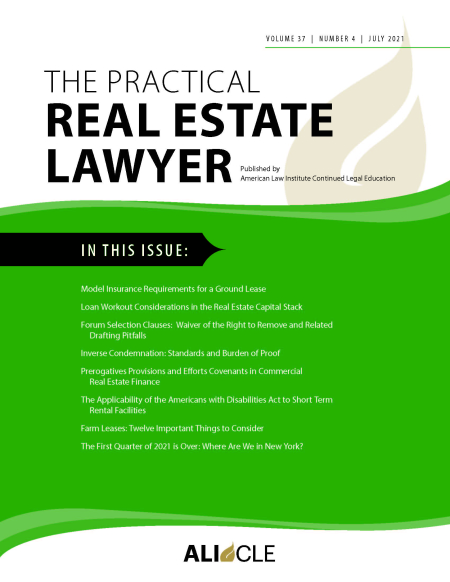
Worth reading: an article in ALI-CLE’s Practical Real Estate Lawyer, authored by our friends and colleagues Steve Clarke, Justin Hodge, Jeremy P. Hopkins, and Christian Torgrimson, “Inverse Condemnation: Standards and Burden of Proof.”
A subscription to PREL costs, but for this issue the good people at ALI have made it available for
Join Us (For Free!): Lawprof Ilya Somin On “Cedar Point Nursery v. Hassid and the Future of the Takings Clause: Physical Occupation, Eviction Moratoria, and More” (Tues. Sep. 28, 2021, 12:50pm ET)
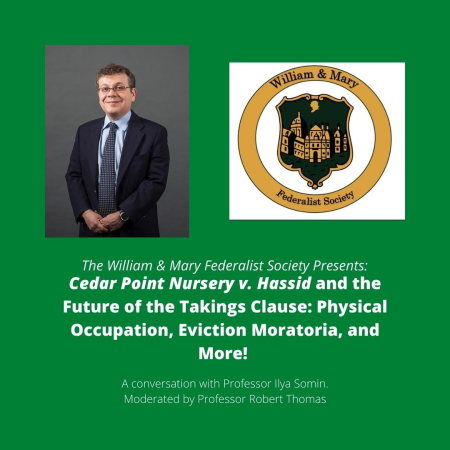
Next Tuesday, September 28, starting at 12:50pm ET, we’ll be moderating a talk sponsored by the William and Mary Law School chapter of the Federalist Society.
Professor Ilya Somin, a nationally-recognized expert in eminent domain, takings, and related topics, is zooming in to speak about “Cedar Point Nursery v. Hassid and the Future
2021 Brigham-Kanner Property Rights Conference (Sep. 30 – Oct. 1, 2021) – Still Time To Join Us
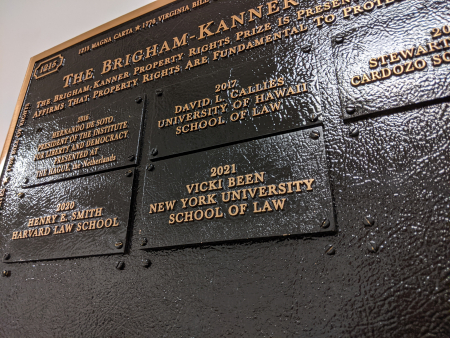
There’s still plenty of time to register and join us for the 18th Annual Brigham-Kanner Property Rights Conference at the William and Mary Law School, Thursday and Friday, September 30 and October 1, 2021.
Yes, you may attend in-person, or remotely. The registration fees are very reasonable, ranging from $0 (yes, free!) to $200