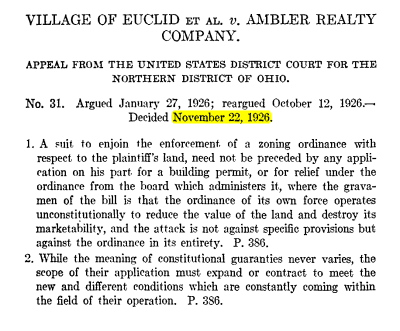
Due process

The facts in D.A. Realestate Inv., LLC v. City of Norfolk, No. 23-1863 (Jan. 16, 2025), a recent decision from the U.S. Court of Appeals for the Fourth Circuit, are fairly sympathetic. And the opinion starts off with a tantalizing quote:

In 1761, Massachusetts lawyer James Otis exclaimed “one of the most essential branches
With our tongues firmly planted in cheeks, the Planning Chairs for the upcoming 42d edition of this popular and venerable Conference bring you this “breaking news” report from San Diego!

As you know, in addition to being the best nationally-focused conference on the subjects that we love and a venue that is nearly certain to have some of the warmest winter weather in the continental United States, and we went on-location from some of the local highlights: the beaches, Torrey Pines, the Zoo, Balboa Park, the Gaslamp Quarter, and Coronado to name but a few.

More about the Conference here, including registration information.

Here are some of the highlights:

  • Property Rights at the Supreme Court: DeVillier and Sheetz and What’s Next
  • Slow Take: Possession, Rent, Relocation, and Offset
  • The Jury’s View: How Jurors See Your Case
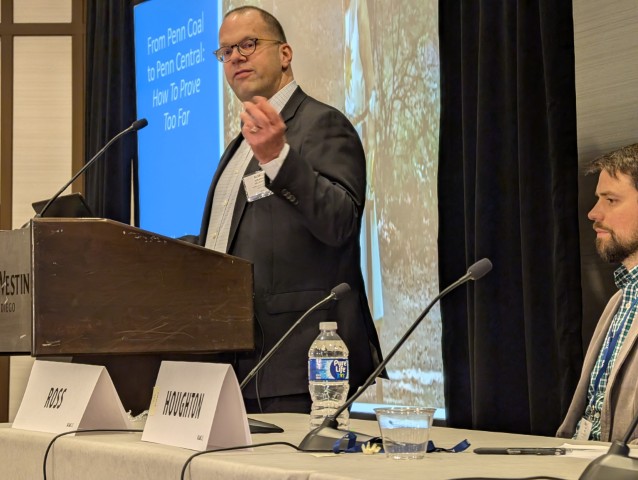
  • From Penn Coal to Penn Central: How to Prove “Too Far”
  • Leveraging Expertise in Eminent Domain Litigation: Working with Land Planners, Engineers, and Other Predicate Experts
  • Kelo at Twenty: What Changed, What Didn’t, and What’s on the Horizon
  • Viva Las Vegas: How the Nevada Judiciary Upheld Property Rights in 180 Land’s Inverse Condemnation Taking
  • Ethics: Guiding the Trolley: Perspectives on Professional Ethics in Eminent Domain for Lawyers, Appraisers, and Right of Way Agents
  • “I Think I Shall Never See” Just Compensation For a Tree: Strategies to Securing Recovery for Trees, Crops, and Fixtures

And more. Check out the complete agenda here. Registration information here

We especially welcome first-time participants, or those returning after an absence. Connect (or reconnect) with your colleagues from across the nation.

The 41st Conference was in New Orleans. Here’s a report of that event, and here are our reports from prior conferences in Austin and Scottsdale.

Don’t miss out on San Diego: we have had record attendance in recent years, so hold your space now. #EminentDomain2025

Continue Reading Breaking News: Come Join Us For The 42d ALI-CLE Eminent Domain & Land Valuation Litigation Conference, San Diego, Jan 30-Feb 1

Screenshot 2024-11-04 at 12-34-18 Texas Supreme Court
Charles McFarland, arguing.

Here’s the latest in a case we’ve been following closely (and disclosure: our firm filed an amicus brief in the Texas Supreme Court).

In The Commons of Lake Houston, Ltd. v. City of Houston, the Texas Court of Appeals held that the city could not be liable for a taking

This one from the Tenth Circuit didn’t even merit a published opinion, but is still worth reading, just because the situation seems so absurd.

In this Order and Judgment, the court affirmed the dismissal of property owners’ claim that the County wouldn’t issue a septic permit until after the owners actually constructed the septic

In Turner v. Jordan, No. 22-13159 (Sep. 17, 2024), the U.S. Court of Appeals for the Eleventh Circuit held that even though the federal courts have jurisdiction over Turner’s takings claim, the court nonetheless has the discretion to choose to wash its hands of the case in order to protect a state’s administrative procedures.

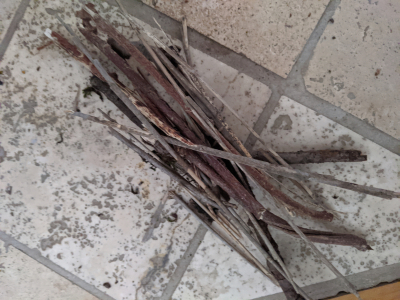
Sticks bundle
We don’t see any free public education here.

Some old-school property “sticks” analysis from the U.S. Court of Appeals for the Ninth Circuit in Zeven v. Jones, No. 23-35438 (Aug. 23, 2024), worth checking out.

The Idaho Constitution has a “free common schools” clause:

The stability of a republican form of government depending mainly

This would not be authorized.

Here’s the latest in an issue that found new vitality after the U.S. Supreme Court’s decision in Cedar Point affirming that government-authorized physical entry to private property is presumptively a taking.

This is the “precondemnation entry” issue in eminent domain which several courts have addressed:

Here’s the latest in the solved-but-not-quite-solved issue of whether the government can keep the surplus which remains after a tax-foreclosure sale (see Tyler v. Hennepin County), the Michigan Supreme Court’s opinion in Schafer v. Kent County, No. 164975 (July 29, 2024), where the court concluded that its earlier decision in Rafaeli v. Oakland

DJK was adding a bedroom to an existing residence and needed a wastewater permit from Vermont’s environmental agency. The agency has a “presumptive isolation zone” around potable water supplies and septic systems in which a property owner is presumed to be barred from doing anything sewage related. In this case, the isolation zone for DJK’s