The key quote from the Illinois Appellate Court’s recent opinion in Robinson v. City of Chicago, No. 1-23-2174 (Mar. 24, 2025), in which a property owner challenged the inclusion of his property in a new Chicago historic preservation district? This seemingly innocuous sentence setting out the standard of review:

The plaintiff acknowledges that his substantive due process and equal protection challenges to the ordinance designating the District as a Chicago landmark are subject to rational basis review.

Slip op. at 13.

Those of you for whom this ain’t your first rodeo know that rational basis review (aka aliens might have done it) being invoked isn’t a good sign for a challenger. It nearly always tells the challenger “you lose, no matter what.” And here, that prediction plays out: the court rejected the property owner’s arguments that the city’s designation of his small neighborhood — a neighborhood that

Continue Reading Who Cares Your “Evidence” Shows This Is Just An Old Part Of Chicago – All That Matters Is The City Says It’s Historic

Purpose

Before we go further, a disclosure: this is one of ours.

Here’s the Complaint for Violations of Constitutional and Civil Rights, filed yesterday by the Santoro Family in federal court in Rhode Island. This lawsuit challenges, under the Public Use Clause, a RI town’s eminent domaining the family’s land for the ostensible purpose of building a new municipal campus

Sounds like a “classic” public use, you say? Not so fast. As alleged in the complaint, the actual use, purpose, and necessity for the taking is something else: to stop the Santoros from building 250+ low- to moderate-income housing.

Because this is one of ours, we won’t say more. But here’s the story, from the Complaint:

1. SCLS Realty, LLC, and Sixty Three Johnston, LLC, family-owned homebuilders whose members are Lucille Santoro, Salvatore Compagnone, Ralph Santoro, and Suzanne Santoro (the plaintiff LLCs are referred to herein jointly as

Continue Reading Challenge To Sham Eminent Domain: The Government Can’t Lie About Why It Takes Property

What does a property owner do if she believes that the government’s eminent domain lawsuit is abusive? Is the remedy limited to the four corners of the eminent action (i.e., a counterclaim, third-party claim, etc.), or may a landowner institute a separate action which includes a tort claim for abuse of process? 

In Indiana Land Trust #3083 v. Hammond Redevelopment Comm’n, No. 24A-PL-1284 (Jan. 31, 2025), the Indiana Court of Appeals held that because the remedies in an eminent domain case and an abuse of process case are different, the owner may press claims that the “taking was for ‘discriminatory private purposes, for private gain, motivated by spite and/or that it is against public purposes[.]'” in a separate abuse of process lawsuit. Slip op. at 5. 

Here’s the order of events:

  • Redevelopment agency instituted an eminent domain case in state court to take owner’s property as part of a


Continue Reading Ind App: Eminent Domain Abuse Is [Also] Abuse Of Process

Magnachartasupremecourtdoor

Readers know that the North Carolina Constitution does not contain a “takings” or “just compensation” clause. Does that mean that the government can simply take property, and not have to worry whether the taking is for a public use, and with just compensation? Of course not.

Because we also know that the N.C. Constitution contains a Law of the Land Clause which says:

No person shall be taken, imprisoned, or disseized of his freehold, liberties, or privileges, or outlawed, or exiled, or in any manner deprived of his life, liberty, or property, but by the law of the land. No person shall be denied the equal protection of the laws; nor shall any person be subjected to discrimination by the State because of race, color, religion, or national origin.

That provision is interpreted to include the usual historic and traditional limits on both the eminent domain and police powers.

Continue Reading NC: Law Of The Land Clause Doesn’t Bar Legislature From Reviving SOL’d Tort Claims

Property_rights_and_the_roberts_court_Agenda_

Register now and plan on joining us on Thursday, February 27, 2025 at the U.C. Berkeley Law School for a one-day conference: “Property Rights and the Roberts Court: 2005-2025.”

Here’s the agenda. Here’s a description of the program:

For much of the past century, property rights were relegated to second-class status compared to the rest of the Bill of Rights. However, under the Supreme Court leadership of Chief Justice John Roberts, this trend has begun to shift.

In recognition of the 20th anniversary of the Chief Justice’s elevation to the Supreme Court, Pacific Legal Foundation is partnering with Berkeley Law’s Public Law and Policy Program to host a day-long conference exploring the major property rights developments and future of property rights law in the Roberts Court.

We’ll hear from two different panels of renowned legal scholars and accomplished litigators, as well as a keynote lunch discussion between

Continue Reading Join Us: “Property Rights and The Roberts Court: 2005-2025” (Feb. 27, 2025, UC Berkeley Law School)

The facts in D.A. Realestate Inv., LLC v. City of Norfolk, No. 23-1863 (Jan. 16, 2025), a recent decision from the U.S. Court of Appeals for the Fourth Circuit, are fairly sympathetic. And the opinion starts off with a tantalizing quote:

In 1761, Massachusetts lawyer James Otis exclaimed “one of the most essential branches of English liberty is the freedom of one’s house. A man’s house is his castle.” John Adams’s Reconstruction of Otis’s Speech in the Writs of Assistance Case, in Collected Political Writings of James Otis 12–13 (Richard Samuelson, ed. 2015). American law has embraced that principle since our nation’s founding. U.S. Const. amend. V. But we have also long recognized that “all property in this country is held under the implied obligation that the owner’s use of it shall not be injurious to the community.” Mugler v. Kansas, 123 U.S. 623, 665 (1887).

Slip op.

Continue Reading CA4: Challenge Public Use/Pretext Under Due Process And § 1983, Not Inverse

With our tongues firmly planted in cheeks, the Planning Chairs for the upcoming 42d edition of this popular and venerable Conference bring you this “breaking news” report from San Diego!

As you know, in addition to being the best nationally-focused conference on the subjects that we love and a venue that is nearly certain to have some of the warmest winter weather in the continental United States, and we went on-location from some of the local highlights: the beaches, Torrey Pines, the Zoo, Balboa Park, the Gaslamp Quarter, and Coronado to name but a few.

More about the Conference here, including registration information.

Here are some of the highlights:

  • Property Rights at the Supreme Court: DeVillier and Sheetz and What’s Next
  • Slow Take: Possession, Rent, Relocation, and Offset
  • The Jury’s View: How Jurors See Your Case
  • From Penn Coal to Penn Central: How to


Continue Reading Breaking News: Come Join Us For The 42d ALI-CLE Eminent Domain & Land Valuation Litigation Conference, San Diego, Jan 30-Feb 1

Euclid_front98 years old, and still going (for better or worse)

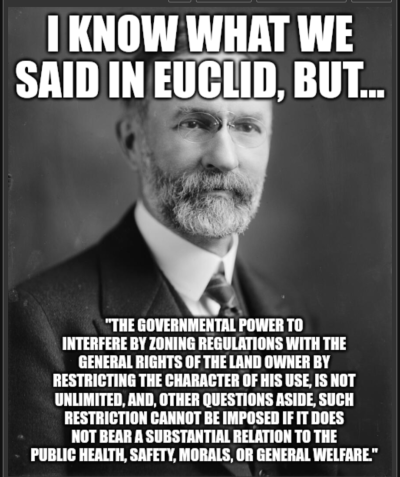
On this day in 1926, the United States Supreme Court issued its landmark opinion in Village of Euclid v. Ambler Realty Co., 272 U.S. 365 (Nov. 22, 1926).

You know this one (and can you call yourself a dirt lawyer if you don’t?). It’s the one in which the Supreme Court first upheld — against a facial due process challenge — the validity of this thing we call “zoning.” While in the intervening century, zoning has become a catch-all term for all sorts of regulatory restrictions on the uses of real property, land users know that “zoning” — ackshually — refers only to the regulation and separation of uses, and restrictions on density, and height regulation. At least that’s how it began.

While “Euclid” and “Euclidean zoning” have become part of the land use

Continue Reading (Un?)Happy Euclid Day!

Screenshot 2024-11-04 at 12-34-18 Texas Supreme Court
Charles McFarland, arguing.

Here’s the latest in a case we’ve been following closely (and disclosure: our firm filed an amicus brief in the Texas Supreme Court).

In The Commons of Lake Houston, Ltd. v. City of Houston, the Texas Court of Appeals held that the city could not be liable for a taking for an ordinance that limited development and use within the city’s 100-and-500-year floodplains because the ordinance was a valid exercise of police power and otherwise survived the rational basis test.

As we wrote here, that seems like utter nonsense to say that a valid police power reason categorically insulates a government action from a takings challenge. After all, the entire regulatory takings doctrine is built on the notion that an otherwise-valid exercise of government power (here, the police power, delegated from the State to the city) can so impact an owner’s property rights that

Continue Reading Oral Arguments In Texas Takings Case: If The Govt Limits Use For Healthsafetywelfaremorals, Is It Exempt From Takings?

This one from the Tenth Circuit didn’t even merit a published opinion, but is still worth reading, just because the situation seems so absurd.

In this Order and Judgment, the court affirmed the dismissal of property owners’ claim that the County wouldn’t issue a septic permit until after the owners actually constructed the septic system. Colorado law, they argued, requires them to get a permit before building a septic system. That’s nice, replied the County: here, we do it different; first you build, and only then do we decide whether you get a permit.

The owners alleged that without a septic permit, they could not obtain a construction permit. Which means that they couldn’t build their home as planned. Next stop, federal lawsuit alleging due process violations (both kinds) and a taking. 

The district court dismissed and the Tenth Circuit summarily affirmed:

  • Procedural due process: yes, the conflict between


Continue Reading CA10: A Municipality Is Forcing Owners To Violate State Law … No Problem!