
Thanks to a colleague for giving us the heads-up about a recently-filed cert petition involving an issue we covered in a different case recently: judicial takings. Specifically, an allegation that a federal court has taken property, and as a consequence, the United States owes just compensation. The background of the case is pretty interesting
US BIO In Brott: No, The Fifth Amendment Isn’t Really “Self-Executing”
Here’s the latest in a case we’ve been following since its inception, Brott v. United States, the case which asks the deceptively simple question of whether property owners who sue the federal government for a taking are entitled to both an Article III forum, and to have the issues determined by a jury.
New Judicial Takings Cert Petition: Can A Federal Court Take Property By Changing The Law?
Here’s the cert petition, recently filed in a case we’ve been following as it has made its way from the Court of Federal Claims and through the Federal Circuit.
The underlying matter was litigated in the District Court and the Fifth Circuit. Those courts concluded that the plaintiff did not own mineral leases
ALI-CLE Eminent Domain Conference, Third Day: Berger And Burling On Takings
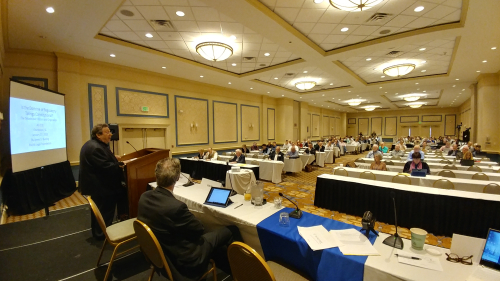
We’re on our third day at the 2018 ALI-CLE Eminent Domain and Land Valuation Conference in Charleston, SC, and as usual, we’re having our headline presentations by takings guru Michael Berger (pictured above), who is updating us on the most interesting and important cases of the past year, and Jim Burling, who will
ALI-CLE Eminent Domain & Land Valuation Conference – In-Person Registration SOLD OUT (But You Can Still Join By Live Webcast)
Our upcoming American Law Institute-CLE Eminent Domain and Land Valuation Litigation Conference in Charleston, South Carolina has SOLD OUT our in-person registrations.
We will have a record attendance (with over 100 first-time attendees) and the conference hotel has informed us that we can fit no more people in the meeting rooms. We cannot remember this
ALI-CLE Eminent Domain & Land Valuation Conference – There’s Still Time To Join Us In Charleston
35th Annual Advanced Course
 Eminent Domain and
Land Valuation Litigation
Live Program | Video Webcast | Video Webcast Segments
Thursday – Saturday, January 25 – 27, 2018
Francis Marion Hotel | Charleston, SC
Do not miss this popular conference! Intended for all eminent domain and land use practitioners, both experienced and those new to the
New Amici Brief: Of Juries And Article III Courts – Required In Takings Cases?
Here’s the amici brief filed earlier this week in Sammons v. United States, No. 17-795, a case we’ve been following. Here’s the cert petition.
The issue in this case is the same as in two cases already pending in the Supreme Court, the first a patent case argued in December, and the
Williamson County, Federalized: No CFC Tucker Act Jurisdiction Because Owner Didn’t Exhaust Agency Procedures
One word is conspicuously absent from the Federal Circuit’s opinion in Alpine PCS, Inc. v. United States, No. 17-1029 (Jan. 2, 2017): “exhaustion.”
We all know that exhaustion of administrative remedies isn’t usually required before bringing a constitutional takings claim, but make no mistake — despite the absence of the word in the opinion
New Amici Brief: In Our System, Unlike Those In Which Monarchs Rule Over Their Subjects, The Federal Government Can Be Sued In Its Own Courts
Here’s the amici brief we filed earlier today in a case we’ve been following closely since its inception (and in which we filed an amicus brief when it was in the Sixth Circuit).
This is Brott v. United States, No. 17-712 (cert. petition filed Nov. 6, 2017), the case which asks whether Congress can require property owners asserting inverse condemnation or regulatory takings cases seeking just compensation against the federal government to sue in the Article I Court of Federal Claims. The Question Presented which the petition presents is straightforward:
Can the federal government take private property and deny the owner the ability to vindicate his constitutional right to be justly compensated in an Article III Court with trial by jury?
Rather than go into detail about our brief’s argument, we’ll just post the Summary of Argument:
The government does not enjoy its usual sovereign immunity when it takes property, either affirmatively or inversely, and this Court has repeatedly confirmed that the Just Compensation Clause is “self-executing.” First English Evangelical Lutheran Church of Glendale v. County of Los Angeles, 482 U.S. 304, 315 (1987) (“We have recognized that a landowner is entitled to bring an action in inverse condemnation as a result of ‘the self-executing character of the constitutional provision with respect to compensation.”).
But what does this mean, exactly? Even as the Sixth Circuit recognized that property owners have a right to compensation that springs from the Constitution itself and the right to sue does not depend upon a waiver of sovereign immunity, it held that Congress is not compelled to provide an Article III forum to vindicate that right. Or indeed, any forum at all. Thus, even if the forum Congress created―the Article I non-jury Court of Federal Claims (CFC)―is not constitutionally adequate, well, that’s good enough. In the words of the Sixth Circuit, “[t]he Fifth Amendment details a broad right to compensation, but does not provide a means to enforce that right. Courts must look to other sources (such as the Tucker Act and the Little Tucker Act) to determine how the right to compensation is to be enforced.” Brott v. United States, 858 F.3d 425, 432-33 (6th Cir. 2017). That is sovereign immunity by another name.
However, we think this Court said it best in United States v. Lee, 106 U.S. 196 (1882), the takings lawsuit over what today is Arlington National Cemetery, when it held that courts (referring to Article III courts, and not what is, in essence, a Congressional forum), must be available for those whose property has been taken:
The [government’s argument it cannot be sued] is also inconsistent with the principle involved in the last two clauses of article 5 of the amendments to the constitution of the United States, whose language is: ‘That no person * * * shall be deprived of life, liberty, or property without due process of law, nor shall private property be taken for public use without just compensation.’ . . . Undoubtedly those provisions of the constitution are of that character which it is intended the courts shall enforce, when cases involving their operation and effect are brought before them.
Id. at 218-19.
The story of how the private estate of General Robert E. Lee’s family became Arlington National Cemetery is at the center of this case: the Court held that Lee’s heir was entitled—after a jury trial in an Article III court—to ownership of the property. The Court affirmed that in our system, unlike those in which monarchs rule over their subjects, the federal government could be sued in its own courts, and that the government had violated Lee’s due process rights and had taken Arlington without compensation. Lee may have been rendered 135 years ago, but the principles which the Court enunciated on sovereign immunity, the independent federal judiciary, and the Fifth Amendment, are still highly relevant today.
Others have filed amicus briefs in support, and we’ll post those shortly. Or, you can now go to the Court’s docket entry for the case and download them directly yourself.
Stay tuned, as always.
Continue Reading New Amici Brief: In Our System, Unlike Those In Which Monarchs Rule Over Their Subjects, The Federal Government Can Be Sued In Its Own CourtsLinks And Materials From Today’s Las Vegas Eminent Domain Conference
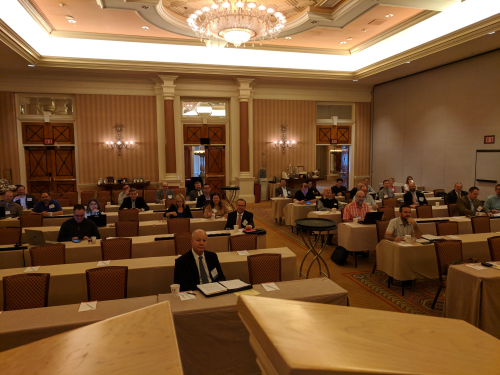 This photo of the view from the lectern at the start of the day
proves we really were in the room and not distracted by all the distractions
possible in Las Vegas
Here are the materials and cases which I spoke about earlier today at the CLE International Eminent Domain Conference in Las Vegas. I