
Our American Bar Association colleague Ed Thomas (no relation, although we often joke that we’re probably cousins), the President of the Natural Hazard Mitigation Association and a guy who acknowledges that the need to protect against natural disasters must take property rights into account, has compiled some thoughts about the Court of Federal Claims’ recent
HAWSCT Clarifies Joinder Of Indispensable Parties
Here’s the latest from the Hawaii Supreme Court on the joinder of parties under Rule 19, where there’s a claim that an absent party is “indispensable” and thus the case should be dismissed. Bottom line is that an absentee should be joined if its presence is needed, and the “indispensable” determination only needs to be
California Supreme Court Considering “Inclusionary Housing” Fee
Last week, the California Supreme Court heard oral arguments in California Building Industry Assn. v. City of San Jose, No. S212072, the case which challenges San Jose’s “inclusionary housing” requirement.
The Court of Appeal held that under rational basis review (and not heightend scrutiny) San Jose’s affordable housing exaction might survive because it was
On Facial Challenges, Exactions, Standing, And Statutes Of Limitations: Final Cert Briefs In SCOTUS Substantive Due Process Case
Earlier, we posted the cert petition in Hillcrest Property, LLP v. Pasco County, No. 12-846 (cert. petition filed Jan. 15, 2015), which asks the Supreme Court to review the Eleventh Circuit’s decision throwing out Hillcrest’s facial substantive due process challenge to the county’s “Right of Way Preservation Ordinance.” The ordinance allows the county to land
6th Cir Schadenfreude Alert: Municipality Liable For Fees And Costs For Removing Takings Claim From State Court
Williamson County gives everyone grief, and if you needed any more proof, here it is.
In A Forever Recovery, Inc. v. Township of Pennfield, No. 13-2657 (Apr. 2, 2015), an unpublished opinion from the Sixth Circuit, the court upheld the district court’s award of attorneys’ fees and costs to a property owner who
Guess What: Hawaii Housing Is Expensive!
Two stories to read, in tandem:
- In the ultimate dog-bites-man story, yesterday’s Honolulu Star-Advertiser headline reads “Home demand outweighs supply.” Well no kidding. As one fellow quoted in story said,”This is the most overstudied subject in the history of mankind … You don’t need a study to know what the numbers are. It’s
New Law Review Article Worth Reading: “Through a Glass Clearly: Predicting the Future in Land Use Takings Law”
It’s not often that we say a law review article is a “must-read.” But this one definitely is, especially for all you regulatory takings mavens: David L. Callies, Through a Glass Clearly: Predicting the Future in Land Use Takings Law, 54 Washburn L. Rev. 43 (2014). A pdf of the article is posted here
Recent California Court Of Appeal Regulatory Takings Opinion Should Be Published
Here’s the letter request which we sent today to the California Court of Appeal, Second Division, asking the court to publish its recent opinion in Brost v. City of Santa Barbara, No. B246153 (Mar. 25, 2015). In our post about the case, we wrote “we hope there’s a motion to publish and that the court
Pacific Business News Details The Rail’s Impact On Honolulu Property
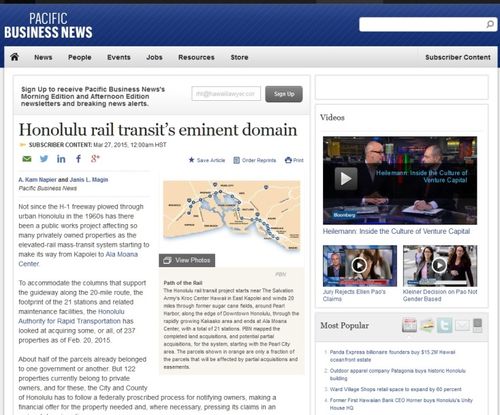
The cover story in Pacific Business News‘ recent edition, “Honolulu rail transit’s eminent domain” is worth reading. Most importantly, the PBN staff created maps which show how much property is targeted for acquisition, and where it is located, precisely. Yes, the full story is behind a partial paywall, but as we said
State Appeals NC “Map Act” Takings Case
In Kirby v North Carolina Dep’t of Transportation, No. COA14-184 (Feb. 17, 2015), the North Carolina held that state’s “Map Act,” which gives the DOT the ability to designate property for future highway use and prevent its development in the meantime, was a taking. There was great shouting and gnashing of teeth that making