Zoning & Planning

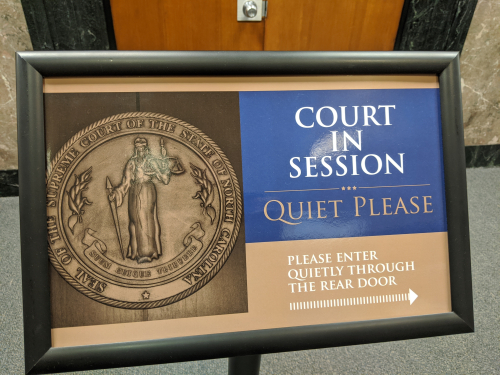
This morning, the Supreme Court of Virginia heard oral arguments (by telephone) in a case we’ve been following.

This is an inverse case that asks whether less than a total loss of access to a parcel could be taking — did the owner plead enough to put the issue to a jury — and

20160114_125445

Here’s an article, just published in the American Planning Association’s monthly magazine, Planning (read the entire April issue here), summarizing the Ninth Circuit’s latest foray into regulatory takings, Bridge Aina Lea, LLC v. State of Hawaii Land Use Comm’n, No. 18-15738 (9th Cir. Feb. 19, 2020).

In Legal Lessons – What Constitutes Loss?

Real_liberty

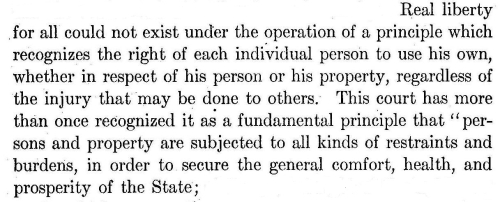
Here’s what we’re reading today, spurred by the headlines swirling around all of us. Mostly cases about the role of the courts when government curtails liberty or property rights under its police or emergency powers. We’ve now seen the first lawsuit claiming that an order to shut down businesses is a due process violation and

As long-time readers know, we often kvetch about the way many courts ignore the Palazzolo rule that simply because someone obtains property subject to preexisting restrictions on use does not preclude them automatically from raising takings claims. See here, here, here, and here, for example. More about the Palazzolo case here, including

Torromeo Industries owned a 12-acre parcel zoned “Industrial.” Two buildings — one a home, the other a 4,000 square foot industrial building — were on the land. Sole access to the property way by a private driveway along the 149 foot frontage of the parcel. Industrial zoning has a minimum lot size of 80,000 square

Here’s the cert petition we’ve been eagerly awaiting in a case we’ve been following about Seattle’s rewriting of the traditional lessor-lessee relationship.

The petition arose out of facial takings and due process challenges to Seattle’s “first in time” rule for residential leasing. The city adopted an ordinance requiring owners to rent to the first tenant

This just in. In Pakdel v. City and County of San Francisco, No. 17-17504 (Mar. 17, 2020), a three-judge panel of the U.S. Court of Appeals for the Ninth Circuit affirmed the dismissal of a regulatory takings claim which the District Court threw out for not being ripe under Williamson County‘s “state procedures”

Missed out on the 2021 ALI-CLE Eminent Domain and Land Valuation Litigation Conference swag?

Well fear not: here’s your chance to get your high-class reminder — a kit of road warrior essentials — to save the Conference date on your calendar. We’re already underway with planning the agenda and faculty, so it’s never too soon

Here’s the latest in a case we’ve been following that involves a local government prohibiting, via a zoning ordinance, the mining of silica (used as “frac sand”). Kind of like how Pennsylvania barred certain coal mining in our old friend, Pennsylvania Coal Co. v. Mahon, 260 U.S. 393 (1922). 

In Minnesota (where our story

Here’s the video of the OA held this morning (March 10, 2020) in a case we’ve been following, about the statute of limitations governing inverse claims. Maryland Reclamation Association filed an regulatory takings claim in 2013, and eventually the jury awarded a whopping $45 million in just compensation and interest. Hartford County asserted the