Vested rights

14.AGRHI

Here are links to some of the materials mentioned at our session today on the GMO issue at the Hawaii Agriculture Law Conference:

A key win for property rights today in the Minnesota Supreme Court’s decision in White v. City of Elk River, No. A12-0681 (Dec. 4, 2013). In that case, the court concluded that a municipality could not revoke a campground’s nonconforming use as penalty for alleged violations of the conditions of the conditional use permit.

Here’s the amici brief of Pacific Legal Foundation and the Center for Constitutional Jurisprudence in Marvin M. Brandt Revocable Trust v. United States, No. 12-1173 (cert. granted Oct. 1, 2013). That’s the case in which the Court is considering the meaning of the term railroad “right of way” as used in an 1875 federal statute.

As we’ve explained, although this case is a quiet title action out of a Colorado U.S. District Court, it could have huge implications for rails-to-trails takings cases in the Court of Federal Claims and the Federal Circuit. The issue is whether the federal government retained an “implied reversionary interest” when it issued railroad patents, or whether these grants were subject only to a railroad easement. The difference is that easements may be extinguished, while reversionary interests cannot.

The Tenth Circuit, in contrast to other courts, held that the right of way is subject to an implied reversionary interest in favor of the United States, meaning that the property owner doesn’t have “property” that was taken when the railroad was abandoned and was turned into a recreational trail. The merits brief of the petitioners is posted here.

We filed an amicus brief in the case, available here

The PLF/CCJ brief argues:

This case raises important questions regarding the common law system of property ownership and the certainty of titles in property.

In the decision below, however, the Tenth Circuit repudiated the common law rules of property ownership in favor of a per se rule, holding that the United States—the original grantor of the railroad easement and the Brandts’ fee estate—will retain an “implied reversionary interest” in an 1875 Act right-of-way, even after the government patents the underlying land and conveys it to a private party without any express reservation of reversionary rights. … The decision below extended the Tenth Circuit’s rule, holding that all private landowners whose titles are traceable to a federal land patent will be subject to the government’s unexpressed reservation of a reversionary interest in a railroad right-of-way, regardless of the rights and expectations established by their titles.

If not reversed, the Tenth Circuit’s rule will unsettle the rights and expectations of tens of thousands of landowners across the nation. … Amici urge this Court to reverse the Tenth Circuit’s opinion in this case and to reaffirm the fundamental common law principle that ownership of land will be determined by title, not implication.

More background on the case in a piece in Jurist by PLF’s Brian T. Hodges, “Brandt v. US: Should the Common Law of Propert be Scrapped?”  

Amicus Curiae Brief of Pacific Legal Foundation and Center for Constitutional Jurisprudence in Support of P…


Continue Reading Amici Brief In Rails-To-Trails Case: Tenth Circuit Repudiated Common Law Rules Of Property

Today, the Hawaii Supreme Court rejected certiorari (remember that under our procedures, you “apply” for cert which is “accepted” or “rejected”), and declined to review the Intermediate Court of Appeals’ decision in In re Campbell, No. 30006 (June 13, 2013), the case involving Land Court registration (Torrens title) and mineral and metallic mining rights.

Here’s the State’s Reply Brief supporting its application for cert and responding to the landowner’s BIO in the land court registration case, In re Campbell. The brief argues that “[t]his is no minor land dispute,” and “that the State is very concerned about the ICA Opinion.”

What’s so important about the State’s claimed reservation

Here’s the Response to Application for Writ of Certiorari by the State of Hawaii, which opposes the State’s cert app asking the Hawaii Supreme Court to review for grave error the Intermediate Court of Appeals’ opinion in In re Trustees Under the Will of the Estate of James Campbell, No. 30006 (June 13

DSCF1078

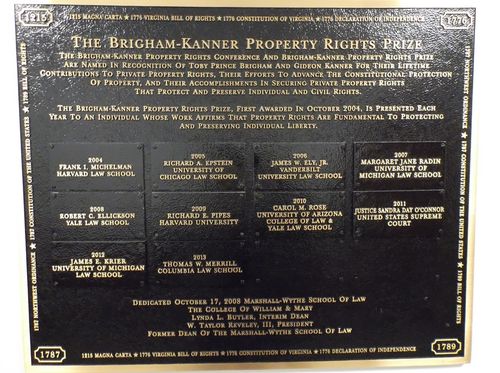
The last couple of days, we’ve returned to Williamsburg, Virginia to attend the annual Brigham-Kanner Property Rights Conference at the William and Mary Law School.

The Conference is the annual gathering of legal scholars and practitioners who focus on property law and property rights to celebrate the award the B-K Prize to “an individual whose

Here’s one we’ve been meaning to post for a while, if only because it presents a fascinating issue about the nature of Torrens title (so much so that we filed an amicus brief on behalf of Pacific Legal Foundation in the Intermediate Court of Appeals).

The State of Hawaii has filed an Application for a