
There’s been a lot written after the Supreme Court heard (re)arguments earlier this week in Knick v. Township of Scott, No. 17-647, most of it helpful in understanding what issues the Justices are considering, and how each of them might break on the ultimate question: should Williamson County be overruled, and should property owners
Cert Denied, Denied, Denied, Denied In Reg Takings Cases
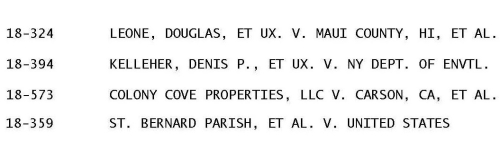
In case you have been following along, you can take these four cases off your watch list:
- Leone: Hawaii Supreme Court concluded that holding property that has no present use in the hope that someday in the future the government might rescind the use-restrictive regulation, is “investment use,” and therefore no taking.
- Kelleher:
Hot (Eminent Domain) Topics, Cool Jazz
Don’t Miss the 2019 Eminent Domain Litigation Conference from American Law Institute CLE on Vimeo.
Check out this sound blurb, produced by the good media folks at ALI-CLE, about the upcoming Eminent Domain and Land Valuation Litigation Conference. (And no, we didn’t record this in a jazz club; although I wish we had.)
There’s
Knick Transcript Available
Well, no sooner had we hit “publish” on our last post (which ended with, “let’s wait for the transcript”), that the court reporter posted the transcript. Whoa, fast.
Read and analyze away, friends!
Transcript, Knick v. Township of Scott, No. 17-647 (U.S. Jan. 16, 2019)
Knick Argument Redux: Dark Corners, And A Lack Of Clear Consensus (Chief Justice Remains The Lynchpin)
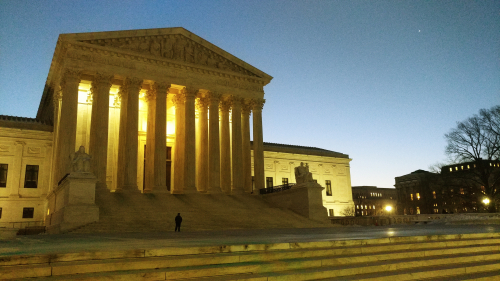
As Professor Gideon Kanner likes to remind us, eminent domain has been characterized as “the dark corner of the law.” We thought back to that phrase when we joined the queue outside of the Supreme Court this very dark (and very cold) morning, for the rehearing in the Knick v. Township of Scott case
SCOTUS Shortlister Judge Kethledge Has Read The Knick Briefs: “[T]he Takings Clause does not say that private property shall not ‘be taken for public use, without just compensation, and without a remedy in state court.'”
It wasn’t going to be too hard to figure out what the U.S. Court of Appeals for the Sixth Circuit was going to do in Lumbard v. City of Ann Arbor, No. 18-1258 (Jan. 10, 2018). After all, the case involved a federal takings claim in federal court, which the district court dismissed because
Stop Making Sense: Knick, Williamson County, And Lessons For Takings From The Dusky Gopher Frog Decision – Are “Takings” Federally Justiciable?
Our final 2018 post focused on what we thought was the biggest case of that year, and which, we’re predicting, will be the biggest case of 2019: Knick v. Township of Scott, No. 17-647, that’s the one in which the Supreme Court is considering whether federal takings claims can be brought in federal court
Wrapping Up 2018, And Previewing 2019’s Most Important Case: Final Briefs In Knick v. Township Of Scott
We’re going to end 2018 with the latest in what we think was the most important issue of the past year (and which, we predict, will be the most important case in takings law for at least a decade when it likely gets decided in 2019), Knick v. Township of Scott, No. 17-647.
That
Space Remaining Is Limited – Register Now For ALI-CLE Eminent Domain And Land Valuation Litigation Conference (Palm Springs, Jan. 24-26, 2019)

We’re almost there, but we still have room remaining. At the 2018 Conference in Charleston, we both sold out the registrations and the conference hotel, so we planned ahead for the upcoming 2019 Conference in Palm Springs at the Renaissance Palm Springs Resort.
Register here. You will also be able to download
Ninth Circuit: Inverse Condemnation Plaintiff Must “Share The Pain” – City Can Shed Obligation To Pay Just Compensation In Bankruptcy, Which Is “Purely A Monetary Claim”
Today’s post is long, but, we think, worth the investment of your time.
Bankruptcy is the way to get rid of debt. Plaintiffs who have sued the debtor but who have not reduced the lawsuit to a judgment are unsecured creditors. Unsecured creditors for the most part, go to the end of the payment queue