This is the second in a series of five posts taking a look at last week’s landmark ruling by a sharply-divided Supreme Court, Knick v. Township of Scott, No. 17-647 (June 21, 2019). Here are the related posts:

This is the second in a series of five posts taking a look at last week’s landmark ruling by a sharply-divided Supreme Court, Knick v. Township of Scott, No. 17-647 (June 21, 2019). Here are the related posts:
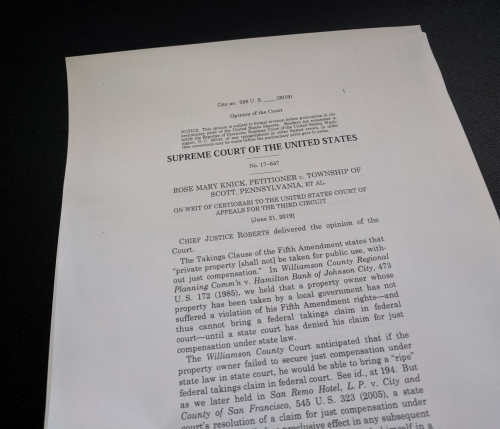
This is the third in a series of five posts taking a look at last week’s landmark ruling by a sharply-divided Supreme Court, Knick v. Township of Scott, No. 17-647 (June 21, 2019). Here are the related posts:
This is the fourth in our series of five posts with thoughts on the landmark decision in Knick. In this installment, the dissent. Related posts:
This is the fifth and last in our series of posts with thoughts on the landmark decision in Knick. In this post, we’ll be puling out our crystal balls, and doing a bit of forecasting. Here are the related posts:
A lot is being written about Friday’s Supreme Court opinions in Knick v. Township of Scott, No. 17-647 (U.S. June 21, 2019) (including us). Here’s a sampling.

We’ll be doing a longer post with our thoughts on the U.S. Supreme Court’s landmark ruling in Knick v. Township of Scott, No. 17-647 (June 21, 2019). But here’s the big picture.
It appears that at least five Justices finally seem to understand what we in the property bar have been saying for decades
Property lawyers, dust off your Federal Rules of Civil Procedure, and federal judges your long vacay from dealing with regulatory takings and inverse condemnation cases is over, because this just in: by a 5-4 margin (Chief Justice Roberts authored the majority opinion, with Justice Kagan writing the dissent), the U.S. Supreme Court today finally (finally!)
Here’s what we’re reading today:
Here’s a case that’s pending in the New York Court of Appeals that has been briefed and is awaiting argument.
In Natural Fuel Gas Supply Corp. v. Schueckler, No. 17-02021 (Nov. 9, 2018), the Appellate Division answered this question:
This appeal therefore presents a novel question of condemnation law: can a corporation involuntarily expropriate
The recent opinion of the Texas Court of Appeals (First District) in University of Houston v. Jim Olive Photography, No. 01-18-00534 (June 11, 2019) addressed a fascinating (and still unsolved) question: does intellectual property qualify as “property” for purposes of the takings clause?
The court held “no,” but that answer isn’t definitive.
The facts