Inverse condemnation

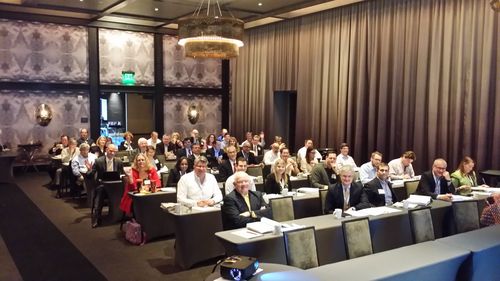
20160129_091552

The second day of the 2016 ALI-CLE Eminent Domain and Land Valuation conference went as well as the first. Here are some highlights:

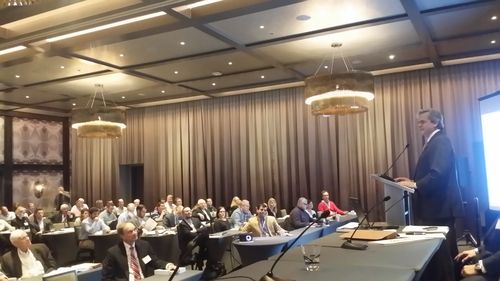
  • Austin Mayor Steve Adler (pictured above), who is (was?) also an eminent domain lawyer, welcomed us to his city. 
  • We moderated a discussion between Andy Gowder and Dana Berliner about “First
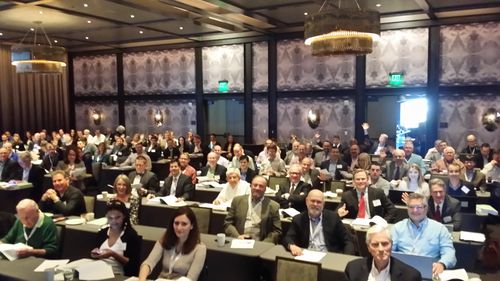
20160128_091958

20160128_092004

Here’s what’s going on today, the first day of the 33d annual ALI-CLE Eminent Domain and Land Valuation conference in Austin, Texas. We’re at standing room only, with a record number of attendees and our usual nationally renown faculty.

We started off the day with our usual “Eminent Domain Update” session with Amy

20160126_164326

Austin, Texas, is where we’re at for the next few days, for the 2016 edition of the American Law Institute-CLE Eminent Domain and Land Valuation conference, now in its 33d year. First time we’re in Austin, however, and our registration numbers are looking very good, and we haven’t had this big a turnout in years.

We know inverse condemnation liability can be triggered by intentional government action. But what about when government doesn’t act?

That was the issue before the Court of Appeals of Maryland in Litz v. Maryland Dep’t of the Environment, No. 23 (Jan. 22, 2016). And when the opinion starts this way, you just know where

Here’s the amici brief filed last week by the Cato Institute and the National Association of Reversionary Property Owners in Resource Investments, Inc. v. United States, No. 16-802. That’s the case in which the property owner is claiming that the delay in issuing Clean Water Act permits was so extraordinary, it was a

A longer one from the California Court of Appeal, but unfortunately, we don’t have the time to digest it in detail. But you really should read Pacific Shores Property Onwers Ass’n v. Dep’t of Fish and Wildlife, No. C070301 (Jan. 20, 2016), in which the court upheld a ruling that the Department of Fish

Here’s the amicus brief we filed today in support of the Petitioner/property owner in Resource Investments, Inc. v. United States, No. 16-802. That’s the case in which the property owner is claiming that the delay in issuing Clean Water Act permits was so extraordinary, it was a temporary taking. Ultimately, the Federal Circuit

When we first read the caption in Metropolitan St. Louis Sewer Dist. v. City of Bellefontaine Neighbors, No. SC94831 (Jan. 12, 2016), we admit to a bit of confusion because this is an inverse condemnation case, and it appeared that a public entity was suing one of those activist groups, “The Bellefontaine Neighbors.”

Appellate decisions reversing a grant of summary judgment because there are disputed factual questions are not 100% satisfying. Yes, if you are the plaintiff/appellant, you live to fight another day instead of facing the exit door. But you haven’t won yet either, and the hard part — proving that you should win, and not merely

ALI-CLE-2016-masthead

We’re now only a bit more than two weeks away from the 2016 Eminent Domain and Land Valuation LitigationCondemnation 101 Conference, which runs from January 28-30, 2016, in Austin, Texas. 

As we’ve noted here earlier, we think that this is going to be a fantastic conference that will cover a lot