
Here’s the State of Hawaii’s response to an amicus brief we filed in a case that asks the Hawaii Supreme Court to resolve the question of what statute of limitations governs takings claims under the state constitution. We argued that constitutional claims such as these might not be subject to legislatively-imposed statutes of
Who Is In Charge At The County Of Maui? SCOTUS OA Hinges On Internal Dispute Over Who Can Settle
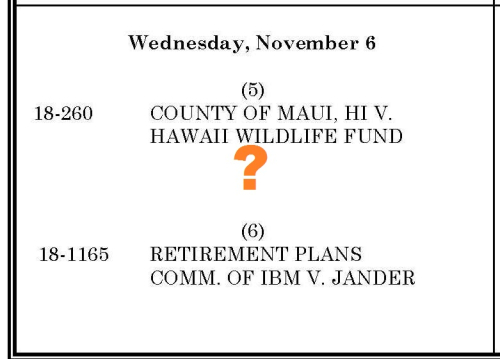
We’ve been following the ongoing efforts to settle the Clean Water Act case involving the County of Maui with some amusement.
Why, you ask? Part of it is that we like municipal law. (Perhaps sad, but true.) But we’re amused mostly because the case’s current posture illustrates the dual principles of “be careful what you
Amicus Brief: Federal Circuit Assumes Plaintiffs Understand SCOTUS’ Regulatory Takings Doctrine Better Than SCOTUS Understands Regulatory Takings Doctrine
We’re in California, where we’re playing Lincoln Lawyer for a few days because in its infinite wisdom, the utility company has preemptively shut off power for one week due to the threat of wildfire inverse condemnation lawsuits. We’re actually playing Chevy Tahoe Lawyer, because we’re literally working out of a truck since that’s
ALI-CLE Eminent Domain & Land Valuation Litigation Conference – Jan 23-25, 2020, Nashville
Cert Denied (Again) In Quick-Take-By-Injunction Pipeline Case
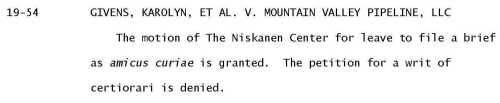
One should never be surprised, we suppose, when the Supreme Court denies a cert petition due to the daunting statistics, but we really thought that maybe the third time was a charm for the quick-take-by-preliminary-injunction issue, and that the Givens petition had a real chance. The petition was strong, the issue (in our opinion)
HAWSCT: Insurer’s Duty Of Good Faith Claims Processing Covers Its Conduct Before Submission Of A Claim
This one is a break from our usual programming because it involves … insurance law. Specifically the law of “bad faith.”
We highlight the case because we represent the prevailing petitioner. (See, we don’t just do property appeals.) And come on, everyone should be interested in insurance law. Especially the law of how health insurers
Berman International – Philippines Supreme Court: Takings Must Undergo “Painstaking” Judicial Scrutiny

Reading through the opinion of the Supreme Court of the Philippines in City of Manila v. Roces Prieto, No. 221366 (Aug. 29, 2019), there is a lot there that will look familiar to U.S. lawyers, specifically U.S. eminent domain lawyers.
Viz.: It is up before the Court on a petition for certiorari, there
Here Be Dragons: New Amicus Brief Asks For A “Fresh Look” At The Penn Central Test

Here’s the amici brief we are filing today in support of the Petitioner in a case we’ve been following, Smyth v. Conservation Comm’n of Falmouth, No. 19-223 (cert. petition filed Aug. 20, 2019).
The Massachusetts Court of Appeals held that a judge, not a jury, determines Penn Central takings questions, and that the
What A Difference The Defendant Makes: The Federal Courts Finally Locate A Natural Gas Act Preliminary Injunction They Don’t Like
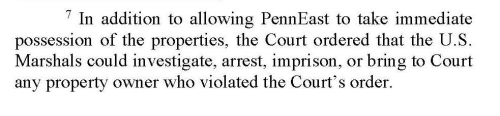
Today’s post is kind of long, but we think the opinion is well worth your time.
NGA Preliminary Injunctions
Regular readers know that we’ve made no secret of our disapproval of the prevailing practice in federal courts of using preliminary injunctions to allow private for-profit pipelines to grab immediate pre-condemnation possession of property using the
Whose House? Our House. D.C. Circuit: Pipeline Taking For Partial Export May Not Be A Public Use (For US Public)
A great result for colleague Carolyn Elefant, who represents property owners in a case and issue we’ve been following.
This is one of those Natural Gas Act pipeline cases. Not on the issue of immediate-possession-by-injunction (we’ll have the latest development in that chapter very soon), but on the administrative law side, involving FERC’s