Appellate law

Last week, along with my colleagues Deborah La Fetra and Kady Valois, we filed this cert petition in a case we’ve been following (even before we joined as counsel).

The petition seeks review of the Fifth Circuit’s opinion holding that there’s nothing a federal court can do if a local government does not pay

In Skatemore, Inc. v. Whitmer, No. 21-2985 (July 19, 2022), the U.S. Court of Appeals for the Sixth Circuit held that neither the Just Compensation Clause, nor the Fourteenth Amendment abrogated the states’ immunity from being sued in federal court for compensation for takings.

This is another one of those cases where — due

Screenshot 2022-06-06 at 08-22-58 Search - Supreme Court of the United States

A hearty congratulations to our Pacific Legal Foundation colleagues Jeff McCoy (counsel of record), Jim Manley, Damien Schiff, and Ethan Blevins for today’s cert grant in a case that brings together dirt lawyers and federal courts nerds.

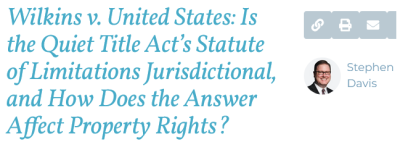
Wilkins v. United States asks whether the (federal) Quiet Title Act’s statute of limitations is “jurisdictional,”

Its deja vu all over again: like it did just a short while back, in Lafave v. City of New Orleans, No. 21-30358 (June 1, 2022), the U.S. Court of Appeals for the Fifth Circuit once again has rejected a takings claims “based on the city’s failure to honor a judgment of the

Bergerpage

A new article by lawprof Bethany Berger, “Property and the Right to Enter,” criticizing the Supreme Court’s ruling in Cedar Point Nursery. The article builds on the amicus brief in the case, also authored by Prof Berger.

Here’s the Abstract:

On June 23, 2021, the Supreme Court decided Cedar Point Nursery v. Hassid, holding that laws that authorize entry to land are takings without regard to duration, impact, or the public interest. The decision runs roughshod over precedent, but it does something more. It undermines the important place of rights to enter in preserving the virtues of property itself. This Article examines rights to enter as a matter of theory, history, and constitutional law, arguing that the law has always recognized their essential role. Throughout history, moreover, expansions of legal exclusion have often reflected unjust domination antithetical to property norms. The legal advocacy that led to Cedar Point continues this trend, both undermining protections for vulnerable immigrant workers in this case, and succeeding in a decades long effort to use exclusion as a constitutional shield against regulation.

Definitely worth reading.
Continue Reading New Article (Bethany Berger): “Property and the Right to Enter”

PXL_20220422_171653637

Here are the links to the cases and other materials that we talked about last Friday at the Georgia Bar Association’s annual Eminent Domain Conference. Our talk was entitled “It’s the Chief Justice’s Property World, We Just Live In It: National Trends in Takings, Property, & Eminent Domain,” and was part of

Not too long ago, we posted the Fifth Circuit’s panel opinion in a case where the court held that there’s nothing a federal court can do if a local government does not pay a state-court just compensation judgment. We filed an amicus brief in that case arguing “[t]he Takings Clause does not permit the Sewerage

Here’s an issue that we’ve been following for a while. What will a court do when a condemnor is ordered to pay (the property owner has a judgment in hand), but the condemnor says “no thanks”?

The latest incarnation is the U.S. Court of Appeals’ opinion in Ariyan, Inc. v. Sewerage & Water Board

Well, that was quick. Last month, as we reported here, the a Ninth Circuit panel held that the City of Oakland, California, could require property owners to pay thousands of dollars in what is branded “relocation fee” to their tenants as a precondition of the owner moving into their own property. This isn’t an