
Like a lot of things in Gary, Indiana, the Housing Authority was “troubled.” So troubled, the feds took it over. The Housing Authority received big money from the feds, and was required to agree to an annual contribution agreement, by which the Authority ok’d a HUD takeover in the even of the Authority’s substantial
New(ish) Article: “The Realities of Takings Litigation” (Dave Owen)

Another law review article worth reading. This one from lawprof Dave Owen, is about “The Realities of Takings Litigation” (forthcoming BYU Law Review). That title certainly got our attention – any time a law journal article is about ‘reality’ and takings, and includes empirical research, we’re going to read it.
Here’s the
New Article: “Takings Localism” (Tim Mulvaney & Nestor Davidson)
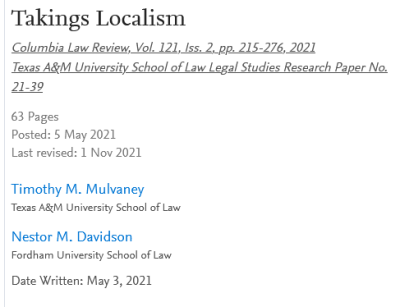
Be sure to check out the latest article from takings scholars and Nestor Davidson and Tim Mulvaney, “Takings Localism,” 121 Colum. L. Rev. 215 (2021) (pdf here).
Here’s the abstract:
Conflicts over “sanctuary” cities, minimum wage laws, and gender-neutral bathrooms have brought the problematic landscape of contemporary state preemption of local governance to national attention. This Article contends that more covert, although equally robust, state interference can be found in property, with significant consequences for our understanding of takings law.
Takings jurisprudence looks to the states to mediate most tensions between individual property rights and community needs, as the takings federalism literature recognizes. Takings challenges, however, often involve local governments. If the doctrine privileges the democratic process to resolve most takings claims, then, that critical process is a largely local one.
Despite the centrality of local democracy to takings, state legislatures have restricted local authority on property issues in a range of ways. States have expanded compensatory liability for owners facing local regulations, imposed procedural constraints on local authority, and limited the exercise of foundational local powers. Seen in its entirety, this state intervention—like contemporary “new preemption”—is acontextual and unduly rigid, cutting at the heart of the devolutionary principles underlying takings jurisprudence.
This unbalanced state role requires a recalibration of decisionmaking power between state and local government to foster intersystemic dialogue and reflection. States certainly play a crucial role in defining and protecting property interests, but they must justify choices to constrain local discretion when state and local values conflict. The extant state statutory regime dispenses with this justificatory task via a formalistic disregard for the contextualization that legitimates vertical allocations of authority. A corrective to decades of imbalance in state ordering of local authority would thus properly recognize “takings localism.”
Free up local governments, or tie their hands…which is better? After reading this, you decide.
Continue Reading New Article: “Takings Localism” (Tim Mulvaney & Nestor Davidson)
CA9: Once You Open The Door For One, You’ve Opened It For Everyone
It takes a bit of work to work your way through the Arizona statute being challenged in the U.S. Court of Appeals’ opinion in CDK Globall LLC v. Brnovich, No. 20-16469 (Oct. 25, 2021). But we recommend you read the opinion and do the work nonetheless, because it tells us something about the way
Still Time To Sign Up For Northwestern L. Rev.’s Symposium: “Reimagining Property Rights in the Era of Inequality” (Friday, Nov. 12, 2021)
“This year, the Northwestern University Law Review presents a symposium on property and inequality, which brings together scholars of legal history, property, tax, land use, fair housing, environmental law, natural resources and water rights, family law, education, and constitutional law, to highlight new scholarship at the intersection of these fields.”
Hawaii Supreme Court Guts-And-Replaces The Legislature’s “Gut-And-Replace” Switcheroo
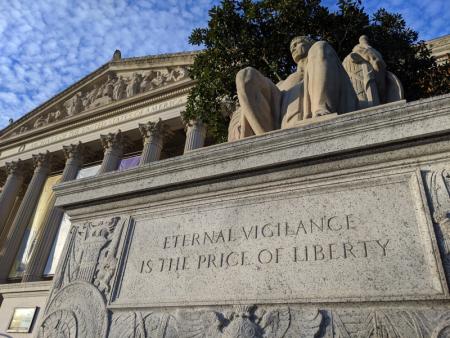
Here’s one that has been on our radar for a while (we filed our amicus brief nearly two years ago). So long ago that it was the final case that remained on our docket from our time in private practice. It’s not even about takings (but we’re posting it anyway as one of those
Aloha, Jim Mee
This is one post I wish I didn’t have to write. I recently learned that long-time colleague, friend, and kindred spirit Jim Mee passed away in September.
Jim was one of the good guys, a true giant in the Hawaii land use and eminent domain Bar. His accolades are many, his list of professional accomplishments
CA2: NYC’s Eviction Moratorium May Have A Contracts Clause Problem
There’s not a lot of direct takings love in the U.S. Court of Appeals for the Second Circuit’s opinion in Melendez v. City of New York, No. 20-4238 (Oct. 28, 2021), but there’s enough there that you might want to read it anyway.
Because the opinion resurrected the plaintiffs’ Contracts Clause claim. You heard