Property rights

Untitled Extract Pages

In honor of property rights advocate and trial lawyer Toby Prince Brigham (1934-2021), Owners’ Counsel of America has endowed a scholarship for a second- or third- year law student to attend the annual three-day ALI-CLE Eminent Domain and Land Valuation Litigation Conference (the upcoming Conference will be in Austin, Texas, February 2-4, 2023.

In honor

Here’s what we’re reading today:

Whatpropertydoes

Worth checking out: Christopher Serkin, What Property Does, 75 Vand. L. Rev. 891 (2022).

Covering (inter alia) property, rule against perpetuities, adverse possession, Lucas background principles, judicial and regulatory takings, Mahon v. Keystone Bituminous, and vested rights and amortization of preexisting uses.

Here’s the abstract:

For centuries, scholars have wrestled with

Book_475

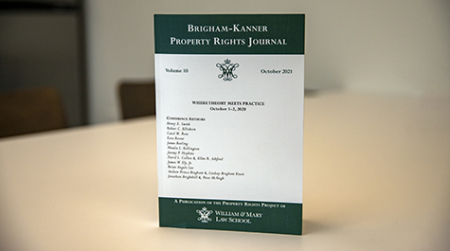
In case you have not already obtained your printed copy (you really should subscribe), it is now available in pdf format.

The theme for the issue is “Where Theory Meets Practice,” and with articles on “Property Beyond Flatland,” “Property Rights and the Modern Resurgence of Rent Control,” “Hurdles to Just Compensation,” “Implied Preemption in

Screenshot 2022-06-06 at 08-22-58 Search - Supreme Court of the United States

A hearty congratulations to our Pacific Legal Foundation colleagues Jeff McCoy (counsel of record), Jim Manley, Damien Schiff, and Ethan Blevins for today’s cert grant in a case that brings together dirt lawyers and federal courts nerds.

Wilkins v. United States asks whether the (federal) Quiet Title Act’s statute of limitations is “jurisdictional,”

Its deja vu all over again: like it did just a short while back, in Lafave v. City of New Orleans, No. 21-30358 (June 1, 2022), the U.S. Court of Appeals for the Fifth Circuit once again has rejected a takings claims “based on the city’s failure to honor a judgment of the

IMG_20170801_132241

Here’s the latest in a case we’ve been following.

A Utah statute requires that if a condemnor doesn’t actually use property it acquired “under a threat of condemnation,” it must try and sell it back to the (former) owner. The statute defines “threat of condemnation” as when “an official body of the state or

On one hand, there’s nothing terribly surprising about the Texas Supreme Court’s opinion in Hlavinka v. HSC Pipeline Partnership, LLC, No. 20-0567 (May 27, 2022) holding that yes, “polymer-grade propylene” qualifies as an “oil product” under Texas statutes that allow a private pipeline company to take property to transport oil products, and that yes

Austinairport

Here’s what we’re reading today: