
Check it out: Clint Schumacher’s latest Eminent Domain Podcast, with guest Professor Ilya Somin on Murr v. Wisconsin.
The Federal Courts Aren’t “Super Zoning Boards Of Appeal,” But They Have Time For Monkey Selfies
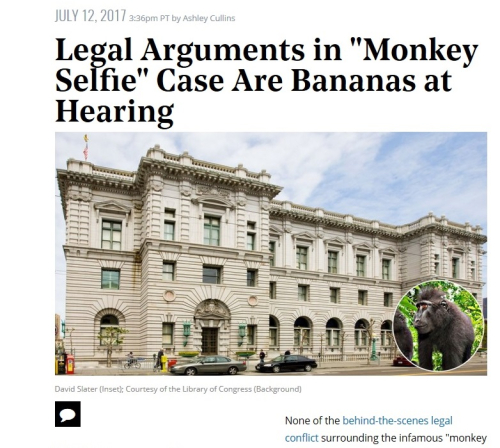
We’ll just leave this right here. Dr. Zaius could not be reached for comment.
Conn App: Because Owner Can Easily Correct The Problem With Confiscatory Regulation, His Reasonable Expectations Have Not Been Thwarted
A very short one from the Connecticut Appellate Court, Santos v. Zoning Board of Appeals, No. AC37281 (July 11, 2017) in a Penn Central-style takings challenge to local land use regulations. We’re going to set out the facts, then let you guess who prevailed.
The plaintiff purchased an unimproved parcel of land in Stratford
2018 ALI-CLE Eminent Domain & Land Valuation Litigation (Charleston, SC) Early-Bird Discount Registration Open
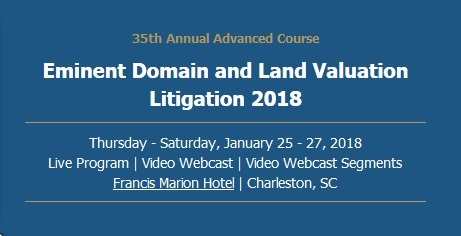
ALI-CLE has posted up the early bird registration page for the 2018 edition of the Eminent Domain and Land Valuation Litigation Conference, to be held January 25-27, 2018 in an exciting new venue, Charleston, South Carolina.
We are putting the agenda and faculty together for the Conference (which, as always, will include the
Murr Round-Up
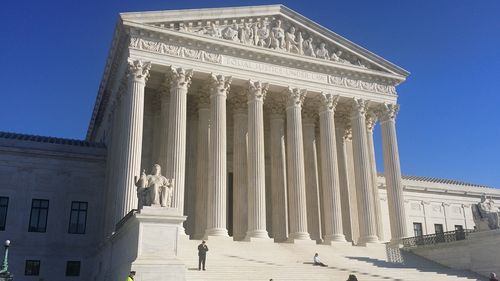
Now that the dust has settled somewhat, for your weekend reading, here are your links to some of the vast amount of commentary which the Murr v. Wisconsin decision has thus far generated:
- “Justices Answer Parcel Question in Property-Rights Dispute” – Courthouse News Service
- “Murr – SCOTUS Meets Dick Babcock’s Ghost”
Night of the Living Zombie Zoning Inspectors – Ordinance Allowing Searches For Unauthorized Cemeteries “Constitutionally Suspect,” But Not Yet Justiciable
The Township of Scott, Pennsylvania, apparently has a problem of unregulated cemeteries. Who knew?
So it did what local government do when they think they have a problem, it passed a law. That law, Ordinance 12-12-20-001, required owners of all cemeteries, public or private, to maintain them. The ordinance also contained two troublesome provisions.
Cases And Links From Today’s American Planning Association’s 2017 Planning Law Review
Here are links to the cases and materials we spoke about today during our portions of the APA’s 2017 Planning Law Review webinar:
- Justice Kennedy’s Social Justice Warrior Test For Takings Clause “Property” In Murr v. Wisconsin
- The Federal Circuit’s Lost Tree decision (cert denied just after Murr, so this should be seen as a
Friday, Aug 11, 2017, New York City: Chair-Elect Reception, Unpacking Murr – ABA State & Local Govt Law Section
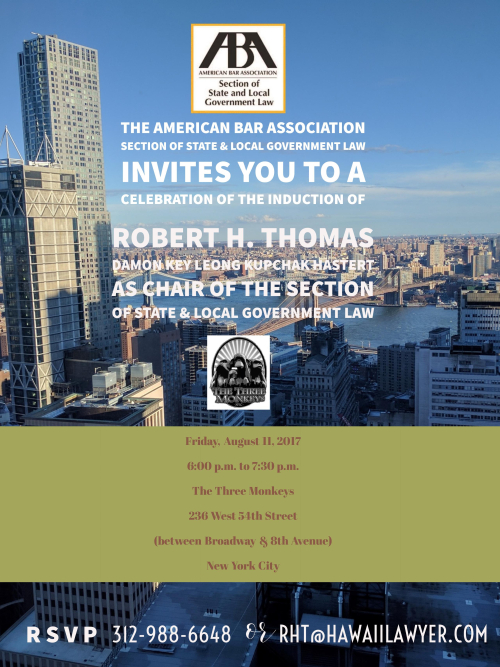
If my colleagues don’t wise up and change their minds before August, I am slated to become Chair of the ABA’s Section of State and Local Government Law (which, by the way, includes an Eminent Domain Committee, Chaired by Howard Roston, and co-Chaired by Kelly Walsh and John Peloso). On Friday, August 11, at
Your Post-Murr Reading List
There’s a lot of buzz about “what’s next” after Murr v. Wisconsin, and what this case may augur for regulatory takings. There are already quite a few discussions and analysis panels scheduled, including these three in which we’re participating:
- The American Planning Association’s annual Planning Law Review (Wednesday, July 5, 2017), which will include
The Connecticut Supreme Court “Gets” The Larger Parcel Issue: It’s About Joint Use Of The Two Parcels
Here’s the opinion of the Connecticut Supreme Court in a case we’ve been following, Barton v. City of Norwalk, No. SC 19671 (July 4, 2017).
As we noted in our earlier post where we detailed the facts, the case involved two non-contiguous parcels, one of which was used for a parking lot