Just Compensation | Appraisal

A metro-area transit district condemned a portion of a residential lot for a light-rail line. The property was owned by a LLC, which in turn was owned by a family trust. The condemnor offered $19k as compensation, but the trust thought it was worth a lot more: $280k.

One of the big issues contributing to the

A short, but published, opinion from the U.S. Court of Appeals for the Fifth Circuit.

In Archbold-Garrett v. New Orleans, No. 17-30692 (June 22, 2018), the court held that the plaintiffs’ Fourth Amendment, Fifth Amendment, and Fourteenth Amendment claims (search and seizure, compensation, and procedural due process) were ripe for federal court, even though

Here’s the latest in a case we’ve been tracking, the City of Missoula, Montana’s takeover of a privately-owned water system. In 2016, the Montana Supreme Court held that the city could exercise its power of eminent domain to take the property for a “more necessary” public use. The court allowed the city to take the

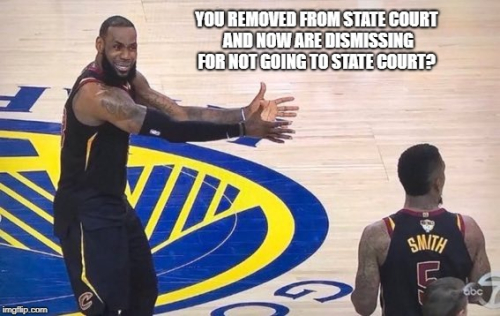
Lebronremoval

The main point we’re trying to make in the amici brief we are filing today on behalf of Citizens’ Alliance for Property Rights Legal Fund in Knick v. Township of Scott, No. 17-647 (cert. granted Mar. 5, 2018), is that the average property owner simply cannot fathom why—if a state or local government has taken

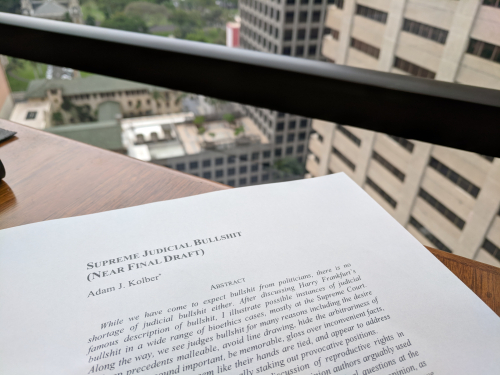
IMG_20180322_100645

Here’s some of the things we’re reading or reviewing today, focused on the legal scholars and takings (with the last one being of general interest):

  • Michael Pollack, Taking Data, 86 U. Chi. L. Rev. ___ (2018) (“This Article proposes a new approach to regulating government investigations of data that has been shared with ISPs

The Virginia Supreme Court once famously noted that some things were so obvious, you didn’t need to cite any authority for the proposition. See Goldstein v. Old Dominion Peanut Corp., 177 Va. 716, 722, 15 S.E.2d 103, 105 (Va. 1941) (“We have so often said this that no citation for its verity is needed,”

Thanks to colleague Chris Kramer, we’ll be speaking later this week (Friday, May 4, 2018) in Phoenix at the 22nd Condemnation Summit at the Arizona Biltmore.

Our session will cover “Condemnation Trends: Nationwide & Arizona.” The rest of the day’s agenda looks mighty good too, with session on valuation of easements, paying for

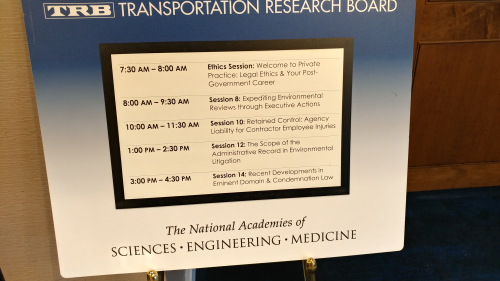
IMG_2947
Some of the Land Use Institute faculty, including (front row left), Planning Chair Frank Schnidman and Planning Co-Chair Patty Salkin

Last Friday at the 32nd Annual Land Use Institute in Detroit, I was honored to moderate a freewheeling discussion by a panel of takings experts, Professor Steven Eagle, Minnesota lawyer Howard Roston, and Michigan’s

Here’s a bit passed on to us from a colleague who reads USA Today. Leading off “Justice Gorsuch confirms conservatives’ hopes, liberals’ fears in first year on Supreme Court,” is this snippet, which points out a Just Compensation case in which we represented the (denied) petitioner:

WASHINGTON – Neil Gorsuch had been a member of the Supreme Court for exactly 11 weeks when he made clear in a single day what type of justice he would be.

The court struck down an Arkansas law that treated same-sex couples differently than opposite-sex couples on their children’s birth certificates. Gorsuch dissented. 

The court refused to consider a challenge to the Department of Veterans Affairs’ system for evaluating disability claims. Gorsuch dissented.

The court declined to hear a challenge to a California law limiting who can carry a concealed gun in public. Gorsuch dissented.

And the court turned aside a challenge to the meager sum Mississippi paid when it converted a former landowner’s property into a park. Gorsuch said the justices should hear a similar case “at its next opportunity.”

Thus it was that on the last day of its 2016-17 term — as the court addressed gay rights, government power, gun ownership and government takings — Neil McGill Gorsuch announced to the legal world that he would not go along to get along.

“He came to the court more ready to jump into the deep end than a lot of recent nominees,” says Jonathan Adler, a law professor at Case Western Reserve University School of Law.

Here’s why

we thought the denial of cert in that case (and others) wasn’t necessarily a bad sign.
Continue Reading USA Today Notes Just Comp An Area Where Justice Gorsuch “Jumping Into The Deep End”

When the city condemned a portion of CED’s property back in 2012 for a highway project (replacing an intersection with a roundabout), the city’s appraiser testified that the taking did not confer any “special benefits” to CED’s remainder parcel. Eventually, CED and the city settled the case and the city paid agreed-upon compensation and severance