
On one hand, the Colorado Supreme Court’s opinion in Forest View Co. v. Town of Monument, No.18SC793 (June 8, 2020), concluding that a restrictive covenant is not a property interest that the government needs to pay for conflicts with the decisions on similar facts from other jurisdictions (Kansas, for example). On the
Federal Court: Not Going To Deal With Takings Argument Because 11th Amendment
Way back when (you know, less than 2 months ago, a lifetime in coronavirus time) when the plaintiffs filed the complaint, we noted that, win or lose, it laid out the takings argument in a comprehensive and understandable way.
It still may be that the arguments are worthwhile pursuing. Our more comprehensive thoughts on
BIO In “Police Power” Takings Case: Can A Municipality Be Liable For A Taking If The Police Destroy Private Property In The Course Of Apprehending A Suspect?
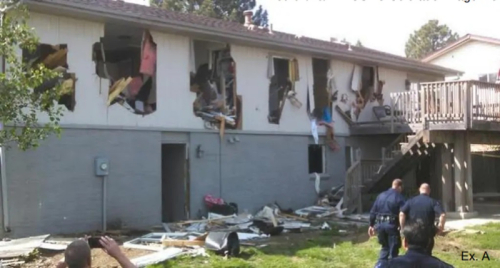
Here’s the city’s Brief in Opposition in a case we’ve been following (so closely, in fact, that we filed an amicus brief in support of the property owner – see “Amicus Brief: Invocation Of “Police Power” Is Not Dispositive In Takings“). A case in which the issues have taken on new and heightened
Podcast: COVID-19 & Property Rights: Do Government Actions in Response to the Coronavirus Pandemic Create Compensable Takings?”
Here’s the recording of the Federalist Society’s Environmental Law & Property Rights Practice Group teleforum we did a couple of weeks ago, “COVID-19 & Property Rights: Do Government Actions in Response to the Coronavirus Pandemic Create Compensable Takings?” Stream above, or download it here.
Fifth Circuit: Texas Groundwater Rights Are Takings Clause “Property”
There’s a lot of opinion in the U.S. Court’s of Appeals’ opinion in Stratta v. Roe, No. 18-50994 (May 29, 2020). Yes, the court reversed the district court’s dismissal of a takings claim. But most of the opinion is devoted to the question of whether a Texas water conservation board — an agency whose
NC Considering Constitutional Amendment: Compensation For Emergency Shut-Downs
Did you know that the North Carolina Constitution does not formally contain a “takings” or “just compensation” clause? Instead of an outright prohibition on uncompensated takings for public use, the N.C. Constitution has a “law of the land” clause:
Sec. 19. Law of the land; equal protection of the laws.
No person shall be
Federal Circuit: Arkansas Game Did Not Overrule Ladd (NITUs Are Categorical Takings)
Congratulations – if you understood this post’s headline, you are officially a rails-to-trails nerd. A super-nerd.
But even if not, you shouldn’t need a rails-to-trails nerd’s level of knowledge to understand and appreciate the Federal Circuit’s ruling in Caquelin v. United States, No. 19-1385 (May 29, 2020). It’s a case worth reading
Latest Coronavirus Complaint: NY State’s Order Suspending Evictions Is A Taking
In Virginia, Where The Baffled Courts Now Compose “Major” vs. “Minor” Streets
Here’s the latest in a case we’ve been following (briefs here, and oral argument recording here).
Any eminent domain lawyer will tell you that loss of access cases can be difficult. In some jurisdictions, you have to lose all access before the court will consider you harmed. Or the courts see a
In Virginia, Where The Courts Choose The Streets’ Names: Major Or Minor
Any eminent domain lawyer will tell you that loss of access cases can be difficult. In some jurisdictions, you have to lose all access before the court will consider you harmed. Or the courts see a difference between a loss of “direct” access versus “circuitous” access. All we know is that from an owner’s perspective