
42 U.S.C. § 1983 | Civil Rights

Worth reading: a student-authored piece in the latest issue of the Harvard Journal of Law & Public Policy, “Original Understanding of ‘Background Principles’ in Cedar Point Nursery v. Hassid.

From the Introduction:

But in Cedar Point, when considering a regulation that authorized union organizers to enter certain businesses, the Court
Today at 10am Hawaii Time (1pm PT/4pm ET), the Hawaii Supreme Court will hear oral arguments in a case asking whether a 1922 deed restriction imposed by the Territory of Hawaii on a land patent conveying fee simple title to a private owner, subject to the land always being used for “church purposes” (i.e

Today is a good day to remember that legal emancipation had its roots in the “contraband” property theory. Here’s a post from a few years ago where we visited what we called “The Birthplace of a More Perfect Union” (Fort Monroe, Virginia).

The contraband property theory was itself very imperfect, and a compromise

Games people play
Night or day they’re just not matchin’
What they should do
Keeps me feelin’ blue
Been down too long
Right, wrong, I just can’t stop it

This one isn’t about takings, but is nonetheless a must-read.

In Health Freedom Defense Fund, Inc. v. Carvalho, No. 22-55908 (June 7, 2024), a panel

Here are three federal circuit opinions, all unpublished. None of them worthy of a stand-alone post, but also not to be overlooked entirely.

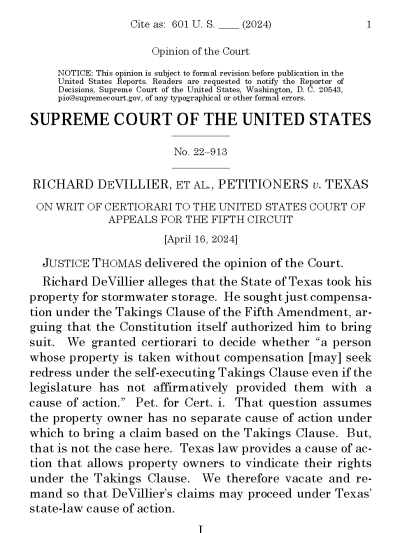
Devillier

Note: this is the second of our posts on the U.S. Supreme Court’s recent decision in Devillier v. Texas. The first — which tries to put the weird post-opinion controversy over which party “won” at the Supreme Court into its proper perspective — is here.

In this post we’ll cover the case’s

The winner takes it all
The loser’s standing small
Beside the victory
That’s her destiny

Note: this is the first of a short series of posts on the U.S. Supreme Court’s recent decision in Devillier v. Texas.

In Part II, we’ll cover the case, the procedural path that Texas dragged everyone through,

In Brinkmann v. Town of Southold, No. 22-2722 (Mar. 13, 2024), the U.S. Court of Appeals for the Second Circuit addressed a longstanding issue left unresolved by the Supreme Court in Kelo v. City of New London, 545 U.S. 469 (2005): is it enough that a condemnor’s professed use qualifies as a public